• TalkBass has been independent since 1998. Add your voice.
    Create a free account to reply to discussions, view embedded media, and browse with fewer display ads.
    Join freeLog in
    Want zero display ads or expanded classifieds tools? Compare plans.

Considering a Rickenbacker 4003

I have two 4003s and here's my take:
1) You will need to have the nut slots lowered; the string action is too high out of the factory.
2) The bridge doesn't adjust low enough in my opinion.
3) The truss rods are no big deal to adjust but you need special thin-wall wrenches. I gently clamp my necks into straightness ( with rods loose first!)
4) Nothing else sounds like a Ric. They have an awesome throaty, ballsy, grindy tone. And can warm up nicely if you want that.
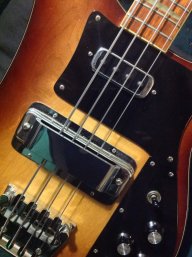
4a) the cover over the bridge pickup is in the way.
5) They're gorgeous. You want one. You need it. They're a classic bass guitar.

* Older 4000 series basses had a reputation for soft frets. They were. They used 12% nickel silver fretwire and strings like stainless steel Rotosund 66s ate them alive. Today they use harder wire.
I had the same experience with my 4001. I KNEW that was soft fretwire, but when I asked about it on RRF, the response was "you trashed your frets, purely your fault, Ric can do NO WRONG!". Like everybody else who bought a Ric in the 70's, I took the flats off immediately and put on Roto Swing 66 Stainless so I could BE Chris Squire (didn't work, of course), and the frets were toast in three years of ordinary play. I have always suspected the whole warranty Void issue Ric used to harp about had nothing to do with string tension (aren't flats HIGHER tension than rounds?), and everything to do with the soft fretwire. Whatever they are using now is MUCH harder.
 
  • Like
Reactions: Root 5 and Giffro
@bobyoung53 .
Well, nothing "mythical" about the headstock break I witnessed in person, it broke exactly where you see a Gibson break, either side of the TRC, leaving a thin little bridge of wood either side. It's undeniably bad basic carpentry, any furniture maker or framer can tell you that, yet somehow Gibson and Ric keep doing it. Sometimes bad design just gets "baked in" to a brand by customer expectation. That's not limited to Ric and Gibson, or course. Ric finally realized that using a "swimming pool" pup route 1/2" away from the neck heel was a bad idea when necks started developing " negative neck angle", literally the neck beam folding at that point. The mystery is why it took them so long to realize this was just basic Bad Design 101. I deliberately fixed both of those two inherent design flaws in my own Ric clone builds, it's stupid easy and basic common sense. As to the utility of two rods, either Ric has discovered some magical Special Sauce that virtually every other major builder somehow overlooked, or its just a marketing ploy that people like the sound of, but most people rarely or never actually use. The most common scenario among guitar techs is finding one rod tight and the other loose, doing nothing, so they adjust them to equal tightness. It makes sense on a 6 string where the width of the neck increases the likelihood of twist, but virtually the entire industry has decided a single DA rod makes more sense.


I had exactly that scenario when I took my 4003 to a guitar tech. One truss rod functioned, the other was loose and effectively redundant. Just needed tightening, but remained useless. I own a 4003S and love them, so not bashing here. Just relaying my anecdotal experience
 
I’m always up for seeing pictures of 4004s if you wanna post one of yours.:hyper:
I love my quartet!
View attachment 3856432


Bought this from a guy who picked it up at NAMM the year they reintroduced ruby red.
Still looking for a pic of my ex-Cheyenne in midnight blue. Needed cash and sold it to a guy in Germany using Ebay’s International Shipping service. What a joke. They ended up reimbursing him and sending it to their warehouse in Kentucky. I thought I saw it come up for sale later but couldn’t be sure it was the same.

3FEAB597-4B2B-4BC9-8CF4-939278F910AC.jpeg
 
I’ve owned 2, a 4004cl and a Laredo. Both came with Schaller bridges. Are these stock? What are they and if not stock, how did you get them?
That ruby looks great!
Rickenbacker used ABM bridges on all 4004 models from the start, until that company went put of business.
I’m not sure of when that happened,(2006-ish?), but then they started using Schaller roller bridges until production of 4004 models ceased, a few years ago.
I do love the look and functionality of the abm bridges.
396CCDB1-AAAD-44F6-96BA-CA90A409A404.jpeg
 
I have never owned a Rick before, but the price on this one seems attractive at $1,350.00:

View attachment 3854679

The condition seems good, not sure about fretwear. I know I like the sound of Ricks but I am little hesistant about the truss rod system, bridge, and ergonomics.

I bought a 4003 from 2009 of the same finish a few days ago. I've been wanting one for years and got a used one in excellent condition for more than that price. I'd say get it. I'm not an expert on these as other people here and have just had it for a few days, but...

I play own a Precision, Jazz and Hollow all from Lakland because I love their tone, build and comfort. The Ric is a diff beast, but the tone is worth it to me. FYI, I'm doing a few things to bring it to my liking and style a bit more:

  1. I immediately removed the pickup cover because it limits my hand position, but this is not a Ric issue as my Lakland Pbass also came with one.
  2. I purchased a pickup plate to cover the hole left unprotected by removing the pickup cover The Original Treble Bezel - Deluxe / Chrome | RicStrings.com | Reverb
  3. I changed strings to DR Sunbeams and liked it but then swapped for DR stainless steel LoRiders and it came to life
  4. I scheduled a pro setup for next week. I can setup my other bases but the trussrod and bridge system of the Ric is more than I trust doing myself
If you want the bass and the condition is good get it. It's such a different sound and I feel I have basses for most situations now (of the styles I play). And the look is so unique too. Are the ergonomics perfect, the bridge great and adjustments easy to do? No, no and no. But this is a personal choice only you can make.

Good luck in your journey.
 
I have never owned a Rick before, but the price on this one seems attractive at $1,350.00:

View attachment 3854679

The condition seems good, not sure about fretwear. I know I like the sound of Ricks but I am little hesistant about the truss rod system, bridge, and ergonomics.

Will you be able to play it before you buy it? If not, I’d pass. I had a 4001 for decades. Most of the time it sat in the case. It was set up well when I bought it and pretty much for normal aging, it was a solid bass with no issues. It was an absolute killer using Rick-O-Sound in a power trio, other than that, it became a case queen until I sold it in 2008.
 
My guess: L&M already had a stock order open with Rickenbacker for some 4003 Jetglos already when Moosehead ordered his in January, so he didn't have to wait as long because an order had already been in the pipeline. If you're not dead-set on Fireglo, they have some 4003 Mapleglos showing in stock online, maybe you can change your order.
I was talking to Long and McQuade today and the Rickenbacker rep told them that they are not making any Fireglo until sometime in the Summer and I can expect my Bass in August.
 
  • Like
Reactions: Moosehead1966
I actually liked the old soft fretwire on my old RIC. It got better with age. Made for good sliding, which sounds great on a RIC. Watch videos of Jon Camp from Renaissance. He made that white RIC sing like no other. Too bad some A-hole stole it.
 
In my case, the frets developed "dents" that did not improve with age, they just got deeper. Part of that was that they file the top of Ric frets flat, so instead of the thin edge of a dome fret contacting the string, you have a relatively wide point of contact, so the line of wear is wider. They can't crown them because the thick fingerboard laquer "ramps" up onto the fret edges. If you crowned them traditionally, you'd bite into the laquer. It's possible to refret a Ric without trashing the laquer, but you have to file down all those laquer "ramps" and then polish it all back up, or re-laquer the whole board. It looks great, of course, luckily they have changed to harder wire and largely solved this problem.
 
I bought a Rick once, but sold it within the same year because:
  • Noisy pickups - by design
  • Uncomfortable bridge - good luck palm muting
  • Signature sound - you either like it or not; I didn't for the styles I play
My verdict was: A Rick is a special purpose bass, not an all-around desert island instrument (like a Fender). And I like to keep the stable minimal so... They are rare and are known to have good resale values though. I sold it for the exact price I bought it so no regrets.

You can buy it & change "subjectively problematic" components as needed (if any) of course, if the bass feels really good to you.
 
  • Like
Reactions: Rocknroller4
I bought a Rick once, but sold it within the same year because:
  • Noisy pickups - by design
  • Uncomfortable bridge - good luck palm muting
  • Signature sound - you either like it or not; I didn't for the styles I play
My verdict was: A Rick is a special purpose bass, not an all-around desert island instrument (like a Fender). And I like to keep the stable minimal so... They are rare and are known to have good resale values though. I sold it for the exact price I bought it so no regrets.

You can buy it & change "subjectively problematic" components as needed (if any) of course, if the bass feels really good to you.

Yeah it's subjective. The first bass I ever bonded with was my trusty old Ric 4001 that I got used back in 1984. Before that I had a Gibson Grabber that I never got along with and sold. I've had many Fenders and other basses since but Rics are still a favorite, great instruments for me and I could use one exclusively for what I do. But I get that they are not for everyone.
 
  • Like
Reactions: Rocknroller4