• TalkBass has been independent since 1998. Add your voice.
    Create a free account to reply to discussions, view embedded media, and browse with fewer display ads.
    Join freeLog in
    Want zero display ads or expanded classifieds tools? Compare plans.

Consistency. How come nobody here ever talks about it?

Oct 7, 2000
18,619
38,941
New York City
www.joenerve.com
Disclosures
Endorsing artist: Musicman basses
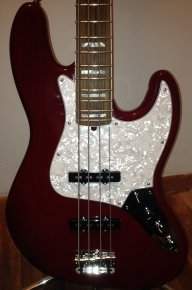
I play lots of different basses. As of late, it's pretty much MMs and an antigua jazz bass that I've unexpectedly fallen in love with. I use one head, a Carvin BX500, and either a GK Neo 212, or a Berg NV610.

I've been playing a lot of back to back gigs, with different bands, and I'm astounded still by how a venue and a band can effect the sound, AND the playability, of my instrument. It's the main reason I love the versatility of the Big Al. Gives me tons of tweakability, and a feeling of safety I get with no other bass.

A couple of weeks ago I did an outdoor gig in a parking lot, followed by a gig on a small wooden stage in a tiny club. While it's a no brainer that the acoustics were insanely different, if I didn't know better (or play both gigs), that first gig could have turned me off to the jazz bass, bigtime. It was a 3 piece band playing the simplest old school rock (hang on sloopy kind of stuff), and the physical setup of the whole thing made me feel like I was wrestling an alligator. Felt like I was a new bass player. I had no sustain, each note would kinda swell and die real quickly, had that old feeling of "who's hands are on my body". Actually thought something was going on with me physically.

I got to the 2nd gig, a zep tribute, and the same bass melted in my hands. The lightest touch on an open A string rang for days. I heard every frequency in every note, felt it too... it was heaven. Literally like I was playing on a neck made of butta. :)

So.... what's my point?

First, I guess I wonder why nobody ever talks about this here. Almost feel like I'm the only one who ever experiences it, yet I know we all do.

And second, it makes me look at people's opinions regarding basses and amps with a lot of subjectivity, and a very open mind. There are people who often say things about certain amps that baffle me. The definition just doesn't fit with my experience. I hear that certain amps have way more than enough volume to cut through this and that, while that same amp got destroyed by a single guitar and average pounding drummer when I owned it. I dont' think these peopple are lying about their experience. I think though that they may have just been using it in a studio where the acoustics are favorable, or have only played a couple of clubs with it. And the same goes with basses. I could elaborate a lot more, but ya'll get the idea.

This is also the main reason why GC reviews on basses and amps mean nothing to me. I don't know how I feel about a bass or an amp until I've played it in a handful of venues, with a handful of different people. Yeah, life was easier when I played in only one band. :) Only had one bass and one amp back then too.

Thoughts?
 
Yeah, this is a huge deal. I've got a weekly gig where almost every note gets swallowed up by the room. But when I hit a D or C#, everything opens up. That room LOVES those notes. But with everything else I feel like there's something technically wrong. But there isn't. I'm not going to lie, I've formed opinions on gear based on this kind of experience. There is so much more to it!
 
My wife would say, "I feel your pain. Tell me more about how it made you feel when you were having trouble with how your rig seemed to be responding."

I'd say, "Sometimes there's not a lot to do about unpredictable stages; but here are three things that I find work:

1. Raising your cab to ear level.

2. Sending FOH a DI upstream of stage eq. My preference is preamp (tapped w/ post-eq DI send)-->parametric eq for stage rig adjustments-->power amp feeding stage cabs.

3. IEMs."
 
Once again you tender an interesting perspective. How much better do you play when how the sound of your instrument slots into the mix puts a smile on your face? How much can that change from room to room and band to band? A lot of people put a lot of resources into chasing their ideal sound and it is odd that the phenomenon of how environment effects your sound and sound effects your playing doesn't get discussed more often.

But then talking about the gear itself is a lot less difficult...
One thing is I'm finding I change strings more often than I used to. It's a simple method of getting more EQ options...easier to cut what's there than try to boost what isn't.

It's been interesting too experimenting with using several EQ stages. The pedalboard right now is a Diamond comp, a VT Bass, an Xotic BB Bass and a Sadowsky pre going into either an SWR Amplite or a very flat response AI Contra head into a Markbass NY 804 cab. It's a fairly new setup to me but so far it's capable of quickly getting a useable sound in some diverse rooms.

Overcoming my fundamental laziness I've been avoiding provided cabinets. Trying to make friends with something unfamiliar and unpleasing during a 40min opening set with no sound check is hugely distracting to the music. It helps to have found a cab that is really close to my ideal sound. I'm a lot less indifferent than I have been in the past.

And you're right dead right that what one person says about certain gear is often useless to someone else's situation. There are a few people that have the talent for describing gear in more explicit, unambiguous ways (Ken Jung and Tom Bowlus come to mind) but in many cases gear reviews don't take into consideration the whole signal chain or describe the music, environment or how the person plays. But asking people to craft more complete, less egocentric reviews is a pretty tall order.
 
Definately. Great point.
Sometimes, even in the same room, I might encounter radically different sound, resulting in radically differing eq-ing for me.

Even in the same gig- e.g. when we 1st start, the room may be fairly empty, then, by the middle of the night, the room's packed & then occasionally, it might be 2/3rds full at the end.
Consistency in this instance takes lots of experience in dialling in yr sound.
Contrary to what many say also, is, in my situation at least, my sound seems far bassier onstage than it is in the room (depending on if bass is in the FOH PA system). So, I have to allow for that in how I EQ for a room-if my rig is "carrying" the room (no bass in FOH PA)
Having a LONG lead, or wireless system helps here if you can get out front during soundcheck.

Like you Joe, I use a Berg NV cab (412) usually, when I do have to provide my own room volume. I find these solid (& sealed) cabs work wonders to provide a punchy bass tone out into the room.

Much to consider here.
 
Interesting topic. I know I tend to generalize. For example, I always say I keep my amp flat, which is true the majority of the time.

But for boomy rooms, I use a serious bass cut to control the boom. I actually keep this dialed in so I can turn off the flat button to immediately get a cut. I can then fine tune it later.

And while I have said in the past I think the contour buttons on the iAMP are basically useless, I play one venue where the bass sounds thin. But the contour 1 button makes it sound good again. Contour 1 is a -6dB cut at 500Hz. It doesn't work (for me) anywhere else *except* this one venue.

And once I played on a very high plywood stage where nothing helped :( I should have put my bass amp on the floor :atoz:

So I guess I usually just gloss over the venue specific changes. But I rely on my amp to get me a consistent tone.
 
There are so many variables I don't wonder it's hardly discussed. Is it my bass? my amp? The PA? The PA guy? The room?!

I've tended to use the same strategies seanm uses. In most cases the sound has always improved once a crowd shows up and there seems to be an underlying assumption among FOH guys that the crowd is a vital part of the general EQ.
 
I had a 250 watt fender combo that I kinda wish I never sold. It was louder than most combos, small and light, and it had "room" knob that actually worked. I was able to keep my sound dialed in and tweak it to the room with one knob that basically I guess got rid of or added boom. It was different than a contour (which the amp also had), as it didn't scoop the EQ. It seemed to fiddle the exact frequencies it needed to in order to adjust to different venues. I think it was a very well thought out and underatted control. Too bad more amps don't have it.

Best solution for dealing with room inconsistencies for me has always been a mid control on my bass. Probably one of the big reasons I've always been a MM fan, and disliked Fenders. I think the fact that I started playing the jazz more often these days made me wonder why this issue doesn't come up here much. I guess the other reason is we learn to just roll with it. Or we buy new basses and amps thinking the problem is with the ones we already own. :)
 
We played a room a couple of weeks ago that was a huge "B Trap" and resulted in any B note, especially lower freq B's to rumble around and build into a big hum. Fortunately we only had one song in the key of B which was like wrestling the alligator for 4 minutes. Tried and tried to tame it but finally just gave in and managed it best we could.

As for notes losing sustain at outdoor gigs, I use a compressor for outdoors and it helps.
 
Definitely agree that acoustics vary substantially, but I've found my SVT 4 Pro/ 410 HLF set up to be very consistent. I also stay pretty close to it and am not a particularly mobile stage performer (more of the Ox school than Flea school) so I don't usually have too many problems from one venue to another. If I do find the bass disappearing or booming I make an adjust to the mids on my Aguilar TH DI and that usually clears it up. The DI is set pre EQ so FOH is not affected unless my cab is also mic-ed.
 
Greatly varying room acoustics can really change things up. This is one of the reasons I enjoy having an entire system 'amp/cab/bass' that basically delivers the tone I enjoy pretty much right out of the box. That leaves EQ to be used primarily in the 'classic' sense of 'equalization' (i.e., keeping the 'bass system' sounding reasonably the same in varying acoustic environments).

This results in most room/venue acoustics to be no big deal for me. With a slight boost or cut in the lower mids and upper mids/treble, depending on the room, I'm pretty much constant. (of course, there are those rare rooms where everything just sounds like dog, and you just have to muscle through that).

Regarding different musical contexts, I take care of that with note and style choice, approach to the tune and a bit of hand position variation. Never, ever felt the need to 'have a particular bass for a particular style of music', although these days, in some of the busy pop mixes I perform in, my passive P seems to more effortlessly slot itself into the mix.

IMO and IME!
 
If you want to learn how to control a room, rather than it controlling your sound, read about standing waves. You'll see things called 'room modes' and 'null points', which refer to places where bass just doesn't happen. Look at sound as a sine wave- it has a peak above the center line, a peak below the center line and it crosses the center line. The distances from the speakers to the walls, ceiling and floor matter a lot. So do the distances from the listeners to the walls/ceiling/floor and speakers. As a band or other music source plays, walk around a room and listen to the bass response- it changes greatly in most places. In rooms where it doesn't change much and it's very even, look around for acoustic treatments and uneven surfaces, non-parallel walls/surfaces and objects that can disturb sound- especially if music sounds good when the room is fairly empty.

Knowing about this will simplify room equalization greatly. Large rooms often will "ring" at lower frequencies than small rooms and medium-sized rooms can be boomy when it's not expected.
 
I used to play for a church service in a movie theatre.... USED to play. Worst acoustics for a band I've ever encountered and I've played plenty of bad venues.

Ended up a P-Bass with TI's and a pick was the only thing that would sound half decent. Any amp messed with PA, running bass thru monitors had to be cranked to 108dB just to hear myself. In the end I had to use IEM's to get rid of the mud and save my hearing.
 
If you want to learn how to control a room, rather than it controlling your sound, read about standing waves. You'll see things called 'room modes' and 'null points', which refer to places where bass just doesn't happen. ...

Knowing about this will simplify room equalization greatly. Large rooms often will "ring" at lower frequencies than small rooms and medium-sized rooms can be boomy when it's not expected.

As a practical matter, though, this knowledge doesn't set us free. About our only option for acoustically treating venues is by drawing a bigger crowd. Even that's hard to control with any precision (e.g., me to drummer: "Looks like we've got about 250 people in here; that should be optimal for absorbing this particular beerhall's 1.2 kHz reflections. Any more people come in, let's start sinking it up *just a little* to prevent the crowd from getting bigger.")

And not only do rooms have a particular acoustical signature, but the room sound will vary depending *where* in the room you are listening. In short, that means that to solve the problem of uneven sounding rooms, eq is not a scalpel but a club--an instrument not of precision but of force. (This is especially true if I'm adjusting eq based on what the mix sounds like from my area of the stage.) That's why in studio control rooms, we treat the room instead of just throwing a graphic eq across the monitors; it's also why there's a thought-through critical-listening mix position.

If I've got PA support in a venue that has terrible acoustic design, I feed it the best sound I can and then let the PA do the lifting. That means, the worse sounding the room or the stage, the *quieter* I want my stage rig, so that the increasingly extreme eq decisions I might use to hear what I want on stage don't compete with the FOH sound. That's also in the worst sounding rooms why I want both an eq stage downstream of the FOH DI *and* a way to get my cabs closer to my ears.
 
Not totally sure about the question is it guitar or amp,, i will say i understand the " feeling" that your guitar feels alien at times ,, and ya cant zero in on your tone,, i think its all relative ,,, somedays ya just feel " taller" than others,, but,, ya gotta play through it,, if i practice 3 hrs one day i play like poo the next ,, but the next is" butta" no idea why.
 

Latest posts