• TalkBass has been independent since 1998. Add your voice.
    Create a free account to reply to discussions, view embedded media, and browse with fewer display ads.
    Join freeLog in
    Want zero display ads or expanded classifieds tools? Compare plans.

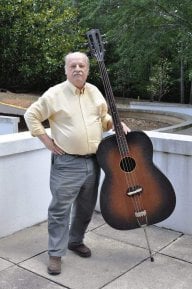
Contrabass Balalaika

bholder

Affable Sociopath
Gold Supporting Member
Supporting Member
Sep 2, 2001
32,358
87,044
Vestal, NY
Disclosures
Received a gift from Sire* (see sig)
s-l1600.png

BCM4 Balalaika Contrabass Master 4 strings Doff | eBay
 
As an eBay Associate, TalkBass may earn a commission from qualifying purchases.
Jack Casady has a bass balalaika that he bought in the 60s. His is not the contrabass model but still huge. He brought it out to Jorma's Fur Peace Ranch early last year and played it during one of Jorma's Quarantine Concert Series streams. It is a gorgeous sounding instrument, rich acoustic sound. Here is a youtube link, he talks about getting the instrument and the modifications Rick made to it. Then they play "Third Week in the Chelsea", Jack played his balalaika on the studio recording.


Here is an excerpt from an interview with Jack where he talks about his balalaika.

FlyGuitars Are there basses that you have liked over the years, and hung on to?

Jack Casady I would say that my most favourite instrument to pick up and hit one open A note off is a bass balalaika that I have. Rick Turner transformed it in to a four string bass from a three string bass. There's a contrabass and a bass, I have the bass balalaika and I got it in Paulo Alto in 1967, from a gentleman named Dante Perfumo. He was an Italian musician who just collected all kinds of instruments. I went down and visited him and I remember he had almost like a chicken coup garage out the back and he had all these woodwind instruments from the 1800's that were tuned before they went standard 444.

The bass is a big triangle and at the bottom is probably 40 some inches. It looks like you're playing a giant flat iron.

FlyGuitars Did you ever use it in the studio?

Jack Casady I recorded a number of songs with it with The Jefferson Airplane. I recorded 3rd week at the Chelsea on it and I even did a whole album with Canadian guys called The Good Brothers and it just has one of the most beautiful acoustic sounds. It was EAD and then I had Rick Turner narrow the nut a little bit and add on a different metal bridge so that I could convert it. It's still gorgeous to this day. I could walk over and hit that instrument, and the neck is like a tree trunk (laughs). The thickest part of the neck I think is about two inches deep.
 
Considering that the amplification comes largely from the vibrations of the top would it be beneficial to have the bridge placed near the center as it appears in the OP? In relation to the body as a hole it looks very similar to where the bridge is on an upright bass or other classical stringed instrument. That is to say in the neighborhood of half of the way between the bottom of the tailpiece and the neck joint.
 
Not with frets. Fretless, yeah; but with frets, move the bridge and there goes the intonation.

My previous post was from the perspective that I have noticed the more body there is behind the bridge, the more bass in the harmonic mix.

To my eye the bridge looks too close to the soundhole as it is, though I admit it's not easy to judge. So I would put money (not much, but some) on the intonation being out of whack in it's current setup.