
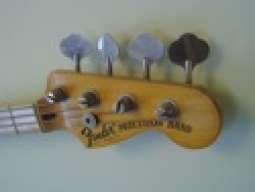
Hi, this is my first time to post here at Luthiers Corner...my question is about a crack under the screw of a 1997 Fender Jazz Bass Deluxe. location is on the machine head of "E" string. will this be a problem in the future? will the crack progress over time? can a glue fix this and prevent further damage? Thanks Very much.


Enjoy the benefits of a premium membership!
Upgrade Account
-
TalkBass has been independent since 1998. Add your voice.
Create a free account to reply to discussions, view embedded media, and browse with fewer display ads.
Join free Log in
Want zero display ads or expanded classifieds tools? Compare plans.
You are using an out of date browser. It may not display this or other websites correctly.
You should upgrade or use an alternative browser.
You should upgrade or use an alternative browser.
More options
Who Replied?
Take the tuner and screw out first and Super glue it (CA glue). Keep adding more and let it wick into the crack until it stops drawing it in. Then clamp it. Leave it over night then reassemble. Fixed!
-------------------Take the tuner and screw out first and Super glue it (CA glue). Keep adding more and let it wick into the crack until it stops drawing it in. Then clamp it. Leave it over night then reassemble. Fixed!
Hi reverendrally, thanks for the tip. have you experienced having the same problem in a bass guitar? will it last and hold? thanks
Superglue is excellent for these sorts of cracks. Stick your fingers together and see how long it last... umm, or maybe don't. 
I've used it many times on similar things. It sets hard and lasts. Some of the glue also soaks into the timber hardening it even more. It you have the bass fixed by a luthier, they will charge to do exactly what I've described.
I've used it many times on similar things. It sets hard and lasts. Some of the glue also soaks into the timber hardening it even more. It you have the bass fixed by a luthier, they will charge to do exactly what I've described.


Would dilute TiteBond also work? Few tips:
*Remove the tuner & screw.
*Clean the crack with the tip of an xacto knife.
*With a small sliver of toothpick in place, re-introduce the screw only. This may widen the crack slightly which helps with the gluing process.
*Once you've wicked the glue into place, remove the anchor screw and clamp the headstock.
Riis
*Remove the tuner & screw.
*Clean the crack with the tip of an xacto knife.
*With a small sliver of toothpick in place, re-introduce the screw only. This may widen the crack slightly which helps with the gluing process.
*Once you've wicked the glue into place, remove the anchor screw and clamp the headstock.
Riis
Why wouldn't you? Removing a tuner is quite a simple operation and will hardly kill the neck. Why wait until the crack worsens and the screw falls off?I wouldn't mess with that at all unless the screw is working its way loose or something.

Why wouldn't you? Removing a tuner is quite a simple operation and will hardly kill the neck. Why wait until the crack worsens and the screw falls off?
Honestly, my whole life is consumed with building complicated things and massive repair projects, so a stable crack would sit towards the bottom of my list. But if I were to mess with that, I would put the glue in before removing the tuner and screw to allow space for flow before the removal squeezed it tight.


Would dilute TiteBond also work? Few tips:
*Remove the tuner & screw.
*Clean the crack with the tip of an xacto knife.
*With a small sliver of toothpick in place, re-introduce the screw only. This may widen the crack slightly which helps with the gluing process.
*Once you've wicked the glue into place, remove the anchor screw and clamp the headstock.
Riis
Above is the preferred method used by professional techs.
A few more details:
Opening and cleaning the crack are important. So is the clamping rig. You will need to construct angled cauls to allow a clamp to pull straight across the crack to close it completely. Pad the cauls with leather or cork. Opening the crack can be done with the screw and maybe you will be able to get the glue to seep in deep enough. Or not. Clamp and cauls can be used to spread the crack wider.
Clean the crack: Abrasion and washing are the two methods. De-ionized water will help to pull the dirt away from the wood. Use sparingly with a lint free cloth. Forget about cotton swabs because the risk of leaving fibers in the crack is great. Scrape as little as possible. The goal is to only to remove dirt, not wood. Missing wood means less surface for the glue to bond.
Dilute glue ten percent. Use a syringe to inject glue into crack. Titebond is the glue of choice. You'll have approximately five minutes from application to clamps and clean up. So a dry run or two is in order. Clean up with water and a rag.
Hardware removal: When you go into an operation they remove your clothes. All of them. While you do not need to strip down the entire guitar to repair this crack, it's a good idea to remove the strings and at least three tuners to give yourself enough room to operate.
CA glue: It will work. Using liquid thin (medium viscosity will not wick into the crack) is impossible to control. It will lock in the dirt. It will also be messy. It will end up in places you don't want it. There will be grinding and buffing to get rid of it. If that seems like fun, have at it.
Last edited:
^ Man, talk about making a mountain out of a molehill...

This is how others fix it. Its nice to have that kinda detailed answer.^ Man, talk about making a mountain out of a molehill...
Go use your super glue
^ Man, talk about making a mountain out of a molehill...
It's the correct way to make a clean, permanent repair. It's the way a professional would do it.
It's the correct way to make a clean, permanent repair. It's the way a professional would do it.
Maybe you are seeing something I am not, but there doesn't appear to be enough spread in that crack for very much "dirt" to build up, let alone space to allow for an exacto blade to slip in and scrape around without removing wood.

^ Man, talk about making a mountain out of a molehill...
There are many ways to do things half-assed. There are very few ways to do things effectively and neatly.
You will not go wrong following 202DY's directions; they are effective and professional. You may not have to build cauls, but you will need an effective and non-marring way to get an accurate clamping hold on the repair.
Maybe you are seeing something I am not, but there doesn't appear to be enough spread in that crack for very much "dirt" to build up, let alone space to allow for an exacto blade to slip in and scrape around without removing wood.
When a crack has that much contrast from the surrounding wood.....
There's a right way, and the simple way.
It's the correct way to make a clean, permanent repair. It's the way a professional would do it.
Well I'll leave it to you "experts" while I get on with building and repairing...

Well I'll leave it to you "experts" while I get on with building and repairing...
Thanks reverend.....
Last edited:
Latest posts
-
 How can Fender release a "Vintage" series with an unplayable bridge?
- Latest: PBandJazzBass
-
-
