
• TalkBass has been independent since 1998. Add your voice.
    Create a free account to reply to discussions, view embedded media, and browse with fewer display ads.
    Join freeLog in
    Want zero display ads or expanded classifieds tools? Compare plans.

Double Bass Cracked Heel Opinions

I'll be interested to hear others weigh in on dropping a bolt thru the neck of a shen.

From my perspective, there's part rationale and part taboo. There's definitely a point at which removing wood is simply going to weaken the whole structure, but I do think there's sometimes a place for hardware if used correctly. There's a big difference between Jimbo fixing it with an impact driver through the fingerboard and a luthier's calculated, reversible repair. The spline repair you did on that cello looks great, and I wonder too if that's not an option, but something that I don't personally have the tools (or possibly the skill :roflmao:) to execute well, and I wonder how much more bench time that would require from a pro luthier.

 
From my perspective, there's part rationale and part taboo. There's definitely a point at which removing wood is simply going to weaken the whole structure, but I do think there's sometimes a place for hardware if used correctly. There's a big difference between Jimbo fixing it with an impact driver through the fingerboard and a luthier's calculated, reversible repair. The spline repair you did on that cello looks great, and I wonder too if that's not an option, but something that I don't personally have the tools (or possibly the skill :roflmao:) to execute well, and I wonder how much more bench time that would require from a pro luthier.
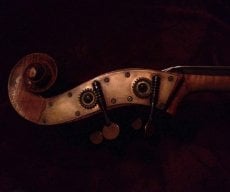
Eh, you're selling yourself short. With a little patience I don't think it's that big of a job and I'm far from a luthier.
 
When I saw the cracks and you said it was to be a glue only repair, and they separated it to put glue in, I had my doubts. If the cracks open enough to put glue in, I didn't see it being repaired that way.

Dropping a bolt thru it will kill the value of the instrument imho. Others on here are in a better position to comment on this, but to me dropping a bolt in it is a really bad idea. My cello was the same thing, luthiers didn't consider it worthy of a good repair, because they are used to very expensive instruments. (they also advised me to drop a bolt into it.). But I valued it more than that and wanted to repair it properly. I don't doubt Lisa thinks she's doing the right thing, but I'd personally disagree with her advice. I'll be interested to hear others weigh in on dropping a bolt thru the neck of a shen. I know it is what it is, but to me it's worth a properly done repair. Especially one that can be done very cheaply if you do it...

It'd be both. Fill in the cracks, whatever can get in. The plan is to see how it goes after it cures. The bolt could either be done by removing the fingerboard, or driling through the fingerboard and plugging the hole with an ebony dowel.

It'd be considered a proper repair, I would think. I hate to be overly deferential, but I saw her working on Brian Bromberg's bass and figured she'd know what she's doing.

That being said, you're right that it would kill the resale value. However, they also said the cracks alone have ruined the resale value.

Again, the one thing that makes me feel less sick about it all is that isn't some rare vintage piece.

All good thoughts here, thank you everyone!
 
  • Like
Reactions: unbrokenchain
Sinking hardware that doesn’t change with the weather into wood that does is, or should be, a repair of last resort. Pulling the neck or at least the fingerboard to hide the bolt is common sense, as is leaving some sort of sign this repair has been done to avoid damaging some future repair person’s expensive tools.

That's a good point as well kfs. My cello already had a poorly done bolt in it, but under the fb, so if I'd have followed the advice and drilled into it, I would have done more damage...

Why they would pull the fb and still bolt it was beyond me...
 
  • Like
Reactions: KUNGfuSHERIFF
It'd be both. Fill in the cracks, whatever can get in. The plan is to see how it goes after it cures. The bolt could either be done by removing the fingerboard, or driling through the fingerboard and plugging the hole with an ebony dowel.

It'd be considered a proper repair, I would think. I hate to be overly deferential, but I saw her working on Brian Bromberg's bass and figured she'd know what she's doing.

That being said, you're right that it would kill the resale value. However, they also said the cracks alone have ruined the resale value.

Again, the one thing that makes me feel less sick about it all is that isn't some rare vintage piece.

All good thoughts here, thank you everyone!

My 65 Kay has a spline repair. If it would have been a bolt, I never would have bought it. Personally, I would not consider it a proper repair. BUT!

It's your bass man. I don't have a dog in the fight. If I wasn't comfortable doing it myself, I doubt I'd be comfortable with the repair costs associated with splining it, so you gotta do what's best for you, your situation, and your wallet for sure! If I was close to you, I'd do it for the cost of materials for ya, just to do it for experience.

Good luck whatever road you choose.
 
  • Like
Reactions: Hans Gruber
I saw her working on Brian Bromberg's bass and figured she'd know what she's doing.

No disrespect to Ms. Gass AT ALL but you do expensive work on expensive basses and cheap work on cheap basses. It’s simple economics.

The owner is a $1500 bass isn’t going to want to sink another $500 into repairs. The owner of a $15,000 bass will beg, borrow or steal $5,000 to save their bass without thinking twice about it.
 
I guess I should make a few phone calls this week with all of my newfound free time and tell all of the Stradivari owners that some hack named Tony back in the 1700s destroyed their instrument when he knowingly used nails to hold the neck joint together....

How many of you internet experts have actually rebuilt hundreds of busted up bass necks while the customer was all tear eyed complaining about no money while you did your best to help them out??????

We all know the best repair- replace the $#@!%^& broken neck with a new one. Every luthier has the same answer: "I didn't break the $#@!%^& neck, you did!!!!"

All the cork sniffing you want to portray doesn't help broke musicians fix their bass. Any hardware- be it bolts or dowels or splines or metal, is a compromise where the individual tech is trying their best to help out a customer who will not pay for a new neck. It may not be perfect, but it often holds- for decades- and allows more musicians to get back to making music rather than a useless broken piece of junk in your closet of unfulfilled anxieties.

A Kay or Shen or Engle or such are not heirloom pieces. Imagine if you paid $1900 for a car and then expected- demanded- that it last for 75 years of hard use. They are working tools with a finite lifetime. Play them, fix them the best you can, and have fun...remember that word- fun, fun, fun....

Danny's granddaddy's car wreck bass.JPG
 
Last edited:
I guess I should make a few phone calls this week with all of my newfound free time and tell all of the Stradivari owners that some hack named Tony back in the 1700s destroyed their instrument when he knowingly used nails to hold the neck joint together....

How many of you internet experts have actually rebuilt hundreds of busted up bass necks while the customer was all tear eyed complaining about no money while you did your best to help them out??????

We all know the best repair- replace the $#@!%^& broken neck with a new one. Every luthier has the same answer: "I didn't break the $#@!%^& neck, you did!!!!"

All the cork sniffing you want to portray doesn't help broke musicians fix their bass. Any hardware- be it bolts or dowels or splines or metal, is a compromise where the individual tech is trying their best to help out a customer who will not pay for a new neck. It may not be perfect, but it often holds- for decades- and allows more musicians to get back to making music rather than a useless broken piece of junk in your closet of unfulfilled anxieties.

A Kay or Shen or Engle or such are not heirloom pieces. Imagine if you paid $1900 for a car and then expected- demanded- that it last for 75 years of hard use. They are working tools with a finite lifetime. Play them, fix them the best you can, and have fun...remember that word- fun, fun, fun....

View attachment 3750993

Lol, you drinkin tonight james?
 
No disrespect to Ms. Gass AT ALL but you do expensive work on expensive basses and cheap work on cheap basses. It’s simple economics.

The owner is a $1500 bass isn’t going to want to sink another $500 into repairs. The owner of a $15,000 bass will beg, borrow or steal $5,000 to save their bass without thinking twice about it.

Makes sense. I was given a handful of options. From like the $60 to $350 range. I'll pay for what's the most reasonable thing to do.


My 65 Kay has a spline repair. If it would have been a bolt, I never would have bought it. Personally, I would not consider it a proper repair. BUT!

It's your bass man. I don't have a dog in the fight. If I wasn't comfortable doing it myself, I doubt I'd be comfortable with the repair costs associated with splining it, so you gotta do what's best for you, your situation, and your wallet for sure! If I was close to you, I'd do it for the cost of materials for ya, just to do it for experience.

Good luck whatever road you choose.

I do appreciate the insight and your honest opinion about the bolt making it less appealing. So if you were to buy my bass with just the crack and hide glue option, you'd personally find that more appealing? Or is that still a dealbreaker?

Or is that a proper repair in your experience (outside of replacing the neck)?
 
  • Like
Reactions: 210superair
Makes sense. I was given a handful of options. From like the $60 to $350 range. I'll pay for what's the most reasonable thing to do.


I do appreciate the insight and your honest opinion about the bolt making it less appealing. So if you were to buy my bass with just the crack and hide glue option, you'd personally find that more appealing? Or is that still a dealbreaker?

Or is that a proper repair in your experience (outside of replacing the neck)?

Well, being just a 'cork sniffer', I guess I wouldn't know.

But honestly, it would depend. For me if it would hold, yeah. Depends how bad the crack is. All I know is when I see a bass with a plug in the fingerboard, I shake my head. Opinions vary man, do what's best for you. It's a ply shen, it's not going to change the world either way. I do agree that whatever gets you playing and works best for you is what you should do, which I think is james' point. And James is the man around here, no doubt. I couldn't have done my repairs without his advice, so following his advice is what I'd advise....
 
  • Like
Reactions: Hans Gruber
Lol, you drinkin tonight james?

Nope. Truth be told, I'm lucky if I have a half dozen beers in a year. I'm not in a program, it is just not my thing . I get ten times the buzz from a 3 hour mountain bike ride or a 10 mile trail run than any alcohol. Being alcohol free by choice in a heavy alcohol use society makes for a lot of odd interactions, but I'm at peace with it. I tried a lot to be that drinking guy when I was younger, but no success....

I'm not trying to ride anyone here. The biggest point I can make is that I've seen epoxy sometimes fails. Dowels sometimes fail. Bolts sometimes fail. Splines sometimes fail. Hot hide glue sometimes fails. New necks sometimes break and fail...and sometimes they all work perfectly well for decades. I use all of them, it just depends upon the individual situation.

I'll comically admit that my current #1 personal bass has the neck held on with two 50 cent hardware store bolts, not by plan or design. I hastily put it on just as a quick shop test one afternoon, mainly due to impatience. It sounded so good that I left it as is and have been gigging on it for about seven months with no known issues. I'll likely glue it at some point later, but a $1 repair is holding great and sounds fantastic....while allowing me more shop time for complicated repairs and new builds for other people who have very specific opinions.

Do your best with honest intentions and price your work accordingly so you have enough margin to offer a warranty to your customers; even if it fails due to nothing that you did, word will get out that you are an honest person and the community will have your back in the long run.

Stay safe in these very trying times. I look forward to getting back to the day when the most we all have to worry about it 190 gram hide glue vs 300 gram....
 
Last edited:
No disrespect to Ms. Gass AT ALL but you do expensive work on expensive basses and cheap work on cheap basses. It’s simple economics.

The owner is a $1500 bass isn’t going to want to sink another $500 into repairs. The owner of a $15,000 bass will beg, borrow or steal $5,000 to save their bass without thinking twice about it.

You're right. For instance, replacing the neck would be at least $1000. Though doing the ratio, $500 to $1500 is the same as $5000 to $15000, right? ;)
 
I don’t understand what all the fuss is about. Well executed hide glue joints hold for centuries without creeping, and if the repair fails, clean it with hot water and do it again.

My personal collection includes a stupid-clean ‘35 King whose scroll was busted off God knows how many years ago. It was repaired with hide glue, no dowels and no hardware.

That’s an extremely high-stress joint. It’s holding fine. The guy I bought it from picked it up as a kid in 1975 and the repair predated his ownership.
 
I don’t understand what all the fuss is about. Well executed hide glue joints hold for centuries without creeping, and if the repair fails, clean it with hot water and do it again.

My personal collection includes a stupid-clean ‘35 King whose scroll was busted off God knows how many years ago. It was repaired with hide glue, no dowels and no hardware.

That’s an extremely high-stress joint. It’s holding fine. The guy I bought it from picked it up as a kid in 1975 and the repair predated his ownership.

I supposed this entire thread could be distilled into this! Thanks!

The only caveat was that the crack might not be quite big enough to get enough glue, but that also kind of begs the question of how bad the damage is in the first place. Appreciate your insight Sheriff!
 
  • Like
Reactions: KUNGfuSHERIFF
I don’t understand what all the fuss is about. Well executed hide glue joints hold for centuries without creeping, and if the repair fails, clean it with hot water and do it again.

My personal collection includes a stupid-clean ‘35 King whose scroll was busted off God knows how many years ago. It was repaired with hide glue, no dowels and no hardware.

That’s an extremely high-stress joint. It’s holding fine. The guy I bought it from picked it up as a kid in 1975 and the repair predated his ownership.

I agree, and I don't think there was any fuss till late in the thread. Hey, the OP asked for opinions. He got various opinions. What's the issue?

But getting on here and flipping out and insulting your fellow bassists seemed absolutely hilarious to me. Not very lady like indeed...