• TalkBass has been independent since 1998. Add your voice.
    Create a free account to reply to discussions, view embedded media, and browse with fewer display ads.
    Join freeLog in
    Want zero display ads or expanded classifieds tools? Compare plans.

Cross-Over (Crossover or Splitter) pedals

If the controls for each paired high pass and and low pass sections are linked, I believe the phase issue should theoretically work itself out...

You are entirely correct. You can design higher order filters with matched phase without too much trouble. Making them sweepable with a single control can be..let's say "interesting."

First order filters are trivial to phase align, plus deliver a smooth transition, which I find pleasing. Of course, if the effects mess with phase all bets are off. :>
 
Thanks for tagging me in, it's an interesting problem. You know, a 3-way crossover is just two 2-way crossovers cascaded, right? So one solution is to simply use two 2-ways. Naturally the thingy I'm selling is much too bulky for this application, but I am prototyping some smaller thingies that might work. Maybe PM me?

There's also the issue of crossover steepness, that most people don't talk much about in pedalboard threads. The steeper the crossover, the more the phase gets mangled and the crossover gets complex quickly. I think first-order is actually better than higher-order crossovers for a blender scenario, but for a 3-way crossover you might want the bands to be more clearly defined, which suggests maybe second-order. That's a 180-degree phase twist, and you'll be cascading two of those to get a 3-way. It can be done, but you're starting to cram a lot of circuitry into a pedal-sized box, and making a 2nd or 3rd order sweepable makes the controls quite complex (translation: more expensive and difficult to source), which I assume is why some designs use separate knobs for high/lowpass instead of a single one.

So, maybe first consider whether first-order crossovers will suit your needs. If so, it's simple. If not, this could get much more interesting. :>

Interesting, I didn't know that three band crossovers were just a pair of cascaded two ways. Most crossover devices have been interested in seem to have a 6dB per octave slope, which (correct me if I am wrong) is a first order crossover? I'm sending you a PM with more details.

Cheers!
 
  • Like
Reactions: Zbysek
Most crossover devices have been interested in seem to have a 6dB per octave slope, which (correct me if I am wrong) is a first order crossover?

Yup, that's first order. I assume most rack multiband comps will be aimed at full-mix compression. Not sure what conclusions to draw here but I'm sure there's a takeaway about crossover slope or rack compressor design decisions or something. It's late I'm going to sleep now. Cheers!
 
  • Like
Reactions: Zbysek and Bassgeer
Ordered a Sugar Britches for my medium board to use with my Malekko B:Assmaster and Whirlwind Orange Box. This should be perfect for me since I hate using the blend on a fuzz and much prefer only having the highs distorted or modulated. I will use a custom Saturnworks buffer where the switch changes the phase 180 degrees since both pedals invert phase when engaged (should allow me to properly set the phase depending on if one or both pedals are on).

My Brimstone Ouroboros will go on my kitchen sink boards I am slowly building (twenty plus pedals - Korg G5, Dedalo Byte, WMD, Bass Whammy, Moog Minifoogers, TWAs, Markbass Compressore, Pigtronix looper, etc.).
 
Last edited:
Just to chime in with a (small) wisdom that wisited me.

TL;DR: if you want low freqencies processed one way and high another way you need to do EQ->effect => sum. if you want all frequencies processed but only part of result mixed you need effect->EQ => sum.
TL;DR example: octave fuzz. If you want fuzz and octave only on certain notes (say higher) you need to feed high part after crossover EQ section to pedal, and then just sum signal back. But if you want to have octave-fuzz effect for all notes, just remove lower parts of distortion, you need a way to split signal, feed it into fuzz, and then into crossover EQ and sum.

==

I am doing "two EQ crossover" setup soon (when 2nd EQ arrive) with MS-60b and graphic EQ. And latter has jacks placed on top, not convenient in my setup. So I thought to place it in front of effects of that "loop", thinking that it would not matter. Only after working with this idea back and forth for couple of days I realized that I would miss effects on frequencies I would cut with EQ completely, and this was not my intent. Plan was to add OD or superfuzz on whole signal, but then keep only added higher overtones. And to do that I need to place EQ strictly after effects. This is opposite of what I am doing in multistomp where I first EQ the signal and then compress it a little, so compression happes based on power/level of frequencies I actually use, not on whole signal power/level.
I don't know if any of existing crossover pedals have option to do pre/post FX eq, I think this is one of cases where it is cheaper and easier done with two EQs.
 
...I hate using the blend on a fuzz and much prefer only having the highs distorted or modulated.

I like fuzz pedals with some kind of variable highpass, because they act all refined when you remove the low end, and gradually get raunchy as you drop the crossover point. So the frequency becomes a sort of "raunch control".

Which, now that I've said it, I realize should be the name of a pedal. Raunch Control[TM]. I'd buy one just based on the name. Album or Band?
 
Funny this got bumped. I was just working on making a crossover with my Zoia last night. It wasn't quite dialed in, but I see the potential. Create two audio paths, and insert a HPF on one and a LPF on the other, with a commonly controlled cutoff frequency point.

After that, route the filtered audio paths to various other effects, then to the output.
 
  • Like
Reactions: Zbysek
Nice. And actually, now that I think for a moment, I do have a question: do the crossover users here think that a crossover through a bass amp With tuned distortions is sufficiently good to skip using a guitar amp with a bass amp? In other words, can you achieve similar tones to classic bass/guitar amp setups?

I don't personally think so. Guitar amps bring some other 'stuff' to the table in the tone world and while I'm not a person who wants a rig that's guitar amp/bass amp, I understand why many do this. I just think bass amps perform and sound intrinsically different.

I'm still using one -- a John Kallas Cross-Mix.

It's hard to explain how I wound up with three crossover pedals. :roflmao:

Yeah, I have a few too. :) Right now none on my board, but not due to much more than needing to restructure what I was doing... I moved to using fewer pedals to do more things and in that move I sacrificed my crossed over chain for functionality in a few other ways for the live stage. The C4 luckily has some amount of contingency & the bonus of removing 3 or more pedals for just that one.
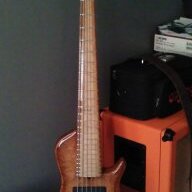
 
Just received shipment of my FEA Labs DB-CL today.

I did as much research as I could online before purchasing, and this thread helped push me in the DB-CL direction. The more I thought about it, the reputation of build quality combined with the ability to do a (technically) three in one job... Compress/limit, compress, crossover made this the pedal I was looking for.

Frank being an amazing builder and available to get tips from takes it from brilliant purchase to unbelievable.
 
Nice. And actually, now that I think for a moment, I do have a question: do the crossover users here think that a crossover through a bass amp With tuned distortions is sufficiently good to skip using a guitar amp with a bass amp? In other words, can you achieve similar tones to classic bass/guitar amp setups?

It's not the same as you are missing the sound of the guitar speaker and cabinet. But it's close enough for me not wanting to haul around another amp. I enjoy the simplicity.

I play a tweeter less, sealed, 4x12 speaker cab so it's voiced quite a bit differently than a modern tweeter, ported, bass cab. The crossover works for me.

On a normal bass cab it probably will be missing some of that wooden upper mid thing a guitar cab provides.
 
  • Like
Reactions: Wasnex
I may set up a second board and go back to using my crossed over effects setup...while my main stage board ended up abandoning this for logistical reasons, I have enough pedals to do a second board that would be a non-midi non-bypass switching board...I'm a little more motivated since I just got an Arcing Prisms from IE and have a bunch of other weirdo and unloved stuff I could set up.
 
  • Like
Reactions: Zbysek and 31HZ
Hello everyone,

first post here for me :D

I would like to replicate live what I do when I mix bass: Have a clean, quite compressed bottom end (smaller than ~250Hz) and a distorted >250Hz.
I already have a simple splitter to build the parallelism and a Radial JDI DI Box, which can be set into "merge" mode so that it combines both at the end (and at the same time would provide a DI, how awesome is that!).
So what I would need is simply one LPF and one HPF for each chain, preferably in small size factor and not 2 million dollars :D. However, I could not find such products. I know how to solder, so I would be able to make them myself also, but I would need instructions for that.

Can anybody recommend anything? Would my plan even work?
I think this would be a nice alternative to buying some expensive almost non-available crossover pedal, at least to see how it sounds at first.

Best,
Klaus
 
  • Like
Reactions: Zbysek