• TalkBass has been independent since 1998. Add your voice.
    Create a free account to reply to discussions, view embedded media, and browse with fewer display ads.
    Join freeLog in
    Want zero display ads or expanded classifieds tools? Compare plans.

Cross-switching three pickups?

Here goes another crazy idea.

Suppose you had a triple-pickup bass, let's say a P/J with an extra Model One stuck in the neck position. Let's label the Model One A, the P-pickup B, and the J-pickup C.

Now, suppose that you wish to avoid pickup loading and have only two pickups active at the same time - that is, either AB, BC or AC, and that you've got a VOL/TONE stack after each of the outputs.

To put it in a picture: A, B, C are pickups, 1, 2 are outputs towards the V/T stacks.
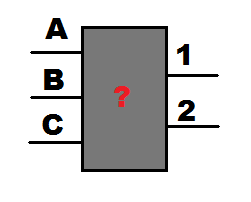
wiring.png


Would it be possible to find a switch that'd let me have the following options:

1) A -> 1, B -> 2
2) A -> 1, C -> 2
3) B -> 1, C -> 2

What goes on after the V/T stacks is irrelevant at the moment - potentially, a mono/stereo pair of jacks, but right now it's not that big of an issue.

What do I need? What kind of <something>P<something>T switch would do this kind of trick? A rotary, maybe?
 
To revive the thread a bit, maybe clarify my original intention and rehash the ideas you provided:

This is what I originally intented: three positions, inputs (pickups) on the left, outputs (vol pots and common tone) on the right:
wiringj.gif


Funkmaster - three switches would take a lot of pickguard real estate in my mind, though I'm glad there's no pickup loading or noise. Though I usually advocate it, I wouldn't really go for phase reversal on this project (even on the Model One).

Lemur821 - which 2 extra tones do you mean? The only combo I wouldn't have is the all-on setup, unless you mean having the Model One split up as well... which would mean not one, but three extra combos.
 
Funkmaster - three switches would take a lot of pickguard real estate in my mind...

Three mini switches take up about as much room as a Strat blade switch. Not much at all. Then you can also use two switches, one a three way to choose between neck/bridge/both, and another three way to choose middle-solo/middle-off, which allows all the combinations on two switches.

I had an 8-string with two Model P's and a Model G and three switches for pickup on-series/off/on-parallel for each pickup.
 
To revive the thread a bit, maybe clarify my original intention and rehash the ideas you provided:

This is what I originally intented: three positions, inputs (pickups) on the left, outputs (vol pots and common tone) on the right:
wiringj.gif
your little moving diagram is great, and totally helped put the answer in my brain.

you need a DPDT on-on-on mini toggle.
 
Lemur821 - which 2 extra tones do you mean? The only combo I wouldn't have is the all-on setup, unless you mean having the Model One split up as well... which would mean not one, but three extra combos.
I misread what you wanted. I thought you were leaving one of the possible two-pickup combos out of your planned setup, for a total of five combos. Yes, on/on/on would be the only one you're missing.
 
Three mini switches take up about as much room as a Strat blade switch. Not much at all. Then you can also use two switches, one a three way to choose between neck/bridge/both, and another three way to choose middle-solo/middle-off, which allows all the combinations on two switches.

I had an 8-string with two Model P's and a Model G and three switches for pickup on-series/off/on-parallel for each pickup.

I see. Maybe that two-switch option would work well for me, then. If pickup loading really isn't that much of an issue, I'd definitely go for the triple...

However, from what i recall about switches that'd give me a common output for the selected pickups - in other words, one master volume and one master tone. The reason I asked with the above schematic in mind was because I'd have a separate V/T control for each of the activated pickups. SGD, am I missing something here with my definition of how switches work? :confused:
 
You don't need a tone control for each pickup because if you have two pickups on, and you turn the tone down on one, it will effect both pickups since the controls are not isolated from one another.

If you have three volumes, than you don't really need switches.

I used a master volume and tone on the basses I had with three pickups.
 
I had an 8-string with two Model P's and a Model G and three switches for pickup on-series/off/on-parallel for each pickup.

What sort of switches and mounting did you use for this? I am in the planning stages of modding a tele-bass and would love to do this sort of setup in a jaguar 3 switch control plate, but I don't know if it's possible to fit a 3-way switch in there.

GPFJ-AP001.jpg
 
What sort of switches and mounting did you use for this? I am in the planning stages of modding a tele-bass and would love to do this sort of setup in a jaguar 3 switch control plate, but I don't know if it's possible to fit a 3-way switch in there.

GPFJ-AP001.jpg

I used mini toggle switches.

They do make 3 position slide switches that would work. The Fender Mustang guitar used two of them. They were DTDP with center off. They worked as pickup on/off and phase reversal switches.

On-Off-On Slide Switch

[Invalid or Expired Link Removed]
 
Now I just have to find either switches small enough to fit in the stock plate or a place to build a custom plate large enough for the 3-way switches. Unless anyone has dimensions for the plate and/or switches that tell me otherwise...

Sorry for the slight thread hijack... :hiding:

Those slide switches are a standard size, so they will fit.

They also have them at Stew-Mac:

Switchcraft Slide Switches

[EDIT]

I was mistaken in that the 2 and 3 way switches are not exactly the same size.

The 3 position switch is longer. The 2 way has a 9/16 slot, while the 3 way has a 13/16 slot, and the mounting holes are farther apart.

:o
 
To original poster: here is how to do this with a rotary switch.

At minimum, you will need a rotary switch with 2 poles and 3 positions. Here is a comparable rotary switch by Alpha Taiwan (sold by Mouser) which I have used in some similar wiring projects:
Invalid Link Removed

(This switch actually has 4 poles; you may ignore two of them for this purpose.)

Pins: (refer to the datasheet)
This switch has 4 center lugs, one for each pole. Each pole is switchable between one of three outer lugs. The outer lugs are labeled 1-12; the corresponding pole lugs are labeled A, B, C and D.

Wiring:
Connect the positive lead from pickup "A" to outer lugs 1 and 2.
Connect the positive lead from pickup "B" to outer lugs 3 and 4.
Connect the positive lead from pickup "C" to outer lugs 5 and 6.
Connect output "1" to center lug A.
Connect output "2" to center lug B.
Do not use center lugs C or D, or outer lugs 7-12.

Operation:

When the rotary switch is turned to the first position (counter clockwise) center lug A will be connected to outer lug 1. This will send pickup "A" to output "1". At the same time, center lug B will be connected to outer lug 4. This will send pickup "B" to output "2".

When the rotary switch is turned to the center position, center lug A will be connected to outer lug 2. This will send pickup "A" to output "1". At the same time, center lug B will be connected to outer lug 5. This will send pickup "C" to output "2".

When the rotary switch is turned to the last position (clockwise) center lug A will be connected to outer lug 3. This will send pickup "B" to output "1". At the same time, center lug B will be connected to outer lug 6. This will send pickup "C" to output "2".

Hope this helps! I have always preferred using rotary switches instead of sliders (or a series of toggles) for these kinds of switching tasks. The result looks cleaner, IMO.