Really? I would think with the vast majority of string sales being roundwound that the majority of players would be able to play just fine with them. I get that a lot of fretless players prefer the sound of flats and the concern with fretboard wear from rounds, but the idea that the majority of players would not be able to play well with rounds seems odd to me.Why ship with flat wounds?
Because most players would not be able to play well with rounds.
JP OTOH, would have used rusty bailing wire if he liked the tone better.

Enjoy the benefits of a premium membership!
Upgrade Account
-
TalkBass has been independent since 1998. Add your voice.
Create a free account to reply to discussions, view embedded media, and browse with fewer display ads.
Join free Log in
Want zero display ads or expanded classifieds tools? Compare plans.
You are using an out of date browser. It may not display this or other websites correctly.
You should upgrade or use an alternative browser.
You should upgrade or use an alternative browser.
curious. Why does Fender sell the Jaco Pastorius bass with flatwound strings?
- Thread starter trickyric
- Start date
More options
Who Replied?
Really? I would think with the vast majority of string sales being roundwound that the majority of players would be able to play just fine with them. I get that a lot of fretless players prefer the sound of flats and the concern with fretboard wear from rounds, but the idea that the majority of players would not be able to play well with rounds seems odd to me.
I find playing super in tune with a fretless is difficult enough. The ability to be able to easily slide into pitch is helpful as well as less abrasion on my fingers. I also dig the tone more. YMMV
I find playing super in tune with a fretless is difficult enough. The ability to be able to easily slide into pitch is helpful as well as less abrasion on my fingers. I also dig the tone more. YMMV
My experience in regard to sliding easier is actually the opposite. When I've played on flats the increased surface area contact with my fingertips creates more friction. It actually feel like I'm having to drag my fingers. Like dragging my fingers down a textured wall vs the glass window next to it. It's less abrasive feeling but feels like more effort is required to slide along the smooth surface.


I think that was called a Jazz bass......Wasn't there a fretted version of the Jaco Pastorius bass?


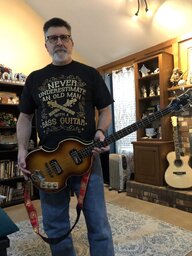
Rounds chew up the fingerboard. Unless they put that boat epoxy on it, nobody would buy one that had any play time on it. It doesn't take much for rounds to grind tracks into a rosewood board.
they actually use Urethane-coated pau ferro for the finger board.Rounds chew up the fingerboard. Unless they put that boat epoxy on it, nobody would buy one that had any play time on it. It doesn't take much for rounds to grind tracks into a rosewood board.
I think that was called a Jazz bass......
I guess there wasn't a Geddy Lee sig, it's just a Jazz Bass?
C'mon.. I couldn't pass up the kind of an opening..I guess there wasn't a Geddy Lee sig, it's just a Jazz Bass?
If you have ever used Roto's or most any other SS string its a bit on the rough side. Back in the day there wasnt endless choices of string to choose from so Roto's were a very popular string. I used them a bunch but havent touched them since the late 80's.
The poly finish on my Jacos is superbly done, but it is a very thin finish. So any repairs would require expert luthiery-level supernatural Salem witchcrafteryness with resurfacing/refinishing the board without ruining it. I've done my own fingerboard repairs on bare wood boards in the past, when I had the tools to do it. But even then, there's no way I could do a refin on one of these without just trashing it.
So that's another reason I'm keeping flats on mine, as I just don't ever want to ever have to dress those fingerboards. Yes, fingerboards still last a long time with rounds on them, but they last a fair bit longer with flats. Hopefully long enough that I'll be dead and buried in the ground with the Jacos in my tomb before then.
L
So that's another reason I'm keeping flats on mine, as I just don't ever want to ever have to dress those fingerboards. Yes, fingerboards still last a long time with rounds on them, but they last a fair bit longer with flats. Hopefully long enough that I'll be dead and buried in the ground with the Jacos in my tomb before then.
L

Because they won't make money out of installing strings from a competitor.
The Steve Harris signature P comes with Rotosound flats, but mercifully not installed.
Did the original Steve Harris Sig (blue, mirror pg, 1¾" neck) come with the heavy gauge Roto flats installed?
Supposedly Geddy Lee had the Fender CS make him a fretted version of the CS beat-up looking one. I think it was a one-off, though, and not something the average Joe could order or pay for....I guess there wasn't a Geddy Lee sig, it's just a Jazz Bass?
L
Really? I would think with the vast majority of string sales being roundwound that the majority of players would be able to play just fine with them. I get that a lot of fretless players prefer the sound of flats and the concern with fretboard wear from rounds, but the idea that the majority of players would not be able to play well with rounds seems odd to me.
Flats intonate a little bit sharp compared to rounds on the same bass, so it can take a little playing time to get used to it. It doesn't take long, but some can be put off by this thinking that suddenly something's wrong with the bass or strings or something like that. That, and the new backwoods-of-Appalachia-washtub-bass tone of flats can help prematurely get the flats off it and the rounds back on.
As far as playing them, flats don't respond as well to plucking near the bridge for the Jaco-esque tone, as a set of dead rounds. So you lose that when you go to flats.
But you gain so much thumpy, papery, cardboardy goodness with the neck PU going to flats, as well as getting rid of most if not all of the muaah too. So there's a lot to be gained as well.
L
Last edited:

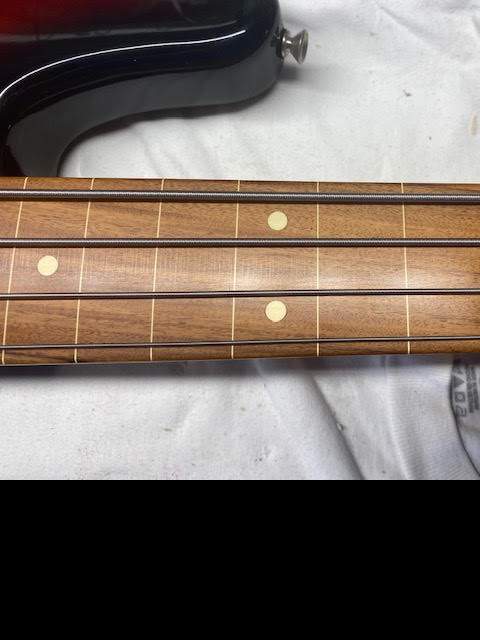
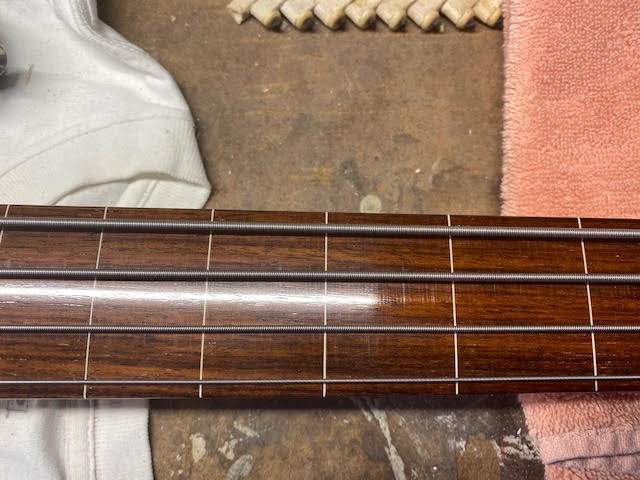
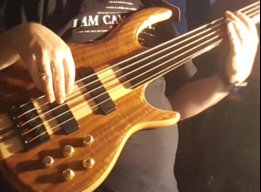
The original 1991 Jaco Pastorius Signature Bass was offered with Roto Sounds RD66. I own number 001 and never used flats, although I don't play it as much as I used to -got a second Fender fretless- it has marks but nothing bad (first pic below). The second fretless has more playing time and noticeable marks, but again, nothing horrible. I guess this depends on your touch and use of vibrato, note the second one does not have freatboard markings -dots-.

Because they eat the fingerboard pretty fast. Maybe ground-wounds would have been better…?I get that. But they could install fender round wounds like he used. That would seem closer to authentic...

This is why we intonate fretless basses just the same as fretted basses when changing string gauge or type. Just set the saddles back further and voila, it's in tune again at proper 34" scale length.Flats intonate a little bit sharp compared to rounds on the same bass, so it can take a little playing time to get used to it. It doesn't take long, but some can be put off by this thinking that suddenly something's wrong with the bass or strings or something like that. That, and the new backwoods-of-Appalachia-washtub-bass tone of flats can help prematurely get the flats off it and the rounds back on.
As far as playing them, flats don't respond as well to plucking near the bridge for the Jaco-esque tone, as a set of dead rounds. So you lose that when you go to flats.
But you gain so much thumpy, papery, cardboardy goodness with the neck PU going to flats, as well as getting rid of most if not all of the muaah too. So there's a lot to be gained as well.
L


