• TalkBass has been independent since 1998. Add your voice.
    Create a free account to reply to discussions, view embedded media, and browse with fewer display ads.
    Join freeLog in
    Want zero display ads or expanded classifieds tools? Compare plans.

Custom Aluminum Neck but NOT a Luthier!

WilbursaurusRex

Supporting Member
Aug 4, 2017
555
601
Greensboro, NC
So, I've had a peavey patriot body (just the body) for almost a couple of years now, and haven't been able to do anything with it. I've wanted to put a neck on it and make it a fun little project. I am NOT a luthier, but I am a machinist finishing up a cnc programing program this year and thought doing an aluminum neck would be a great personal "capstone" project. I was thinking 7075 alum neck, richlight fingerboard, stainless steel frets, and maaaybe make it headless. Ultimately it would be a shorter scale 5 string tuned E-C.

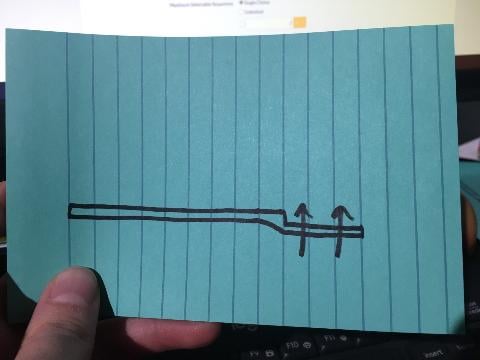
All that said, I was considering bolting the neck on in a different way to allow for a much more contoured heel. Ive attached a terrible picture to give you an idea. I would cut out the traditional neck pocket and route a channel on the underside of the body. The end of the neck would slide into that channel and bolt up into the body from underneath. Is there any glarring issue with going about it this way? I thought it would be a good way to get a more contoured heel and distribute the weight better.

Any input is welcome and appreciated! Im just trying to make sure Im not looking over anything a luthier may know that I dont (which is a lot ;))

IMG_1615.jpg
 
Last edited:
Perhaps investigate possible interference with the pickup route.

It wouldnt be a full underside channel. Maybe extend back 5"-6". The pickup position of the patriot allows the space without running into the pickup cavity

For Sale/Trade - '80s Peavey Patriot Bass Neck and Tuners in NYC
Note that this is an early Patriot neck - P bass width (1.75"). Later Patriots were jazz bass width (1.5").

Aluminum necks have been done, but, off the top of my head, seems like they weren't solid, for weight control. I could stand corrected on that point.

Thanks for the link. The neck would be special because its actually to be a ~31" scale 5 string tuned E-C, so it would need to be a custom. Aluminum has been done in several ways some more successful than others. A solid aluminum neck is a no go. I would mill weight relief into it and then secure the richlite fretboard. The fretboard wont be as rigid as aluminum but still more stable and rigid than wood (supposedly), and would act as a barrier between the aluminum and stainless steel.
 
Electrical Guitar Company makes a pretty broad line of guitars and basses with aluminum necks, fretboards, and sometimes bodies. They hollow out the necks of some of the designs to make them lighter. They've either licensed designs from Travis Bean or they're building necks on contract for the company that did license Travis Bean's designs, I'm unclear on it.

They will also sell custom necks but the prices might make you flinch.

Anyway you might want to check how other builders are handling aluminum.
 
check how other builders are handling aluminum.

definitely doing this. I've read multiple forums (both guitar/bass related and machining/cnc related) and feel I have a pretty decent grasp.

I'm interested in doing this bc I can do it relatively on the cheap since I have access to school equipment (work doesn't allow personal projects) and it could be a great learning process
 
  • Like
Reactions: JRA and ardgedee
A very deep neck tenon with the pocket in the front face of the body still allows you to move the joint toward the bridge and get the body heel out of the way. See the Brubaker Brute bass for example. You would not need to start with as thick a billet for the neck or to remove so much of it this way.

Or you could do a neck-through. If you still want to use the Peavey body, you could cut the wings off and bolt or bond them to the neck beam.

Alternatively, or additionally, how about a hollow aluminum body? Fender briefly offered them in the 90s. I have an aluminum Stratocaster that is fantastically resonant.
 
A friend had one of the 70's aluminum neck basses, had the 'Y' shaped headstock. That thing would NOT stay in tune. It seemed like the heat from your hand was enough to make it expand/contract. Do your homework on this, some pretty tough reasons that evey commercial attempt to do this seems to have fizzled.,


I had a Kramer! Agree with all your observations. It was cool looking and seemed like a good idea at the time, but the execution left a lot to be desired.
 
  • Like
Reactions: Gilmourisgod
So, I've had a peavey patriot body (just the body) for almost a couple of years now, and haven't been able to do anything with it. I've wanted to put a neck on it and make it a fun little project. I am NOT a luthier, but I am a machinist finishing up a cnc programing program this year and thought doing an aluminum neck would be a great personal "capstone" project. I was thinking 7075 alum neck, richlight fingerboard, stainless steel frets, and maaaybe make it headless. Ultimately it would be a shorter scale 5 string tuned E-C.

All that said, I was considering bolting the neck on in a different way to allow for a much more contoured heel. Ive attached a terrible picture to give you an idea. I would cut out the traditional neck pocket and route a channel on the underside of the body. The end of the neck would slide into that channel and bolt up into the body from underneath. Is there any glarring issue with going about it this way? I thought it would be a good way to get a more contoured heel and distribute the weight better.

Any input is welcome and appreciated! Im just trying to make sure Im not looking over anything a luthier may know that I dont (which is a lot ;))

View attachment 5154972
I love it, please document it here as you go. :D

Harvester Guitars (Australia) is about the only person doing custom one-offs of aluminum necked instruments in a commercial fashion. HARVESTER - bespoke guitars - repairs - modifications - SERIE ANTONIO He welds pieces together, so uses 6061 like the Travis Beans. He's inspired by Wandre Instruments (60's Italian) who in turn made many different aluminum necked instruments. Because of the properties, one can build a very different neck with aluminum; some examples at Harvester under his "Serie Antonio". His website is laid out like a blog, which I find cumbersome, but you can see some examples.

As soon as you mentioned bolting it from the back, I thought of Harvester as he's done that a lot, just like Wandre. :)
 
Electrical Guitar Company makes a pretty broad line of guitars and basses with aluminum necks, fretboards, and sometimes bodies. They hollow out the necks of some of the designs to make them lighter. They've either licensed designs from Travis Bean or they're building necks on contract for the company that did license Travis Bean's designs, I'm unclear on it.

Any patents that Travis Bean may have had expired LONG ago. A design patent (the look) of that era was good for 14 years, and a utility patent was good for 17 from the date of issuance.

The issue with aluminum is weight. Kramers had aluminum necks, but a part of the structure was wood, which helped (albeit not enough). The maple most necks are made of has a density of about .6 grams per cubic centimeter. Aluminum is 2.7 - over 4 times as dense. Magnesium (and Graphite) are about 1.7 - any of these materials need to be hollow, or have a lot of the cross section replaced by something much lighter to balance well. A Kramer aluminum necked bass is a wonderful bass sonically, with sustain that will blow your mind, but once you get past that, the neck is darn heavy. In my 20's, the thing was great. A decade later...not so much.

As to your idea of attachment, I think what you are proposing is very much what Travis Bean did.
 
I've been using aluminum necks almost exclusively for 10 years with no issues about tuning stability or neck diving. Sounds like a great project, good luck & can't wait to see the final product!!!

investigate the Travis Bean instruments, they have a very similar construction except with the pickups and bridge mounting directly through the body and onto the neck assembly
 
You should totally do it. An acquaintance from a certain famous Chicago 3-piece rock band swears by his Travis Bean; another guy I know in a Nirvana cover band has a (very heavy!) Kramer that he does entire sets with and it sounds like dynamite.

I'm not a luthier either, but I was a pro machinist for a while. My thoughts / research on a DIY aluminum neck, take them or leave them:

1. ***Definitely*** plan for a truss rod and especially if you're doing a 2-piece. A friend of mine kit built a guitar with a no-truss-rod aluminum neck (unsure of the mfg.), and he fought the setup tooth and nail to get it even remotely playable (shimming, filing, leveling, etc.). To this day, it *still* needs more work to be gig-able. OTOH, a truss rod would have made it a snap. Sure, aluminum is stiff, but 200+ lbs of string tension is no joke. (see attached pic - this was for an E-A-D-G-C project I did long ago, what a coincidence!)(this is also a good reference for "occult" projects: Kalium Music | String Tension Calculator ) edit: I'm not 100% sure how Travis Beans or Kramers, etc., get setup, but I am super curious. String tension has to be a factor!

2. How do you plan to attach the fretboard? My big idea is a simple tongue and groove "dry" fretboard with "inlays" that are actually flathead (or low head) sockethead cap screws, which are then shaped to match the fretboard radius once torqued. Depending on what frets you choose (your fingers never really touch the fretboard with 6100s, for instance), re-shaping may not be necessary with a nicely dressed relief. With first fret "inlays" and bolts on the usual inlay positions, I think that would be enough to hold it together. If you have time and can bench your own tools, I would do a taper on the tongue and groove and offset "tune" your program (without breaking your setup) until you achieve the fit you desire.

3. 7075 wouldn't even be my third choice. Left untreated, it will get chalky and scaly. Depending on the budget, check out 7050. It's 6061 on steroids (and weldable), otherwise 6061 will work fine and be easiest to obtain.

4. Does your CAM package have thread milling capabilities? I would definitely do thread inserts for all threads (mandatory inserts in aluminum is a MIL spec, so you know it's good!)

5. What CAD software do you have?
 

Attachments

  • CircleK-5-string.png
    CircleK-5-string.png
    13.3 KB · Views: 62
Last edited:
  • Like
Reactions: Beej and 1n3
If you need a capstone project for a CNC program, this seems like a very good one; as much a design challenge as a programming challenge. Hope you've also got some CAD chops.

My suggestion is, forget (sell) the Patriot body. Do an aluminum frame from bridge to headstock, then add some wood to suit.

Gilmourisgod has a point about temperature. I've worked a lot with pedal steel guitarists. Pedal steels with aluminum necks are more sensitive to temperature changes than steels with wood necks. That's to be expected, given the different coefficients of thermal expansion. But the brighter tone makes aluminum necks popular, and players adapt to temperature changes.

If you pursue this, I'll follow with interest.
 
  • Like
Reactions: Anthony Fury
I agree with almost everything Anthony Fury said. I'm an experienced Luthier and Machinist, and I have messed around with aluminum and other non-wood necks.

Use 6061. I can't think of any good reason to use 7075. It's 3X the price of 6061, harder to machine, has that chalky problem, etc. 6061 will be so much nicer to work with.

I agree about the truss rod. You really should plan on putting one in. You're going to need to hog enough aluminum out of this neck, just to get the weight reasonable, that it will have some deflection under string load. Can you design this thing to deflect accurately to a fixed amount, in all conditions? I doubt it. You need to be able to adjust that deflection under load. That's what truss rods are for.

I agree with your choice of Richlite for the fingerboard, assuming that you want something other than aluminum. Richlite will be the closest to aluminum in thermal expansion characteristics.

You can epoxy Richlite to aluminum, and have the joint strong enough to take the loads.....but you need a lot of surface area for the glue joint. I recommend that, after you mill out most of the aluminum on the inside of the neck, add a thin top plate of aluminum on the top surface. Like 0.063" 6061. You could heli-arc weld it along the edges or attach it with countersunk screws. Give the neck a full smooth surface to glue the fingerboard to. Rough up the aluminum and the Richlite, and use a good marine epoxy.

Yes, use threaded inserts for any important structural threaded holes. Heli-Coils are fine, or there are many other types available. I personally would use threaded brass inserts and stainless bolts. I use that combination on all my basses, so they will never seize up or corrode together.

Be really careful in the design of that tang on the back, and particularly the transition to the tang. The way you have it sketched, it will be very weak right at that corner of the heel. And that's where the bending loads are the highest, because of the long lever arm of the neck. The tang itself needs to be about 1/2" thick, and the transition should be about 3/4" thick at the thinnest point. You can mill away a bunch of aluminum on the inside to keep the weight down, but you need the thickness in the side view to create enough beam strength. The vertical side walls are the structure.

So, the tang will need to be inset partway into the thickness of the body, like 1/2". You'll need to make notches in it to clear the pickups. You can work that out.

This neck is going to be a pretty complex engineering and machining job. If you have the time and machines, go for it!
 
Last edited: