• TalkBass has been independent since 1998. Add your voice.
    Create a free account to reply to discussions, view embedded media, and browse with fewer display ads.
    Join freeLog in
    Want zero display ads or expanded classifieds tools? Compare plans.

D Standard Club (DGCF)

I was a sworn member of this club for a few years, but about a year ago I went back to standard tuning. I am trying to remember why I did that though because I feel the urge to come back…

One issue I did have with D standard was I learned bass on E standard and I don’t think I ever really took the time to relearn the board in D standard. I just knew to move my hand two frets up… Whenever I’d look for the F on the 3rd string, for example, I’d think of something like “Okay, it would have been on the 3rd fret in E standard, so now it’s on the 5th fret”. I never just knew where the D standard notes were, I always had to add/subtract from e standard, and that was very distracting. I don’t feel like that was my sole reason though because I could obviously correct that with proper practice/exercises.

I used a capo if I needed to, so open string riffs shouldn't have been an issue on my fretted, but I was learning how to play walking basslines on my fretless (taking inspiration and lessons from from E standard uprights) so maybe there were some tunes (or specific lines) that seemed easier to play with the e standard’s open strings.

If those were my two reasons, I don’t think they were particularly strong as I really loved D standard, and I liked playing 4 stringers.

Lately, I’ve noticed I’m restricting myself to 5s only for the B string, but why? I truly don’t like the sound of any note below D anyway, so I don’t see the point.

Anyways, I’m going to return my fretless back to D standard and run through some of the things I may have been learning when I would have went back to E… I have a great deal on a 4 stringer, but wanna make sure I can make D standard work
 
Ahh, I think I recalled why I went to E standard tuning… I was going to work towards getting an upright, but yeah, that ain’t happening anytime soon, so… D standard it is!

it felt great playing it tonight. The timbre of the instrument changed (for the better) and the D string is a lot more usable up and down the string than the B ever was.

It will take a long time to get comfortable again on it, and learn it properly, but that’s all good
 
Ahh, I think I recalled why I went to E standard tuning… I was going to work towards getting an upright, but yeah, that ain’t happening anytime soon, so… D standard it is!

it felt great playing it tonight. The timbre of the instrument changed (for the better) and the D string is a lot more usable up and down the string than the B ever was.

It will take a long time to get comfortable again on it, and learn it properly, but that’s all good
So an upright can't be set to D?
I've never played one but I'm absolutely sure I'd tune it D straight away, but maybe that's just me as I never really played on E, I get lost if I need to (tried one or two times) just don't get the hang of it, to me it's like the neck is just too short. :sorry:
 
Last edited:
So an upright can't be set to D?
I've never played one but I'm absolutely sure I'd tune it D straight away, but maybe that's just me as I never really played on E, I get lost if I need to (tried one or two times) just don't get the hang of it, to me it's like the neck is just too short. :sorry:
I’m sure it can, but my plan was to take weekly lessons and in my experience with bass guitar teachers, they would influence me to go to E standard, and I feel like even I’d get annoyed with transposing all of the Simandl exercises and etudes.

Also, I believe an upright is a bit finicky and it could require a setup by a luthier after such a tuning change, which sounds like it could cost a bit. Plus I’d be renting one at the start, etc.

It just seemed easier to learn in E standard to me, so I swapped my bass guitars to E standard in preparation.
 
  • Like
Reactions: MirandM and RodRy
I dabble in tuning down to get an open low Eb or D (or even an open low Bb / A on a fiver) every now and then. Strangely enough, I find it much harder to adjust to a half step down than a whole step. If it's just playing riffs and patterns then it's no big deal, the difficulties show up in reading sheet music and improvising. With either one you'll still have to mentally shift where the notes are on the fretboard, but for whatever reason I do so much worse tuned down to Eb than to D. Narcissism of small differences maybe?

That said I really do like the idea of D standard, it's just that I haven't fully committed to it past the occasional down tuning. Maybe one of these days...
 
  • Like
Reactions: RodRy
Strangely enough, I find it much harder to adjust to a half step down than a whole step. If it's just playing riffs and patterns then it's no big deal, the difficulties show up in reading sheet music and improvising. With either one you'll still have to mentally shift where the notes are on the fretboard, but for whatever reason I do so much worse tuned down to Eb than to D.

Same here... I once tried the Eb-standard (Eb-Ab-Db-Gb), but my mind couldn't handle it, resulting in a rather serious case of brain fart. Then tried the D-standard and was able to adjust to it a lot more easily.
 
Same here... I once tried the Eb-standard (Eb-Ab-Db-Gb), but my mind couldn't handle it, resulting in a rather serious case of brain fart. Then tried the D-standard and was able to adjust to it a lot more easily.
Same here! I tried Eb Standard and C Standard in the past thinking I would be able to write songs in more keys. But D Standard felt easier to adjust to - I'm not sure why.
 
  • Like
Reactions: RodRy
Awesome! Thank you so much!
Of course, you probably noticed that we don't have a gatekeeper, so I was just being friendly and in no way implying that I was your access point. I should have been more clear in my earlier post.

I play a Squier Affinity Jazz with Fender flatwounds tuned to D standard. It's the only bass in my collection that is in that tuning, and I use it to play on songs where the singer could use a little lower range.
:laugh:
 
  • Like
Reactions: MrAB4003
Of course, you probably noticed that we don't have a gatekeeper, so I was just being friendly and in no way implying that I was your access point. I should have been more clear in my earlier post.

I play a Squier Affinity Jazz with Fender flatwounds tuned to D standard. It's the only bass in my collection that is in that tuning, and I use it to play on songs where the singer could use a little lower range.
:laugh:
Understood! My first bass was my 2008 Squier Affinity Jazz Bass, but it's currently my piccolo bass tuned in E Standard but an octave up. My D Standard bass is my 2022 Ric 4003 and I recorded a bass part today with it.
 
  • Like
Reactions: RodRy
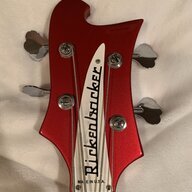
I would love to join the D Standard Club please! I have one of my Ric 4003s tuned to D Standard and it has become my favorite alternate tuning.
We don't have numbers so we can only give you a warm welcome!

btw, you should really try a custom set of StringJoy roundwounds on your 4003S. I have 50-60-80-110 on my 4003 in D and they sound awesome.
 
Last edited:
  • Like
Reactions: MrAB4003 and RodRy
Understood! My first bass was my 2008 Squier Affinity Jazz Bass, but it's currently my piccolo bass tuned in E Standard but an octave up. My D Standard bass is my 2022 Ric 4003 and I recorded a bass part today with it.
2022.... so does it have the V2 bridge? Mine doesn't because it's the 2019 version, but if sometime in the future it presents tail lift, I have a hipshot ready to mount.
 
  • Like
Reactions: MrAB4003 and RodRy
What are the practical benefits to playing in D standard? Is it moving two frets up the neck for more comfort?

That's certainly one of the practical applications of D-standard tuning.

For me personally, it's a matter of being able to tune down a song without transposing. I play in a church where a couple of leading vocalists sing a whole step lower than usual and that's when the D tuning comes in handy. Play the song the same way but a whole step lower.
 
That's certainly one of the practical applications of D-standard tuning.

For me personally, it's a matter of being able to tune down a song without transposing. I play in a church where a couple of leading vocalists sing a whole step lower than usual and that's when the D tuning comes in handy. Play the song the same way but a whole step lower.
Thank you, I feel like oblivious man, I once tried to help a young boy with his bass. He was a really tiny kid, even the Mikro he was using was too big for him. I told him to play from the fifth fret or even the seventh instead of the third to learn basic patterns . It never occurred to me to down tune his bass to D standard. What a dummy I am. He moved on to a one quarter sized violin and is still playing that instrument.