
Enjoy the benefits of a premium membership!
Upgrade Account
-
TalkBass has been independent since 1998. Add your voice.
Create a free account to reply to discussions, view embedded media, and browse with fewer display ads.
Join free Log in
Want zero display ads or expanded classifieds tools? Compare plans.
You are using an out of date browser. It may not display this or other websites correctly.
You should upgrade or use an alternative browser.
You should upgrade or use an alternative browser.
More options
Who Replied?

AbsoluDely!D standard. This is the way.


A few methods of determining gauges for strings in standard tunings and a few you can use for irregular tunings that I've gleaned on TB.
Method 1. If you feel comfortable with the feel of your highest string, than multiply it by 4/3 to obtain the next string and so on e.g
If you find 055 feels good for F than multiply it by 4/3 gives you .073 for C ( find a gauge close to that. Moving on, multiply 073 x 4/3 gives .097 for G Multiply that by 4/3 gives .130 for D
Do this in reverse. Say you are comfortable with a .120 as D than divide it by 4/3 gives .090 for G. Divide 090 by 4/3 gives .067 for C and so on gives 050 for F
Method 2
If you are happy with your top and bottom strings and want to fill in the inner strings than
do this formula : (top string gauge/ bottom string gauge)^1÷number of strings-1 e.g if one likes a 050 and a 120 for top and bottom on a 4 string bass, determine the inner strings thus (.050/.120)^(1÷3) . This gives the ratio of .746
Multiply bottom string .120 by .746 gives gauge for G of .089. Multiply .089 by .746 gives .066 for C. So we have inner gauges rounded to 090 and .065. So set of .120 .090 .065 .050
Method 3 (this works for standard and irregular tunings as it is based on semitone changes in pitch up or down.
If you like a .045 as G in E standard tuning and you want the same feel with string tuned up or down, than the formula for the gauge adjustment per number of semitones is (2^1/12)^( number of semitone change in pitch)
E.g You like a .045 for G in E standard, but you want to drop down to F for D standard than 2 semitones is the change in pitch. Do: (2^1/12)^(2) gives the ratio 1.122. Multiply 050 by this ratio gives .056 for F. If you want to increase the pitch you divide by the derived ratio e.g if for some reason you wanted to tune G 045 to A you would do .045 ÷1.122 giving .041 for A
Method 4
For each semitone change in pitch up or down, you add or subtract .005 from gauge per semitone e.g If 045 floats your boat in E standard, than dropping down to F means adding .005x2 to the gauge. So .045>>.055
The info for these methods is on TB in various places, most of which I can't recall, so I'm not giving source links. But I do acknowledge the original posters as putting this stuff out there. And of course you will have to round gauge numbers usually to the nearest gauge available.
Method 1. If you feel comfortable with the feel of your highest string, than multiply it by 4/3 to obtain the next string and so on e.g
If you find 055 feels good for F than multiply it by 4/3 gives you .073 for C ( find a gauge close to that. Moving on, multiply 073 x 4/3 gives .097 for G Multiply that by 4/3 gives .130 for D
Do this in reverse. Say you are comfortable with a .120 as D than divide it by 4/3 gives .090 for G. Divide 090 by 4/3 gives .067 for C and so on gives 050 for F
Method 2
If you are happy with your top and bottom strings and want to fill in the inner strings than
do this formula : (top string gauge/ bottom string gauge)^1÷number of strings-1 e.g if one likes a 050 and a 120 for top and bottom on a 4 string bass, determine the inner strings thus (.050/.120)^(1÷3) . This gives the ratio of .746
Multiply bottom string .120 by .746 gives gauge for G of .089. Multiply .089 by .746 gives .066 for C. So we have inner gauges rounded to 090 and .065. So set of .120 .090 .065 .050
Method 3 (this works for standard and irregular tunings as it is based on semitone changes in pitch up or down.
If you like a .045 as G in E standard tuning and you want the same feel with string tuned up or down, than the formula for the gauge adjustment per number of semitones is (2^1/12)^( number of semitone change in pitch)
E.g You like a .045 for G in E standard, but you want to drop down to F for D standard than 2 semitones is the change in pitch. Do: (2^1/12)^(2) gives the ratio 1.122. Multiply 050 by this ratio gives .056 for F. If you want to increase the pitch you divide by the derived ratio e.g if for some reason you wanted to tune G 045 to A you would do .045 ÷1.122 giving .041 for A
Method 4
For each semitone change in pitch up or down, you add or subtract .005 from gauge per semitone e.g If 045 floats your boat in E standard, than dropping down to F means adding .005x2 to the gauge. So .045>>.055
The info for these methods is on TB in various places, most of which I can't recall, so I'm not giving source links. But I do acknowledge the original posters as putting this stuff out there. And of course you will have to round gauge numbers usually to the nearest gauge available.
Last edited:
As a math tutor by profession, I love your 4 methods for determining string gauge!A few methods of determining gauges for strings in standard tunings and a few you can use for irregular tunings that I've gleaned on TB.
Method 1. If you feel comfortable with the feel of your highest string, than multiply it by 4/3 to obtain the next string and so on e.g
If you find 055 feels good for F than multiply it by 4/3 gives you .073 for C ( find a gauge close to that. Moving on, multiply 073 x 4/3 gives .097 for G Multiply that by 4/3 gives .130 for D
Do this in reverse. Say you are comfortable with a .120 as D than divide it by 4/3 gives .090 for G. Divide 090 by 4/3 gives .067 for C and so on gives 050 for F
Method 2
If you are happy with your top and bottom strings and want to fill in the inner strings than
do this formula : (top string gauge/ bottom string gauge)^1÷number of strings-1 e.g if one likes a 050 and a 120 for top and bottom on a 4 string bass, determine the inner strings thus (.050/.120)^(1÷3) . This gives the ratio of .746
Multiply bottom string .120 by .746 gives gauge for G of .089. Multiply .089 by .746 gives .066 for C. So we have inner gauges rounded to 090 and .065. So set of .120 .090 .065 .050
Method 3 (this works for standard and irregular tunings as it is based on semitone changes in pitch up or down.
If you like a .045 as G in E standard tuning and you want the same feel with string tuned up or down, than the formula for the gauge adjustment per number of semitones is (2^1/12)^( number of semitone change in pitch)
E.g You like a .045 for G in E standard, but you want to drop down to F for D standard than 2 semitones is the change in pitch. Do: (2^1/12)^(2) gives the ratio 1.122. Multiply 050 by this ratio gives .056 for F. If you want to increase the pitch you divide by the derived ratio e.g if for some reason you wanted to tune G 045 to A you would do .045 ÷1.122 giving .041 for A
Method 4
For each semitone change in pitch up or down, you add or subtract .005 from gauge per semitone e.g If 045 floats your boat in E standard, than dropping down to F means adding .005x2 to the gauge. So .045>>.055
The info for these methods is on TB in various places, most of which I can't recall, so I'm not giving source links. But I do acknowledge the original posters as putting this stuff out there. And of course you will have to round gauge numbers usually to the nearest gauge available.
For method 1, instead of dividing the gauge of the lowest string by 4/3, you can also multiply it by 3/4. That might be easier for some people should they do the method in reverse.
Method 4 is probably my favorite of the 4 methods. I thought that 45-65-85-105 was THE only option for E Standard when I was younger. But I recently found out that I like light gauge strings on my basses. In E Standard, I prefer light gauge La Bella White Tapes. I haven't tried the D'Addario rounds that I normally play in D Standard for E Standard yet. So I'm not sure if I like the extra light gauge (40-60-75-95) or light gauge (45-65-80-100).
But for D Standard, I prefer medium gauge (50-70-85-105) D'Addario rounds. If I switched to D Standard years ago, I would have been looking for heavy gauge (55-75-90-110) strings using Method 4. But those are some thick strings for me, especially the bottom two strings. Really, it's all about the feel of the strings.
I was never great at maths, but I have applied myself a little to diving deeper into mathematics in a music context. One of my favourites is doing the log10 of an interval ratio and multiplying it by 3986.3137 to obtain the cents value, which has some application if are doing fretless. You can also do log2 of the ratio multiplied by 1200 but I prefer the log 10 because the function is on my phone calculator. Thus the non tempered perfect 5th is log10(3/2)x3986.3137=701.9549. Which of course is a little sharper than a tempered 5th and why you can't tune properly by using octaves on the 5th fret of one string, which are pure, and comparing with the 7th fret harmonic p5 on the adjacent string on ET instruments such as a fretted bass. Anyhow, I digress. Thanks for your positive comments.As a math tutor by profession, I love your 4 methods for determining string gauge!
For method 1, instead of dividing the gauge of the lowest string by 4/3, you can also multiply it by 3/4. That might be easier for some people should they do the method in reverse.
Method 4 is probably my favorite of the 4 methods. I thought that 45-65-85-105 was THE only option for E Standard when I was younger. But I recently found out that I like light gauge strings on my basses. In E Standard, I prefer light gauge La Bella White Tapes. I haven't tried the D'Addario rounds that I normally play in D Standard for E Standard yet. So I'm not sure if I like the extra light gauge (40-60-75-95) or light gauge (45-65-80-100).
But for D Standard, I prefer medium gauge (50-70-85-105) D'Addario rounds. If I switched to D Standard years ago, I would have been looking for heavy gauge (55-75-90-110) strings using Method 4. But those are some thick strings for me, especially the bottom two strings. Really, it's all about the feel of the strings.
Last edited:

Method 1 for me makes the most sense to divide by .75 going forward or multiply by .75 going reverse.
.055 / .75= .073
.073 x .75 = .055
Much easier on my machinist eyes
.055 / .75= .073
.073 x .75 = .055
Much easier on my machinist eyes
No problem! Common logs (log 10) are much easier to work with than logs with a base of 2 in general. I'd rather not have to deal with the change of base (no pun intended) formula if I don't have to. That being said, I appreciate you diving in deeper by applying the math to music. I have students ask me "when am I going to use this stuff?" all the time. And part of my job is to explain to them how they can use whatever we're learning. If I have an Algebra 2 or Pre-Calculus student who likes music, I will bring this up to them!I was never great at maths, but I have applied myself a little to diving deeper into mathematics in a music context. One of my favourites is doing the log10 of an interval ratio and multiplying it by 3986.3137 to obtain the cents value, which has some application if are doing fretless. You can also do log2 of the ratio multiplied by 1200 but I prefer the log 10 because the function is on my phone calculator. Thus the non tempered perfect 5th is log10(3/2)x3986.3137=701.9549. Which of course is a little sharper than a tempered 5th and why you can't tune properly by using octaves on the 5th fret of one string, which are pure, and comparing with the 7th fret harmonic p5 on the adjacent string on ET instruments such as a fretted bass. Anyhow, I digress. Thanks for your positive comments.

Of course. It's the same thing. 4/3=3/4=.75. 4/3 is just kind of keeping it in the tuning context I spose, with 4ths tuning for example. A pure P4 having the ratio of 4/3. But the multplication or division by .75 is easier for sureMethod 1 for me makes the most sense to divide by .75 going forward or multiply by .75 going reverse.
.055 / .75= .073
.073 x .75 = .055
Much easier on my machinist eyes
That is a good way to spark interest in music by linking some maths with it. Have them memorise the 12th root of 2 to 20 significant places and point out that frets are placed on a bass or guitar using that number in conjunction with the scale length. You probably get a few 'oh wow!'No problem! Common logs (log 10) are much easier to work with than logs with a base of 2 in general. I'd rather not have to deal with the change of base (no pun intended) formula if I don't have to. That being said, I appreciate you diving in deeper by applying the math to music. I have students ask me "when am I going to use this stuff?" all the time. And part of my job is to explain to them how they can use whatever we're learning. If I have an Algebra 2 or Pre-Calculus student who likes music, I will bring this up to them!
Last edited:
It is good to apply oneself to formulating string gauges if you want to have some control over tension disparities that are sometimes very marked in E standard sets .eg D and A are stand outs tension wise compared to E and G in the common 45 65 85 105 sets. Most folks aren't too bothered by this in E standard. But picking the right gauge to get the right feel is a bit trickier the lower you go imho
Last edited:
I'm all for method 5.
What? Yes, the last method of all, the one that has no calculations and says: just play the bass as you like it.
What I mean to say is, calculations are ok, but what it ultimately comes down to is if your bass plays well for you, yes you, because we all have our own preferences and peculiarities.
So, that usually means, slap on the strings, tune it right (in D of course) and play it Sam!
What? Yes, the last method of all, the one that has no calculations and says: just play the bass as you like it.
What I mean to say is, calculations are ok, but what it ultimately comes down to is if your bass plays well for you, yes you, because we all have our own preferences and peculiarities.
So, that usually means, slap on the strings, tune it right (in D of course) and play it Sam!

The first three FTW ...but I'm in the same boat, or floating near it (very math-challenged), as @DustyBottom!Method 4
For each semitone change in pitch up or down, you add or subtract .005 from gauge per semitone e.g If 045 floats your boat in E standard, than dropping down to F means adding .005x2 to the gauge. So .045>>.055
Method 4 is not very reliable though: a 005 increase is barely significant for strings over 100, a huge deal for those in the 40-50 range.
Strings are expensive, and you can't return them if you get it wrong. Pays to get close to getting it right before a purchase imhoI'm all for method 5.
What? Yes, the last method of all, the one that has no calculations and says: just play the bass as you like it.
What I mean to say is, calculations are ok, but what it ultimately comes down to is if your bass plays well for you, yes you, because we all have our own preferences and peculiarities.
So, that usually means, slap on the strings, tune it right (in D of course) and play it Sam!
Yeh the 005 breaks down once you start wanting to calculate for the bottom string e.g 105>115 is still a bit slack for D1 in my opinion. At least for normal core and low tension strings. 110 with a Jamerson works ok as D as per Pino Palladino. I've found it ok as D. A 120 or 125 would be better I reckon. A .136 low tension TI flat would is probably passable as D1. I haven't tried it. It is very low tension for B0, so tuning it to D is likely a good outcome if one was to dislike it as B. You could use the other strings in the 5iver set for GCF so 136 100 070 056 for the D tuning. Anyone tried this?. I've wanted to, but TI's 5 string set is damn expansive if it doesn't feel okThe first three FTW ...but I'm in the same boat, or floating near it (very math-challenged), as @DustyBottom!
Method 4 is not very reliable though: a 005 increase is barely significant for strings over 100, a huge deal for those in the 40-50 range.
Last edited:
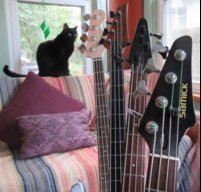
I used the method of what I had on the bass.I'm all for method 5.
What? Yes, the last method of all, the one that has no calculations and says: just play the bass as you like it.
What I mean to say is, calculations are ok, but what it ultimately comes down to is if your bass plays well for you, yes you, because we all have our own preferences and peculiarities.
So, that usually means, slap on the strings, tune it right (in D of course) and play it Sam!
My D-tuned bass is a Squier Jazz with Fender stainless flats. I played it for a while in standard tuning, then tuned it to Eb to work on some Stevie Ray Vaughn songs, then tuned it down to D when I found out about this thread. Huh, strings feel fine in all three tunings.
Lucky dog!
And what if things didn't feel fine? You'd have to do some homework he heI used the method of what I had on the bass.
My D-tuned bass is a Squier Jazz with Fender stainless flats. I played it for a while in standard tuning, then tuned it to Eb to work on some Stevie Ray Vaughn songs, then tuned it down to D when I found out about this thread. Huh, strings feel fine in all three tunings.
Lucky dog!
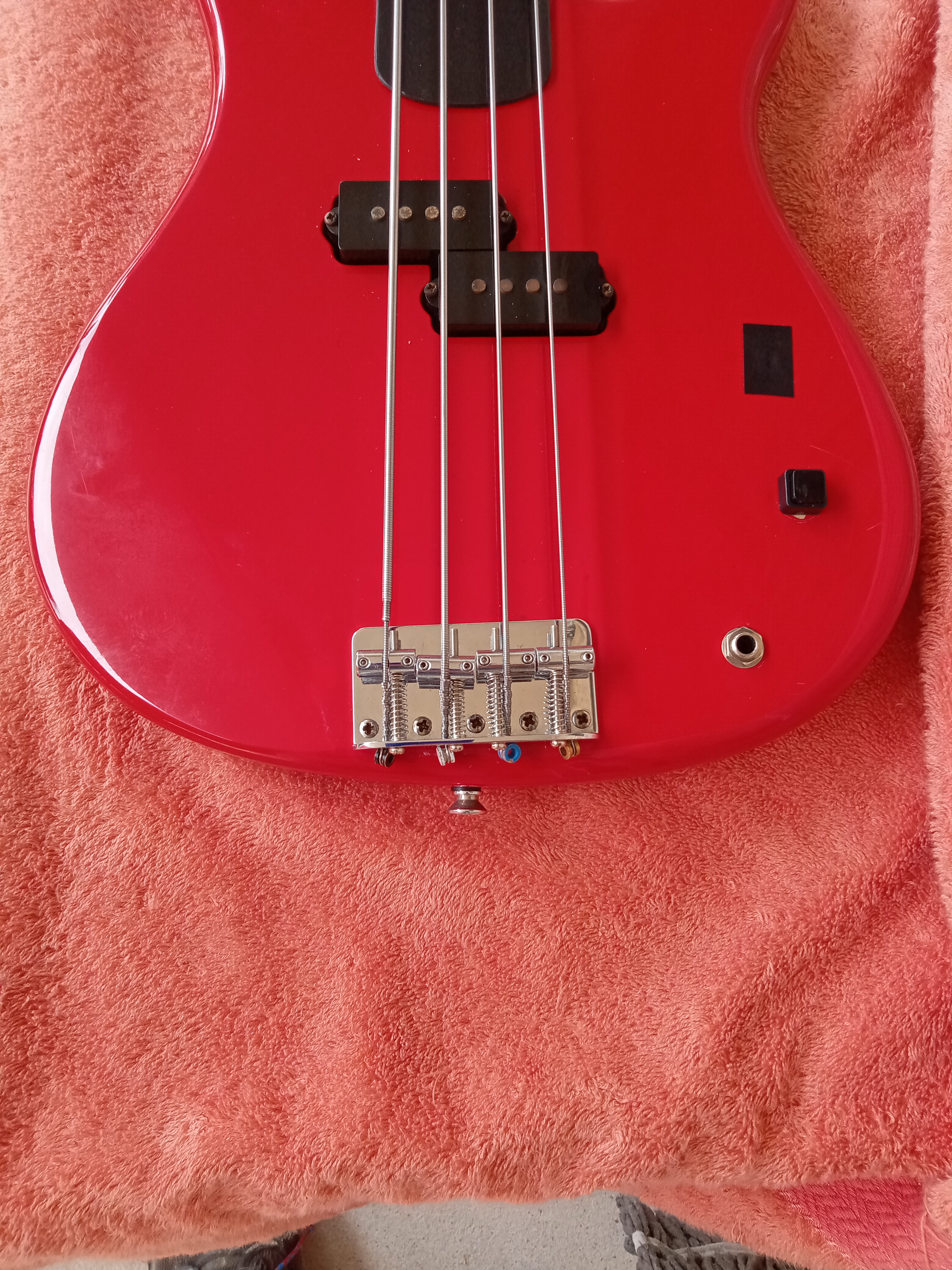
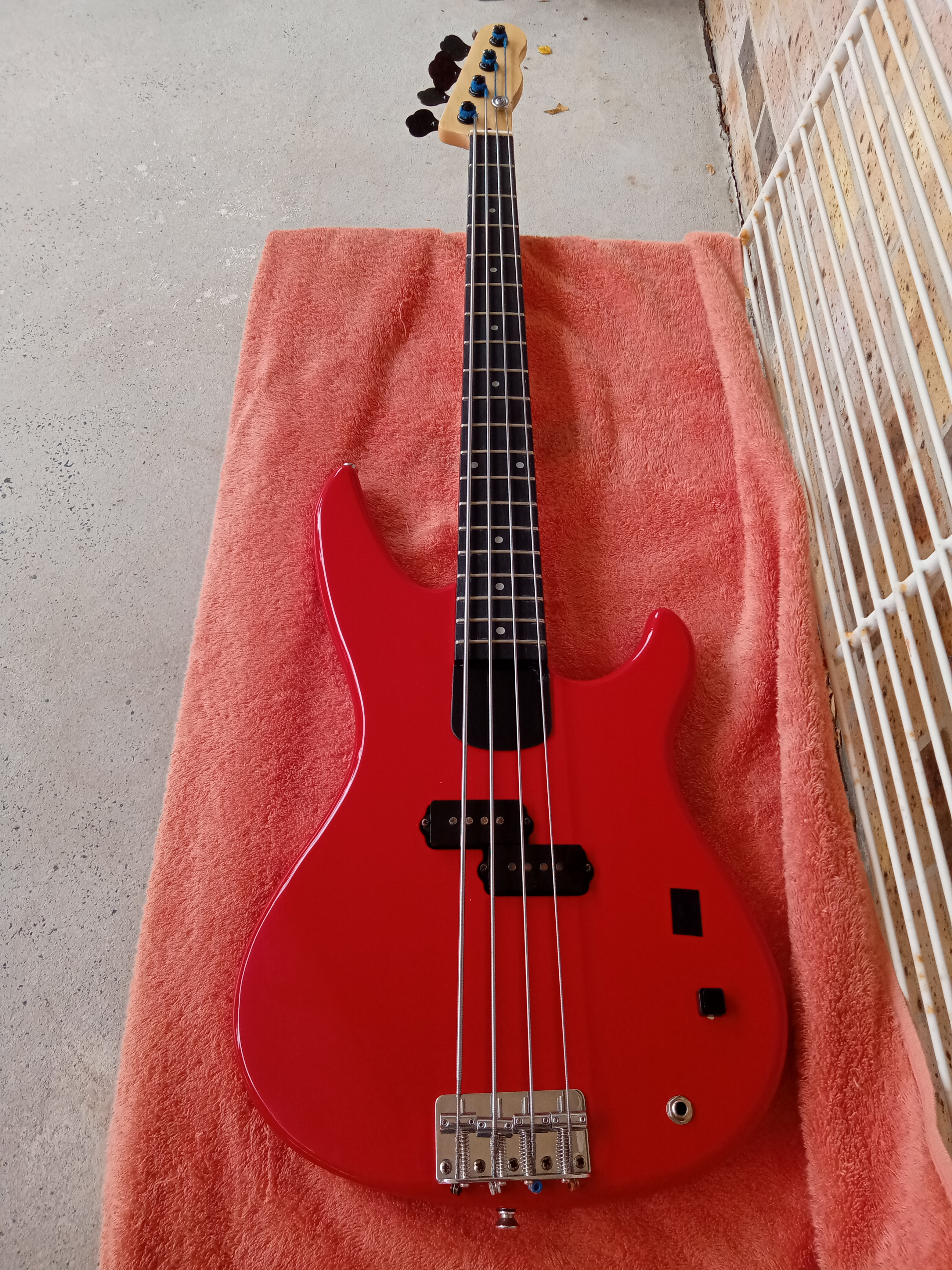
A few pics of my split coil parts bass, with the Jamersons 128T 095 073 052 tuned up from C# to D standard. A little extra tension with the 128T instead of the 110 for D but I feel the 128T is better as D than the 110. Factoring in around 5% extra tension with the Jamersons ( just a guess using Roto77's as a comparison) the overall tension is possibly 183lbs. Which is around the same tension as a standard 45-105 set of rounds tuned to E standard on a 34" scale bass. So the Jamersons so tuned don't stress the neck in anyway and the truss rod doesn't need a tweak if going from E standard down to D standard with these string gauges. The action needed a slight tweak. I'd already done some nut work on the nut, because I initially was doing BEAD with this neck, using slightly larger gauged Chromes. Note the D saddle intonating fwd of the other saddles. I guess due to the taper. Nice strings with a split coil. Very smooth feel. Nice low tone, especially with a simulated tone knob on zero via wired straight to output with no pots, an a 068uf cap in parallel.Next up I want to try the TI 5iver set using the 136 100 070 056 as DGCF. Have to save some pennies first he he

Last edited:
Boo boo in a previous post of mine. Rotosound 77's have 10% more tension than equivalent gauged Chromes. I have compared a Rotosound 77 050 with the La Bella Jamerson 052 and they felt pretty much the same stiffness to me but I don't think that translates to having 10% more tension than Chromes like the Rotos do. Maybe they just feel more tense than normal la bellas, but it's an illusion created by the thicker core and resulting stiffness. Anyhow, I find these Jamersons are great for this tuning.
Last edited:
My shopping list of strings to try involves 2 sets at the opposite end of the spectrum to the Jamersons.
la bella LTF 5 A using the 118 100 075 056 for DGCF .
TI JF345 using the 136 100 070 056 for DGCF
I also want to try out the larger gauged Roto77's ( I've used an 050) That will involve buying singles 130 095 075 050 for DGCF.
The Chromes I like to use sit between these two extremes.
la bella LTF 5 A using the 118 100 075 056 for DGCF .
TI JF345 using the 136 100 070 056 for DGCF
I also want to try out the larger gauged Roto77's ( I've used an 050) That will involve buying singles 130 095 075 050 for DGCF.
The Chromes I like to use sit between these two extremes.
Last edited:


