• TalkBass has been independent since 1998. Add your voice.
    Create a free account to reply to discussions, view embedded media, and browse with fewer display ads.
    Join freeLog in
    Want zero display ads or expanded classifieds tools? Compare plans.

D Standard Club (DGCF)

I revisited a DGCF-tuned bass this week, which has a detuner—I think the D can usually use a slightly thicker gauge to match the rest of a set, especially if there is some drop C involved.

The bass had Lo Riders with gauges .110 .085 .065 .045, which are decent, good with a pick. Now has DR Pure Blues .120 .090 .070 .050 which are a bit brighter & smoother sounding and more responsive & snappy in terms of touch. I’m still working the setup, but slightly thicker strings means slightly tighter tension that supports slightly lower action, so good things… I wish there was a good set DR string tension charts. If these equate to other charts, this .120 - .050 set is roughly 39-40 lbs for each string. This string change met my goals at this time, and I could see using the Lo Riders again if I was focused on pick playing this bass and wanted the Lo Riders sound.
 
The bass had Lo Riders with gauges .110 .085 .065 .045, which are decent, good with a pick. Now has DR Pure Blues .120 .090 .070 .050 which are a bit brighter & smoother sounding and more responsive & snappy in terms of touch. I’m still working the setup, but slightly thicker strings means slightly tighter tension that supports slightly lower action, so good things… I wish there was a good set DR string tension charts. If these equate to other charts, this .120 - .050 set is roughly 39-40 lbs for each string. This string change met my goals at this time, and I could see using the Lo Riders again if I was focused on pick playing this bass and wanted the Lo Riders sound.

I personally prefer hex core over round core for down-tuning. Pure Blues (round core) 50-120 may have more tension (as in pulling weight) but Lo-Riders (hex core) provide more of the stiffness/firmness I like even with smaller gauges.
 
How have I not found this club yet LOL.

I've been tuning my 6 strings to D standard for almost a decade now.

It is far more convenient having access to Eb and the low Bb, I started doing it in highschool when I mirrored tuba parts playing electric bass in concert band. It was super helpful for the gospel gig I did for a while, and works beautifully for my metal music. Now I just use the same bass for everything, it might confuse guitar players but it doesn't take much to confuse guitarists anyway so what's the difference? 😄

I used pretty heavy strings for a while but now I use a .160 - .035 set on my 35" scale and a .154 - .035 on my 37" multiscale for ADGCFBb. Around 46lbs of tension on each string. Big strings also just sound better imo. Many benefits to the D standard world.
 
I personally prefer hex core over round core for down-tuning. Pure Blues (round core) 50-120 may have more tension (as in pulling weight) but Lo-Riders (hex core) provide more of the stiffness/firmness I like even with smaller gauges.

I totally get that. I like experimenting with a few options. I do wish there were a few gauge options more readily available in some cases.
 
Thinking of trying D standard tuning to see if that keeps me happy enough to not buy a 5-string bass. Much of the stuff I like to play has d and e flat notes. I read the whole thread but have a couple questions though. I will be mostly pick playing so what would be a good set of strings to start this journey with that aren't floppy when down tuned? Also, given the choice between an active Stingray or a passive Jazz which do you think would be better suited for D standard tuning?
 
  • Like
Reactions: MrAB4003
Thinking of trying D standard tuning to see if that keeps me happy enough to not buy a 5-string bass. Much of the stuff I like to play has d and e flat notes. I read the whole thread but have a couple questions though. I will be mostly pick playing so what would be a good set of strings to start this journey with that aren't floppy when down tuned? Also, given the choice between an active Stingray or a passive Jazz which do you think would be better suited for D standard tuning?
You have come to the right place! Tuning my 4 string basses to D Standard has also prevented me from getting a 5 string bass. But if I were to acquire a 5 string, I would tune it A-D-G-C-F. I love having the low D and Eb, open low G string, and a fretted low E. The only thing I had to get used was having the E2 at the ninth fret of the G string. Playing in E is a little awkward, but nothing I couldn't get used to.

Either medium gauge (around 50-105) flats or heavy gauge (around 55-110) rounds will work. I play 50-105 D'Addario Chromes and 45-105 Rotosound 77s in D Standard and the tension is fantastic for both sets of strings. Avoid tapewounds because they're made for standard tuning. I tried that a few years ago and they kept going out of tune because they were floppy.

You can tune any bass you want to D Standard. I would experiment with both the Jazz Bass and the Stingray and see what sounds best to you.
 
I took off my SH77 Rotosounds, because the feeling of the strings was not really getting me where I want to be.
Since a bass needs strings, I decided to try out the Fender 9050 flats in 55-105 before ordering Chromes in .105,
because the Fenders have a .090 A string. They came, I put them up and instantly liked them a lot better than either the Chromes or the Rotos.
The play-in period where they sound too bright to my ear did not take long - they seem to fade qickly. I'm curious as to how their life span will look like, but given that they are quite cheap, I think I could live with changing them out every three years or so.
 
trying D standard tuning to see if that keeps me happy enough to not buy a 5-string bass
The reason why I started with D Standard was because I was applying for a band gig where I would have to replace a 5-string player.
I haven't got the gig (well, I did a few small "semi-acoustic" gigs with a subset of that band) but the D Standard proved to be useful, so that now that I finally got an upright bass, I even play it in D Standard, too.

Playing in E is a little awkward
In case of "emergency" – like jamming on Billy Cobham's "Stratus" – a capo is my friend. :)
I also invented an upright bass capo since there doesn't seem to exist such a thing in the whole wide world.

what would be a good set of strings to start this journey with that aren't floppy when down tuned?
I'm using Elixir, and I think it's a kind of "light top medium bottom" set. Both on an Ibanez SR1200 and a Fender Jazz fretless. On an old fretted Jazz clone I have flats, probably D'Addario.

But frankly, I don't really worry much about strings. I'm just adapting my right hand technique as I go. I play mostly with fingers these days.

Even on the upright, I use Spirocore Orchestra Light. With 101 cm, it's rather a short scale bass though. And I actually like the "floppyness" of the low D. But I play mostly blues and similar, so this kind of "artifacts" fits this "lo-fi" type of genre. :D
 
Both the jazz and the stingray classic currently have dunlop super bright nickels on them. Pretty easy on the fingers but i'm trying to get my pick skills up and they feel a bit floppy and inefficient for my current pick capabilities. I was hoping I could kill two birds with one stone by dropping to d standard tuning and not needing a 5 string while also getting a string that has less flex to make 16th note runs a bit easier. I also have a p with labella flats on it so im not against stiffer strings but I don't like really rough strings.

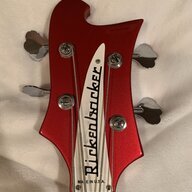
I have a couple of other basses also (p's, rickenbacker) but the reason I am asking about these basses is they have more extended lows and I wasnt sure if an active bass (stingray) would make for a better drop tuning bass than a passive (jazz) one.
 
  • Like
Reactions: MrAB4003
Both the jazz and the stingray classic currently have dunlop super bright nickels on them. Pretty easy on the fingers but i'm trying to get my pick skills up and they feel a bit floppy and inefficient for my current pick capabilities. I was hoping I could kill two birds with one stone by dropping to d standard tuning and not needing a 5 string while also getting a string that has less flex to make 16th note runs a bit easier. I also have a p with labella flats on it so im not against stiffer strings but I don't like really rough strings.

I have a couple of other basses also (p's, rickenbacker) but the reason I am asking about these basses is they have more extended lows and I wasnt sure if an active bass (stingray) would make for a better drop tuning bass than a passive (jazz) one.
The difference in notes from E1 to D1 is a whole tone. That’s not much in the way of extended lows. So my opinion stands about using any bass you want.
 
Both the jazz and the stingray classic currently have dunlop super bright nickels on them. Pretty easy on the fingers but i'm trying to get my pick skills up and they feel a bit floppy and inefficient for my current pick capabilities. I was hoping I could kill two birds with one stone by dropping to d standard tuning and not needing a 5 string while also getting a string that has less flex to make 16th note runs a bit easier. I also have a p with labella flats on it so im not against stiffer strings but I don't like really rough strings.

I have a couple of other basses also (p's, rickenbacker) but the reason I am asking about these basses is they have more extended lows and I wasnt sure if an active bass (stingray) would make for a better drop tuning bass than a passive (jazz) one.
Dunlop Super Brights are quite flexible due to the thin core wires used; they're not very well suited for down-tuning.

I use the DR DDT 45-105 on a Fender Jazz for DGCF. They're specifically designed for down tuning with a thicker-than-average core wires. I'm usually not a stainless steel guy but I like them because they're not as rough and grabby as some stainless steel rounds.

If you want to stick with nickel rounds, I can suggest the SIT Power Wound Nickels 50-110 for DGCF. They're high quality strings that are relatively inexpensive. I use the 40-100 set for EADG.
 
Thinking of trying D standard tuning to see if that keeps me happy enough to not buy a 5-string bass. Much of the stuff I like to play has d and e flat notes. I read the whole thread but have a couple questions though. I will be mostly pick playing so what would be a good set of strings to start this journey with that aren't floppy when down tuned? Also, given the choice between an active Stingray or a passive Jazz which do you think would be better suited for D standard tuning?
I am finding EB Cobalt flats pleasing for D standard. Often with a pick.
 
Yeah, going to put them on the Stingray. Having the extra active eq controls seem like a good option when dealing with a new set of strings that i'm not familiar with.
I think you made a wise choice. Turn up the bass and you can really shake the room with the open low D! That's one of my favorite parts about D Standard tuning. Enjoy your Stingray and welcome to the club officially!
 
New convert here to D standard tuning.
I love it. Extended range and easy to transpose the fingerboard one step.
Still using the same flats 45-105 Chromes on a 32” scale J bass for D tuning.

If I wanted to try LaBellas Deep Talking Flats what gauge would I want?
My bass is 32” scale, top loaded or string through.
When I was digging through the DTFs choices I wasn’t finding string through medium scale as an option.
Should I just stick to top loading strings on bridge?
 
  • Like
Reactions: Crispus

Latest posts