• TalkBass has been independent since 1998. Add your voice.
    Create a free account to reply to discussions, view embedded media, and browse with fewer display ads.
    Join freeLog in
    Want zero display ads or expanded classifieds tools? Compare plans.

Double Bass DB forum "what books are you reading" thread

My Dad was in France, Belgium and Germany, received his third wound, purple heart and ticket home in the Ardennes. Recently went to Bastogne with wife and daughter and relished the experience of walking through the foxholes at Bois Jacques and telling my daughter the few stories he shared. But it was very few stories, like most he did not talk about it much and when there was all the press of the 60th anniversaries he had a lot of PTSD come back.
I'm trying to recall the name of a book that led to a lot of discussion with older vet friends and relatives. The main subject is the difference in the treatment of unsuccessful field commanders in the US army in our various wars. I was drafted during Viet Nam and was trained for but never served in combat. This gave me a little more credibility with some older vets up to a point. Some of their stories would take on a different level of detail and tone for this reason, but also led to conversations that, due to different experiences, politics, and treatment once we returned home, could turn quite problematic to say the least. Some of the info in this book gave me insight into how our two generations perceived these differences. If anyone is familiar with this book I would appreciate getting the title.
 
Last edited:
  • Like
Reactions: jthisdell
Just finished Warren Zane’s (formerly of the Boston punk band Del Fuegos, he’s now a college professor!) book on the making of Bruce Springsteen’s album “Nebraska”. Time to pull that LP off the shelf and spin it again!

I really enjoyed Zanes' biography of Tom Petty. Love a good "making of" book (e.g., Ashley Kahn's chronicle of "Kind of Blue"), will have to check this out.
 
  • Like
Reactions: Keith Rawlings
For more than twenty years I have been looking for a writer who would explore the concept of death in a philosophical sense. This was important for me because I did not find understanding among friends and family, and did not see the right words in books. A feeling of emptiness and hopelessness, the transience of all events and the insignificance of any phenomena in comparison with the absoluteness of death. Treatises on existence and life, the emptiness of things, etc. are not important to me.

As a result, I found Albert Camus in a completely incredible way. He seemed to be on his way to understanding the life-death dualism and had found the words to express this understanding. I'm talking about the essay The Myth of Sisyphus (Le Mythe de Sisyphe, 1942) This was 10 years ago or so. Until now I have not read anything more obvious and more obscure.

Two years ago I read the novel The Stranger (L'Étranger, 1942). This piece really surprised me. I read it in translation, but it seems the translator found the key to understanding Camus. This is a very detached, “empty”, surprisingly atmospheric novel. A film was made based on it, but even the talent of actor Marcello Mastroianni cannot convey the feeling of reading the text and relating oneself to the hero. I have been in a detached state for many years, without feeling the taste and smell of life, so this book turned out to be understandable to me.

I recently finished reading the unfinished novel The First Man (Le premier homme, 1960, publ.1994). Camus died early and did not have time to say much. The novel First Man is actually an autobiography, and I learned a lot, as if becoming friends with the young Camus, although we are several generations apart. The second chapter, the first part, is very different from the rest of the story. She said a lot of things that I myself wanted to express, but could not find the words.

Camus is a unique writer and a unique philosopher who went through a very difficult path of knowing death outside of death and knowing life outside of life.
I hope to read all of his books, but each one requires a lot of work and a lot of thought on my part.
 
+1 on all of this. I'm currently reading Jodi Picoult's "The Storyteller" and it brings up the same feelings in me. It's largely about the Holocaust and the people who lived through it, and how they are loathe to talk about it afterward. Characters in the book who at first don't seem to have much to say turn out to have endured some of the most horrific experiences imaginable, but you don't discover that until much later. What you said about your dad reminded me of this all over again.
Chris, We can learn so much from those who’ve gone before us and hopefully become more aware and more compassionate. On this forum we constantly reference the giants of jazz. These first person accounts provide so much insight, life and context into historical events.
 
This book has probably been discussed here before. I just finished Bill Harrison's Making the Low Notes: A Life in Music, and I found it to be a great read—highly entertaining with loads of scenarios that I could relate to, and also a lot of deep thinking about what it means to be a professional musician. Yeah, Bill!

Other than that, I enjoyed Invalid Link Removed— also excellent. It's a look through the history of jazz at the relationships and connections between musicians and mobsters (many of whom are the managers, agents, club owners, record distributors and folks on the periphery of the business).

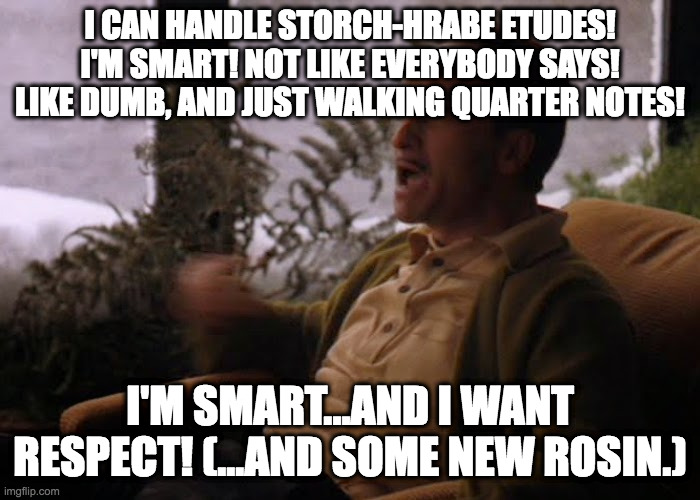
Oh, and I've been reading through Storch-Hrabé, 57 Etudes ... but that's not such a page turner ;)
 
As an Amazon Associate, TalkBass may receive commissions from qualifying purchases made via links on this site.
824kk5.jpg
 

I like the whole Storch-Hrabe series:

"The Secret of the Old Mill"
"The Sinister Signpost"
"The Ghost at Skeleton Rock"
"The Mystery of the Aztec Warrior"
"Danger on Vampire Trail"

Oh...wait...sorry, I'm looking at the wrong section of my bookcase! ;)

Sorry for the diversion!
 
I like the whole Storch-Hrabe series:

"The Secret of the Old Mill"
"The Sinister Signpost"
"The Ghost at Skeleton Rock"
"The Mystery of the Aztec Warrior"
"Danger on Vampire Trail"

Oh...wait...sorry, I'm looking at the wrong section of my bookcase! ;)

Sorry for the diversion!

…and don’t forget the most traumatic of all etudes:

upload_2023-10-11_7-2-47.jpeg
 
I’m going through and rereading a bunch of books I read in my youth 20+ years ago that really shaped my world-view. I’m on the J Krishnamurti stuff right now, and talk about a living text! Feels like dude is right in the room with me.

image.jpg


Considering reading the whole Carlos Casteneda series next, but I don’t know if I can hang with those later books again…
 
I’m going through and rereading a bunch of books I read in my youth 20+ years ago that really shaped my world-view. I’m on the J Krishnamurti stuff right now, and talk about a living text! Feels like dude is right in the room with me.
In my young 20s I hung out with a bunch of players with laser-focus on Pat Martino's numerology work and Krishnamurti. Nights into mornings at the 24-hour deli, "Murti, man . . . check this out. . . the guy was totally sick." Thanks for the chance to visit.

I'm re-reading William Gibson's 21st-century classics. After a second swing through The Peripheral I'm now back onto Agency. If we are really lucky 75-yo Mr. Gibson will finish Jackpot for us . . .

The one that resonates the deepest is still Pattern Recognition from 2002. I'm built for it, and its author.
 
Last edited:
  • Like
Reactions: Inky13 and JBarz
I'm a great listener of audiobooks—especially since I'm on near-continuous duty as a chauffeur for my 15-year-old daughter. I just finished Patrick Stewart's autobiography "Make It So", read by the author in his inimitable, creaky 80-something Picard voice. It's a good—if long—listen, particularly around his early impoverished life in Yorkshire and the backstage theatre stories. He's circumspect about his colourful colleagues: I really thought there'd be more about Ian McKellen, but there's a remarkable story about Ian Holm's abrupt departure from live theatre. Stewart spends rather little time on the various Star Trek franchises, not surprising since he sees himself primarily as a stage actor who lucked out with the fame that STNG brought him. I didn't end up particularly liking the man, but perhaps that's the sign of a good autobiography. Long life does render opportunity for critical self-reflection. A sample snippet at the end of the audiobook has led me to Stewart's one-man reading of "A Christmas Carol". It's just terrific: the product of his very well-received one-man stage play. Great listening for this time of year.

On another front, I'm slowly finishing bassist/producer Tony Visconti's autobiography "Tony Visconti: the Autobiography: Bowie, Bolan and the Brooklyn Boy". It's an interesting look into the low rent recording industry in London during the 60's and 70's, especially wrt to the slow-rising fame of David Bowie and Mark Bolan (T-Rex). I hadn't realized that Visconti was married to Mary Hopkin of "Those Were The Days" and "Goodbye" fame, and the bohemian life backstory for so many famous artists is nearly as interesting as the music bits.

Finally, I'm re-reading H.G. Wells' "War Of The Worlds" which I hadn't looked at since I was a teenager. I've been most struck by how much Steven Spielberg's film version captured the feel, if not the narrative details, of the Wells source. I'd long been a fan of the 1953 film version with Gene Barry and Ann Robinson and had more or less dismissed Spielberg's version (other than really enjoying a couple of set pieces like the first emergence of the alien walker). However, I've been reminded that Wells' version tells the story from the viewpoint of a refugee from the invaders who is at best at the periphery of the main events. That's also Spielberg's take, perhaps most clearly shown in the battle with the aliens on the other side of a hill, all muffled explosions and flashing lights as the refugees run away and Tom Cruise's character's son charges into it.
 
Last edited:
Darwin's Origin of Species. I gotta admit it's boring, but worthwhile. It's quite interesting to see what kind of effort was required to understand scientific problems when they were first formulated, due to the severely limited tools that people had at their disposal. For instance, statistics was in its infancy, genetics had been discovered but Darwin didn't learn about it, and of course DNA was a century away. Today, those things make it so much easier to understand, that we start with them.
 
  • Like
Reactions: jthisdell