
Enjoy the benefits of a premium membership!
Upgrade Account
-
TalkBass has been independent since 1998. Add your voice.
Create a free account to reply to discussions, view embedded media, and browse with fewer display ads.
Join free Log in
Want zero display ads or expanded classifieds tools? Compare plans.
You are using an out of date browser. It may not display this or other websites correctly.
You should upgrade or use an alternative browser.
You should upgrade or use an alternative browser.
Dead spot removal
- Thread starter johnk_10
- Start date
More options
Who Replied?

- Feb 16, 2008
- 21,240
- 23,633
- Disclosures
- John K Custom Basses

I was all set to do this to my bass, but sadly in testing with c-clamps, it was determined that I'd need between 3-6 oz of weight to fix my dead spot. Two ounces would've been ok, but more than 3 is just too much weight to add. Looks like I'll be trying my luck with a new neck.
- Feb 16, 2008
- 21,240
- 23,633
- Disclosures
- John K Custom Basses
if you have heavy machine heads, you can try getting lighter ones, as less mass can also be a solution for dead spots.
My solution - with my Squier P-bass - was to up the gauge of the strings - from a 45 G string to a 49. That placed the 'D' (7th fret) resonance I had closer to, but not right at, Db. I can get an acceptable amount of sustain (if I try really hard) even on the Db - or is that a C#?  I like the feel of the "medium" gauge flatwound set I now use better than the lights that came with the instrument, anyway.
I certainly will consider trying your solution! Excellent information.
I like the feel of the "medium" gauge flatwound set I now use better than the lights that came with the instrument, anyway.I certainly will consider trying your solution! Excellent information.

Were you not able to use all four screws on the back of the tuners?
Are you only able to use two?
That is a VERY slick solution.
Awesome job.
Are you only able to use two?
That is a VERY slick solution.
Awesome job.
- Feb 16, 2008
- 21,240
- 23,633
- Disclosures
- John K Custom Basses
My solution - with my Squier P-bass - was to up the gauge of the strings - from a 45 G string to a 49. That placed the 'D' (7th fret) resonance I had closer to, but not right at, Db. I can get an acceptable amount of sustain (if I try really hard) even on the Db - or is that a C#?
I certainly will consider trying your solution! Excellent information.
thanks.

i've tried many different types (rounds, flats, half rounds, nickel, stainless etc) and gauges (.040-.095, .045-.100 & .049-.105) of strings to eliminate (or at least minimize) dead spots, and while some strings make a little bit of difference, the resonant frequency of the neck is really the issue (not the gauge), so changing the weight/mass of the headstock is the only real solution that i had success with.
Were you not able to use all four screws on the back of the tuners?
Are you only able to use two?
That is a VERY slick solution.
Awesome job.
thanks. i used all four mounting screws to remount them.


Great thread! I just got my new Warmoth Jazz 5 put together and sure enough - it has a slight dead spot at 7th fret on the G.
Put a little C clamp with some small wood scraps for protection in the middle of the headstock and bingo - sustain city on the same note.
I do have hipshot ultralight 1/2" clover tuners on it though - so I will have to think of someplace good for that tungsten. It would be cool if they made a really heavy string retainer. Then you could add the weight and it would be in disguise without any real mods. Maybe a heavy "strap button" to screw on the back of the headstock for a retro look.
Put a little C clamp with some small wood scraps for protection in the middle of the headstock and bingo - sustain city on the same note.
I do have hipshot ultralight 1/2" clover tuners on it though - so I will have to think of someplace good for that tungsten. It would be cool if they made a really heavy string retainer. Then you could add the weight and it would be in disguise without any real mods. Maybe a heavy "strap button" to screw on the back of the headstock for a retro look.
Good stuff!
I recall reading a post only yesterday that said the only way to get rid of a dead spot was to buy a new neck.
Love the Jazzmaster basses, BTW.

Hi all. I'd like to contribute a little

In 1990 I bought a costum-build bass. It had no dead spots anywhere. However it got badly burned in a studio fire. The body couldn't be saved however the neck survived!
SO, i had a new body made (by the same bass-builder and the same sort of wood), and here comes the funny part. I now have a a couple of dead spots. One spot in particular is on the high A on my G string, there's almost NO tone at all. It becomes an overtone almost straight away.
So that tells me that a new neck won't necessarily do the trick!.
- Feb 16, 2008
- 21,240
- 23,633
- Disclosures
- John K Custom Basses
IMO, the neck could have changed its resonant frequency due to the fire with all of that heat. so still think that the dead spots are in the neck. IME, it's extremely rare that a body could create one.

IMO, the neck could have changed its resonant frequency due to the fire with all of that heat. so still think that the dead spots are in the neck. IME, it's extremely rare that a body could create one.
Just read you post about affecting dead spots with string changes and I've noticed that too. It's not a fix as you say but it seems the right strings can lessen them.

I'm going to throw out my uneducated opinion as to why this works. This is the Internet after all, and I can pretend to be an expert! 
The vibrating string is anchored at two points (nodes): the bridge and the nut. The greatest mass is at the bridge end, the least at the nut end. This means that there is less mass at the headstock for the the string's vibration to move, thus it is affected more.
When you play that dead note and feel the neck vibrating, all that energy that usually stays in the moving string is transferred to the neck that is now vibrating in sympathy with that pitch. The neck is absorbing the vibration at that frequency, rather than resisting it.
Maybe the cause is different wood densities in the neck, or the way the truss rod is contacting the wood. Or both; or more.
By adding weight at the most active end of the wavelength - the node at the neck - it now requires more energy to get that greater mass moving to cause that sympathetic vibration.
Adding weight to the heel would not help because it is roughly in the middle of the wavelength, and not anchoring the string at an endpoint where the energy is concentrated. It isn't just adding or removing mass that helps, it is counteracting the movement of the existing mass in motion that is needed.
It would be interesting to see if there is any mathematical relationship between the harmonics of the dead note's frequency and and the ideal position of the added weight at the headstock.
IMHO. YMMV. LSMFT.
The vibrating string is anchored at two points (nodes): the bridge and the nut. The greatest mass is at the bridge end, the least at the nut end. This means that there is less mass at the headstock for the the string's vibration to move, thus it is affected more.
When you play that dead note and feel the neck vibrating, all that energy that usually stays in the moving string is transferred to the neck that is now vibrating in sympathy with that pitch. The neck is absorbing the vibration at that frequency, rather than resisting it.
Maybe the cause is different wood densities in the neck, or the way the truss rod is contacting the wood. Or both; or more.
By adding weight at the most active end of the wavelength - the node at the neck - it now requires more energy to get that greater mass moving to cause that sympathetic vibration.
Adding weight to the heel would not help because it is roughly in the middle of the wavelength, and not anchoring the string at an endpoint where the energy is concentrated. It isn't just adding or removing mass that helps, it is counteracting the movement of the existing mass in motion that is needed.
It would be interesting to see if there is any mathematical relationship between the harmonics of the dead note's frequency and and the ideal position of the added weight at the headstock.
IMHO. YMMV. LSMFT.
I'm going to throw out my uneducated opinion as to why this works. This is the Internet after all, and I can pretend to be an expert!
The vibrating string is anchored at two points (nodes): the bridge and the nut. The greatest mass is at the bridge end, the least at the nut end. This means that there is less mass at the headstock for the the string's vibration to move, thus it is affected more.
When you play that dead note and feel the neck vibrating, all that energy that usually stays in the moving string is transferred to the neck that is now vibrating in sympathy with that pitch. The neck is absorbing the vibration at that frequency, rather than resisting it.
Maybe the cause is different wood densities in the neck, or the way the truss rod is contacting the wood. Or both; or more.
By adding weight at the most active end of the wavelength - the node at the neck - it now requires more energy to get that greater mass moving to cause that sympathetic vibration.
Adding weight to the heel would not help because it is roughly in the middle of the wavelength, and not anchoring the string at an endpoint where the energy is concentrated. It isn't just adding or removing mass that helps, it is counteracting the movement of the existing mass in motion that is needed.
It would be interesting to see if there is any mathematical relationship between the harmonics of the dead note's frequency and and the ideal position of the added weight at the headstock.
IMHO. YMMV. LSMFT.
This is actually a pretty good visualization of what i see going on here ... Iam on a quest to beef up a dead C on my G string, and a minor dead spot on the A on the D , i intended on putting a Hipshot Dtuner on so that seems like a good place to hid alot of weight and to counter that i was gonna weight the under side of the bridge ashtry , iam curisous to see if i can get a fuller note with about 3-5 ozs.
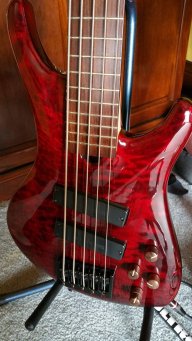


Bumping because this is a great thread, my LTD Surveyor has a dastardly spot on the 5th fret, G string. I was bored one day and simply hung a near-empty roll of duct tape off the far tuner... Problem completely solved, much to my amazement. Can't gig like that, but it works for my solo jam tone OCD, I guess.
This brings the hypothesis of maximizing contact into question though, I'm going to try just hanging an object from a tuner with a length of string next time.. Who knows, it might even be classy if it's a mini disco ball or something
This brings the hypothesis of maximizing contact into question though, I'm going to try just hanging an object from a tuner with a length of string next time.. Who knows, it might even be classy if it's a mini disco ball or something
Question for JohnK, did you try it without the weights. Did the drilling sort the resonant frequency enough to kill the dead spot? Thankfully I don't have deadspots on my basses( sure they exist) that choke enough to bother me, but have a semi solid guitar (ES339) with a deadspot that chokes noticeably at the 12th fret on the G string that bothers me a lot. Can't do my Larry Carlton licks when the note dies.....


