• TalkBass has been independent since 1998. Add your voice.
    Create a free account to reply to discussions, view embedded media, and browse with fewer display ads.
    Join freeLog in
    Want zero display ads or expanded classifieds tools? Compare plans.

Dead spot removal

I recently had some luck removing a really bad dead spot on one of my basses by simply changing over to low tension strings. The previous strings were Chromes and the new strings are TI Jazz rounds. Problem solved and no drilling or tuner swaps needed. There are plenty of low tension strings out there to choose from. You might want to try that route first before resorting to actual modifications.
Of course YMMV.
 
Wow. I've owned a good number of Fenders over the years--and the dreaded dead spot has always been in the 5th-7th fret area of the G string.

Anything squirrelly with the fret, there? A ding, worn spot? Something that would let it j-u-s-t barely contact the next higher fret..?

No, nothing unusual. Interesting to note, I just came up with the idea of tightening my smallest crescent wrench - the only thing here close to a C clamp - and it worked like a charm. I will now figure out whether to use John's method or just clamp something.
 
Great write-up, John!

I found an easy way to add mass without altering the headstock using rare earth magnets, which are available in different sizes and weights:

http://www.rockler.com/product.cfm?page=10713&filter=rare earth magnets

Attach magnets to ferrous metal, like the tuning machines, one-at-a-time, until dead spot goes away. You can reposition them to try different locations. Weighing the magnets will let you know how much mass it took to solve the problem.

These magnets grip so tenaciously, they'd be very likely to stay in place without altering the instrument.

I'm wondering if anyone has tried this and your results if you did.

I'm considering this.

Thanks.
 
Last edited:
I had bad dead spots on my fretless, 7th fret worse, down to the 4th. Really no fundemental on those frets, especially while plucking near the bridge. I put together this parts bass with res-o-lite aluminium tuners. If I put some steel weights, 50 grams with tape on the clover leaf the G tuner the dead spots completely disappeared! So I bought some standard fender tuners, and they were about 50 grams difference per key. So I swapped out the G tuner only, hoping that would work, it made the dead spots almost go away but wasn't like with just the steel weight I taped to the clover leaf, which made the dead spots completely go away. Anyway, I kept swapping tuners one at a time, it didn't improve much more, but it is not that noticable anymore and very playable now. 7th and 4th frets are very good, 6th and 5th are good.

Not sure if the weight needs to be more accurate or its placement is important too, seems to be a bit of both makes a difference. I should have experimented more!
 
2 questions:

1. Will adding/reducing weight work at the body end as well? eg. adding a higher or lower mass bridge?
2. Will switching to a J neck in a P (or vice versa) make a difference ie. less mass, vibrates at different frequencey?
 
2 questions:

1. Will adding/reducing weight work at the body end as well? eg. adding a higher or lower mass bridge?
2. Will switching to a J neck in a P (or vice versa) make a difference ie. less mass, vibrates at different frequencey?

1. It might, but not as much as adding weight to the headstock as the neck is the thing that is vibrating and canceling out the note.

2. The neck is the problem. The body doesn't create a dead spot, so switching to a different neck may change the dead spot just in that the new neck may not have a dead spot to begin with.

I agree with using lower tension strings. I've always had good luck with that. Also I've realized lately since every single one of my basses has a dead spot (usually 7th fret G), that I can almost cheat the dead spot and make it less obvious by fretting with different pressure or my plucking attack or even where I pluck on the string. Plucking closer to the bridge makes it less obvious.
 
If you have a "cheap" bass that needs fret-leveling will this be an improvement at all?

Not really. A fret level doesn't really change the resonance of the neck. Though if you can get a better setup, then it might. But adding weight and changing to lower tension strings will do more than that. I honestly wouldn't pay for a fret level just to try and cure a dead spot if the frets themselves didn't need it. My Mike Lull is PLEK'd and it still has a slight dead spot.
 
2 questions:

1. Will adding/reducing weight work at the body end as well? eg. adding a higher or lower mass bridge?

No.

2. Will switching to a J neck in a P (or vice versa) make a difference ie. less mass, vibrates at different frequencey?

every neck has a different resonant frequency so it will change (it might be less, it might be the same, or it might be more), but in most cases, there will still be a dead spot somewhere.
 
i was noticing that one of my jazzmaster basses (the featherweight, 7lb 9 oz shoreline gold one) had a slight dead spot on only one note. it was the very common 'D' on the G string (7th fret). the surrounding notes were ringing out and sustaining fine, but when i played the D, i could actually feel the neck shake/resonate and it slightly choked out. since the swamp ash body on this particular bass was so light, i made a point of selecting the lightest weight neck that i could find for it which weighed only 1lb 6 oz (most fender type necks are 1lb 8oz - 1lb 13oz).

way back in 1979, when i discussed this issue that's very common on Fender basses with Leo Fender, he pulled out a small C clamp, clamped it on the headstock and said, 'play it now'. sure enough, it was gone, and although it probably moved to a lower note, i sure as heck couldn't find it. this is also the same premise/solution that the 'fathead' (brass plate on the back of the headstock) and later 'fatfinger' (a small c clamp), both of which have been discontinued, were based on, which is adding mass to the headstock to change the neck's resonant frequency.

so, yesterday, i started experimenting with various sized (and weight) C clamps to see if i could solve the dead D problem on my bass. since the body is so lightweight, i wanted to make sure that i added only enough weight to solve the problem and not create any neck dive/balance issues. i'm using gotoh's res-o-lite reverse tuning heads on it, which made it balance perfectly. after a bit of experimentation, i found that the smallest 3 oz C clamp that i had, completely eliminated it. i figured that if i installed a standard weight set of heads (or just two of them) it would solve the problem, but i didn't want two of one type, and two of the other. i also didn't want to just replace the res-o-lites with a whole set of standard weight ones, since 6.5oz would surely create neck dive, plus the res-o-lites are so much smoother and have no slop in them whatsoever. so, i went to my local hobby shop and bought a pack of tungsten 3/8' cylinder weights that are used for pinewood derby cars.

tungsten is the new replacement for lead, since it's non toxic and actually weighs 1.7 times more than the same size piece of lead (which i learned 8 years ago when i was making and balancing my own r/c micro helicopter blades).

anywho, figuring that it was going to take at least 2 oz of weight to solve it, i removed two machine heads and bored two 3/8" holes under each of them to inlay the 1/2oz tungsten cylinders (see pic below with all four inlaid and an extra one laying on top to show it's size)).
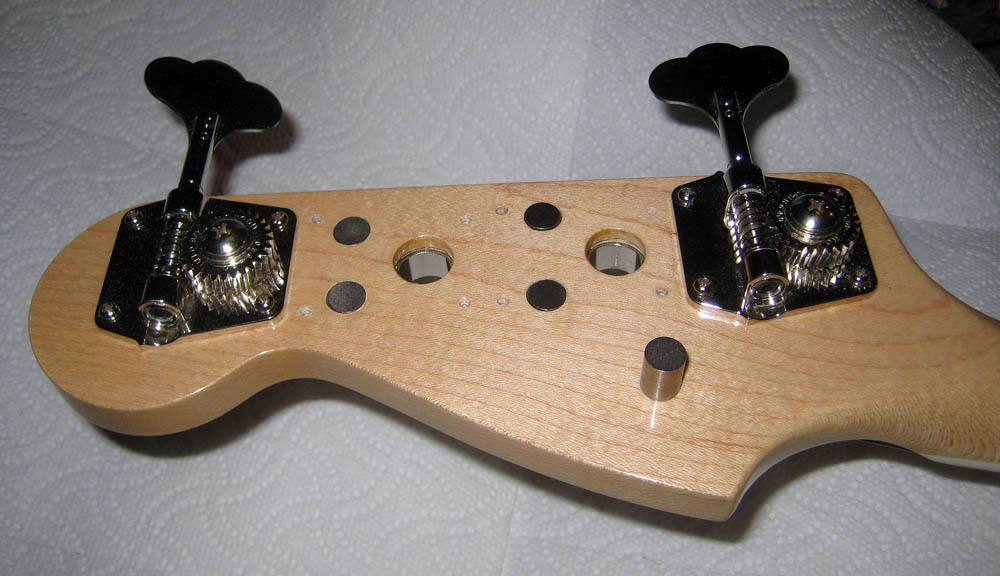
deadspot-removal-01.jpg


i first tested it with only 1 oz added (under the A string key), and while it was a bit better, the dead spot was still noticeable. while testing, i left the holes slightly shallow so that the base plate of the tuning key would 'clamp it in place'. so i ended up using four cylinder weights (two under the D key and two under the A key). i tested it again and the dead spot was not only gone, but it didn't seem to affect any of the other notes, so i bored the holes so the weights would sit flush and epoxied them in. the 2oz of added weight has not upset the balance of the bass at all, it's still very lightweight at 7lbs 11oz, and all of the notes sustain and ring out beautifully (running a set of TI Jazz flats on it). i couldn't be happier with the bass now.

sorry for the long post, but i just thought that i'd post this as a possible (and an invisible) solution for those of you that may be experiencing a dead spot issue.
Hi Johnk_10, i read ur post with a lot of interest, i m a newby to bass and have differing volumes on all my basses - Gio 205, SR605 and Cort B5. Funny enough the Gio is actually the most well behaved and its an entry level bass! I never knew about the placing headstock against a wall while playing, and it works like a charm, virtually equal volume on almost every note!? It sounds amazing. To achieve this what should i do to get my bass 2 sound like this, drill holes anywhere on the headstock and put weights in there? I dont really care too much if it doesnt look wonderful, sound is far more important to me. The A string is the biggest culprit on ALL my basses, frm C# to D#. But thats not my major gripe, its actually all the strings and all the notes - i will do ANYTHING (almost) to have that headstock against the wall response. I m in SA and we dont have a lot of the gadgets that u guys have over there. ANY advice from u (or anyone) will be MUCH appreciated! Thanks.