even using the silly looking clip-on doodad on the headstock
I attached a small C clamp on a headstock once, and it can work, although that looks even sillier.

TalkBass has been independent since 1998. Add your voice.
Create a free account to reply to discussions, view embedded media, and browse with fewer display ads.
Join free Log in
Want zero display ads or expanded classifieds tools? Compare plans.
even using the silly looking clip-on doodad on the headstock


Roger Sadowsky said in an interview once that he thought a lot of "dead sports" were caused by poorly seated frets.

From reading this forum over the years, it is clear many people mistake fret buzz/fret issues for dead spots. That said, I've never played an electric bass that didn't have one or more true dead spots or hot spots.

Frankly, I'm surprised that you're surprised that he's surprised of this!I don't have any evidence because I no longer own any Fenders, but everyone I did own did have the notorious dead spot on the C# of the G string... I'm actually quite surprised that you're surprised of this.



No manufacturer can avoid the problem 100%. Some guys will try different things out. Roger Sadowsky adds graphite rods to the necks and has thickened the headstocks of his basses to help minimize the problem. Michael Tobias adds veneers to the headstocks of some of his basses to do the same, but both Rogers and Mike's basses can still have dead spots. Wood is still wood (and graphite is still graphiteI've only had a few fretted basses with really annoying dead spots... but i've had more than a few fretless basses with serious dead spots. Happily, I don't think any of my current collection suffers from anything noticeable. It helps that they're all kinda high end (which begs the question - how does a manufacturer avoid/fix this problem??)
 ).
).
Charge more?I've only had a few fretted basses with really annoying dead spots... but i've had more than a few fretless basses with serious dead spots. Happily, I don't think any of my current collection suffers from anything noticeable. It helps that they're all kinda high end (which begs the question - how does a manufacturer avoid/fix this problem??)

Depends on your definition of a dead spot I suppose. The Luthiers I work with tend to consider a note that decays within a few seconds as dead, so I have the same perception. However I have never had an instrument that has uniform consistency in sustain length up and down the neck on all strings, because frankly that'd be impossible! I do have instruments that have very satisfactory levels of performance and notes that don't die within a few seconds, that's all. And I think a lot has to do with set-up. Of course there are possibilities of frequencies being absorbed by the neck or body very quickly, but IMO a good builder will calculate how to minimize this occurrence and will build a neck and body that get around that.You have lived a blessed life! I like the same sort of set up, but have experienced many dead spots.
The least worst is the D on the G string, as if you let the open D ring in sympathy it isn't so bad. But often it's not in that spot...
No manufacturer can avoid the problem 100%. Some guys will try different things out. Roger Sadowsky adds graphite rods to the necks and has thickened the headstocks of his basses to help minimize the problem. Michael Tobias adds veneers to the headstocks of some of his basses to do the same, but both Rogers and Mike's basses can still have dead spots. Wood is still wood (and graphite is still graphite
Its a joke, you have high end basses (read expensive) w/o dead spots. So if you have to pay more you won't hear dead spots also; if you have to explain the joke MAYBE it wasn't amusing.uh... not sure where you're going with that.


If I understand it correctly, it changes the mass of the neck which changes the resonate frequency, thus moving the dead spot. If you are lucky, it moves off the fret board.Now, see THIS puzzles me. What the heck do Headstocks have to do with me fretting a note and it being dead?
I think that's the idea. It doesn't necessarily work, but it's one of the few things a builder can do to help minimize the chances of there being significant dead spots on a bass. And, again, the price of an instrument is not an accurate indicator of whether or not it will be dead spot free.If I understand it correctly, it changes the mass of the neck which changes the resonate frequency, thus moving the dead spot. If you are lucky, it moves off the fret board.
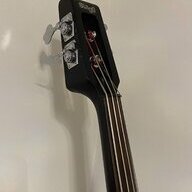
Hi guys, can confirm my american standard jazz has that famous 5th fret dead spot on the G string.
Not too bad with newish roundwounds but after a few weeks it looses all sustain and is almost like its muted.
Still a great bass though, playing live no one but me could pick it.
I have a roadworn 60's jazz aswell that has a very very similar neck with no such spot.
Luck of the draw id say!

Now, see THIS puzzles me. What the heck do Headstocks have to do with me fretting a note and it being dead?


