
• TalkBass has been independent since 1998. Add your voice.
    Create a free account to reply to discussions, view embedded media, and browse with fewer display ads.
    Join freeLog in
    Want zero display ads or expanded classifieds tools? Compare plans.

Dead Spots?????

HOLY THREAD RESURRECTION, BATMAN!

And to keep with the thread... I've owned several basses and have never noticed any dead spots on them. Part of the reason I clicked on this thread as I wasn't even really sure what it meant. I've heard about them on basses, typically on the G string in the middle of the neck, but never noticed it on basses I own(ed).
 
  • Like
Reactions: DavesnothereCA
It would be interesting to get a Luthiers perspective on this. I've played very well constructed instruments that have dead spots. What, in particular, would one be "checking" for throughout the manufacture to ensure that the instrument did not have a dead spot ? I suppose there are parameters that one could design an instrument around to ensure that it's inherent critical frequency did not result in any noticable deadspots, but it sure seems that this would be pretty challenging for the builder.

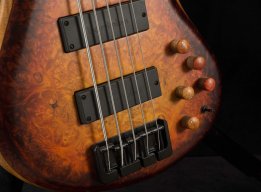
I don't think there's much you can do to totally eliminate the potential for dead spots on a given bass. Roger Sadowsky, for example, has incorporated graphite strips in his necks and thickened the headstocks on his basses to help minimize the likelihood of dead spots occurring - but they still occur. Graphite was, for awhile, seen as being the answer for a dead spot-free bass, but even graphite basses can be "inflicted". Pretty much every high-end bass (I'm talking $3000 and up) I've owned has had at least one minor dead spot.
 
I bought a Yamaha BB615 which seemed really great to play and free of dead spots for the most part, and I enjoyed paying it for a year or so. Then I upgraded my amp! Went from a Behringer combo to an Eden head and bin and what a difference it made to the whole business of my sound. To say that the Eden was 'revealing' of the dead spot (and my technique) is an understatement. I chased my tail for some time after that to pin down what was happening to my 'c' note on the G string, even had the Yam rep come out. It's just part and parcel of the build and as others here have stated, goes back to the resonant frequencies of the timber in the instrument. In tech terms, it's to do with linear phased cancellation, you know sine waves canceling each other out when directly out of phase from one another. I now just play the 'c' on the d string if i need sustain, or just make a fast pass at the c on the g string if I'm feeling lazy. (Why not just play some other notes!) At the end of the day it's no big deal for me as really I want to be playing lots of notes not just holding down a 'c' for too long. It's only really noticed if you linger long time on the note, so no big deal.
I have now built a Warmoth j bass with some amazing timbers. Yep, straight off the showcase for the body (Alder with Maple top) but a custom neck built of Goncalo and Ebony fingerboard. Dead notes? None revealed by the Eden!
Have an awesome day.... and play.
 
Here's a luthier's opinion about the Dead Spot Phenomenon.

This is something that cannot be controlled. We are talking about musical instruments that are cut from different materials, some organic and some not. Even the maple on different basses will differ from one neck to the next. It's virtually impossible to identify and elliminate the dead spot thing in production because there's no real (cost effective)way to test it when it's a block of wood. All that a higher end builder can do is guarantee a higher quality of wood stock, whether that has more bearing on the dead spot issue, well that's solely up to the piece of wood. You can add things or subtract things to alter a bass' mass, but otherwise it's an unavoidable phenomenon. If there's another builder out there who has found a way to eliminate the dead spot thing, I'm all ears.

Just my findings.
 
  • Like
Reactions: Tomas NI
Back in '92 I needed a tic-tac bass for a home recording project and came across an American Standard Jazz Bass which was selling real cheap because of a severe deceased spot at the Bb on the D string.

Since the parts to be played wouldn't involve the interred timbre, I bought the bass, recorded the tracks, and then sold the Jazz on consignment at the same shop I bought it from.

I've always suspected that swapping the J's neck with that of another Jazz Bass (and thus changing the resonant neck & body interaction) may have remedied that particular instrument's dead spot issue.

TB'ers who own multiple bolt-on neck instruments of the same type may wish try a neck swap as a reversible approach to combating any dead spots.
 
  • Like
Reactions: DavesnothereCA
OK..I'll bit this time..This has been discussed a number of times. From my experience, it also tends to happen more on 4 string basses than it does on 5s. Disclaimer: this is from my experience...we do not need a list of people now saying that they have had it on 5ers.

That said, IMHO, if the dead spot is minor...you will not ever hear it in normal playing conditions on a fretted instrument. Some people go freakish about an instrument with a dead spot....Almost all of them have one or two..to some extent. If it is not that bad...then play the dang bass and move on! :bassist:
 
My dead spot "G" (D string 5th fret) started yesterday after owning the Epi for 1 1/2 years. This is a short scale, set neck, but not a through neck instrument....yes it was inexpensive.

The tone came back at lunch today. This issue has not yet shown up on my bolt-on Ibanez. It sounds like you guys all just live with it but if that spot shows up again in the middle of a gig it will suck.
 
Gad, I hate dead spots.
Five years after my initial post and I'm getting the urge to buy another bass, but buying without playing leaves one at great risk of the dreaded plague.
Since my post I've gotten a number of short scales (SX, Switch, Hamer) that had dead spots. All were sold off. I wonder if my Squier Bronco and Rogue Violin bass were an anomaly?
Did I say I hate dead spots? :ninja:
 
Seems like it's settled then. Anyway, I've never played a Gibson ES-335 or any of it's various clones that doesn't have a dead ZONE from somewhere near the 2nd G on the G string up on through about the C. I've just bought a TonePros locking bridge and tailpiece for my The Heritage H-535 (set neck) to see if I can narrow it down to one note or two. Odd thing is, I've never had a Strat or Tele with a dead spot (bolt on).
 
Right angles and standing waves go together like ham and grits.

I was wondering if a Dingwall or other fanned fret guitar would have less of a tendency to support phase-cancelation due to the a-symetric nature of the bass-treble sides of the neck?

Same question with the a-symetric contour on for example a Gecko neck; there will be multiple overlapping pressure nodes in such a configuration, perhaps these will reduce the phenomenon?

I have no experience with either, would anyone with these guitars pay some lip service?

Cheers!
 
  • Like
Reactions: DavesnothereCA
IMO, most basses have a string/fret that has less tonal color and sustain. The offending string/position always sounds worse by comparison, as most of the time they only result in a diminished, not dead response. Often it's G and that is the easiest string to live with. It's only a problem -- on an otherwise worthy instrument -- if there are many such places, or if there is a "zone" where more than one string is affected.
 
I think the dead spot is 95% placebo. I have played all kinds of basses and never noticed it then I heard about them and they started showing up. I recently forgot about them and the problem went away. I am sure some basses really do have them to were its very noticable but this is just my opinion.
 

Latest posts