
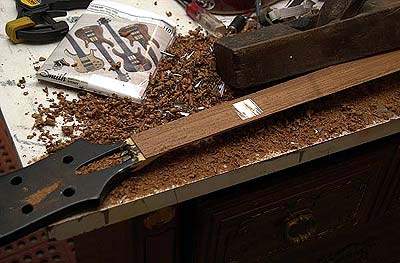
Rickenbacker used pieces of lead under the fretboard to eliminate dead spots.

Enjoy the benefits of a premium membership!
Upgrade Account
-
TalkBass has been independent since 1998. Add your voice.
Create a free account to reply to discussions, view embedded media, and browse with fewer display ads.
Join free Log in
Want zero display ads or expanded classifieds tools? Compare plans.
You are using an out of date browser. It may not display this or other websites correctly.
You should upgrade or use an alternative browser.
You should upgrade or use an alternative browser.
Dead Spots?????
- Thread starter anubis101
- Start date
More options
Who Replied?
~I've noticed that my shortscale basses rarely have deadspots, and [if] there is a deadspot, it's very mild compared to my longscale basses.
I suspect it may be due to the shortscale necks being comparatively stiffer since they are shorter.
A 'dead thread' rises yet again !


Only during the most recent several years, I have begun to buy and play shorter scale basses, as a side effect of wanting lighter weight instruments, and have not paid much attention to whether they have dead spots, but none have presented themselves in an obvious way.
My longtime 1974 Ric 4001 [bought new, and played for most of the period since] has always had one around the 7th fret of the D string, regardless what strings I installed, and if I need to play that note with a long sustain, I avoid that location, as there are three other positions at which the same note can be played, two of them fairly convenient to my playing style.
I have never considered my Ric's dead spot to be a deal breaker, not near so much as the hum of its original single coil pickups, which got swapped out with various others early in its life, ending up by 1985 with the model of active EMGs used on classic Steinberger basses.
Now that I have accidentally stumbled upon and read several TB threads with conversation about dead spots, I will consciously examine each of my newer acquisitions to see what [if any] of such aberrations are there, but there seems to be a consensus in discussion that short and medium scale basses hardly ever exhibit a dead spot, where long scale Fenders [and basses which are of similar look and construction] frequently do.
My own theory for the reason is that a shorter scale neck [usually built along with a smaller body] will resonate at a higher frequency, and if there ARE any dead spots, they might only be further up the neck where less people may notice them, but so far I have no proof of this.
~
Last edited:
~I've only had/played one bass with a dead spot, a Gibson early 70's EB-3L.
Long scale with a a 2+2 headstock.
My Ric 4001 is similar in those specs, and has one as well, though in a different location, as I posted above.
So it's not just Fender Ps and Js [etc] then.
Hmmm....
~
Last edited:
~Rickenbacker used pieces of lead under the fretboard to eliminate dead spots.
View attachment 4110865
I obviously will not be taking my 4001 apart to look for lead bars
, but I do recall not too long ago reading an online article where someone was rebuilding a damaged Ric, and discovered something like what you described.A feeling of deja vu is haunting me.
I wonder whether your pic was from that same article.
~
Last edited:
Probably. I can't tell you whether this was done on all basses or just those that have dead spots. And most likely this was done more on the older 4001's since the newer models are cnc made, so less manual production which usually means a higher degree of consistency and less variation in the final product.~
I obviously will not be taking my 4001 apart to look for lead bars
A feeling of deja vu is haunting me.
I wonder whether your pic was from that same article.
~
btw here's the link Rickresource Rickenbacker Forum • View topic - lead insert in fingerboards?
~Probably. I can't tell you whether this was done on all basses or just those that have dead spots. And most likely this was done more on the older 4001's since the newer models are cnc made, so less manual production which usually means a higher degree of consistency and less variation in the final product.
btw here's the link Rickresource Rickenbacker Forum • View topic - lead insert in fingerboards?
Thanks for the link.
Still looking for the article which I had previously seen, and so far cannot find it in my browsers' bookmarks nor histories, nor in my archives of saved web pages.
Possibly I was using a different browser than the two which I usually use while on TalkBass, or just did not bookmark it.
But anyway, one of the results of further Google searches was another message board thread, with a link to the same pic [as you had posted] in it :
Rickenbacker International Corporation - Forum • View topic - Lead under fingerboard of 4001?
The pic was on the original the website where the work had been documented :
GW Custom Basses and Lutherie - Grandon Westlund, The Bass Kahuna
I do not think that it's the same article which I had seen, but at very least it is similar, and in both cases the narrative was about a Ric [likely 4001] bass being rebuilt, and the lead piece being unexpectedly discovered during the process of doing work on the neck, followed by discussion about why it was there.
~
Last edited:
If you'd read through the posts of the link I provided, you would have seen several posts about the reason for that, including an official reply from rickenbacker. Interesting to say the least and as it seems they didn't do this for a very long time (probably because of what I said).~
Thanks for the link.
Still looking for the article which I had previously seen, and so far cannot find it in my browsers' bookmarks nor histories, nor in my archives of saved web pages.
Possibly I was using a different browser than the two which I usually use while on TalkBass, or just did not bookmark it.
But anyway, one of the results of further Google searches was another message board thread, with a link to the same pic [as you had posted] in it :
Rickenbacker International Corporation - Forum • View topic - Lead under fingerboard of 4001?
The pic was on the original the website where the work had been documented :
GW Custom Basses and Lutherie - Grandon Westlund, The Bass Kahuna
I do not think that it's the same article which I had seen, but at very least it is similar, and in both cases the narrative was about a Ric [likely 4001] bass being rebuilt, and the lead piece being unexpectedly discovered during the process of doing work on the neck, followed by discussion about why it was there.
~
~If you'd read through the posts of the link I provided, you would have seen several posts about the reason for that, including an official reply from rickenbacker. Interesting to say the least and as it seems they didn't do this for a very long time (probably because of what I said).
Yes, I did read them, and while they were also interesting, I did not mention so in my last post, continued to look for the article which I had read previously, and the closest which I found was at the links which I last posted.
Did you check out the pages which I linked ?
~
Last edited:
No, sorry, just haven't had any time. I just sat down to review the latest new posts. But in 10 min. I have to go again. I'll keep it in mind for later.~
Yes, I did read them, and while they were also interesting, I did not mention so in my last post, continued to look for the article which I had read previously, and the closest which I found was at the links which I last posted.
Did you check out the pages which I linked ?
~

Nooooo! Here it rises again!Good god... be merciful and finally allow this 10+ year old thread to die in peace!

So I've had this new Squier CV 70s Precision for nearly a month now. When I bought it, I checked for dead spots pretty hard, especially in the usual places (G string, between A# and C) and all seemed fine. But I just put a fresh set of strings on it, Fender 9050ML, and suddenly, a major dead spot, smack on the C...

From reading this thread and others on the topic, the dead spot didn't appear, inasmuch as it was probably there but unnoticeable with the stock strings.
Later this evening, I will try to change only the G string and see what happens. I have a set of D'Addario Chrome Light flats and a set of Fender 9050M. Hopefully, the G string in one of them will attenuate the dead spot without sounding too different from the other 3 strings. (Using the Fender string would be the most logical choice to keep the inter-string harmony, but I'd rather go with the D'Addario's lighter gauge, so I'll try that option first).
My question is:
I understand that it's probably wiser to just learn to live with dead spots, to play around them, etc. Where I find it more difficult is when using a foam (or fabric) mute under the strings at the bridge. Then, the dead spot goes really, really dead. Anything I can do about that? Should I only mute the 3 lower strings and leave the G unmuted?

~
Dead spot ?
I once played a CLUB like that !
But seriously, did changing just the one string help any ?
Sometimes changing all of them changes the overall tension on the neck enough to make a difference, which is what you did just before your problem began.
~
Dead spot ?
I once played a CLUB like that !
But seriously, did changing just the one string help any ?
Sometimes changing all of them changes the overall tension on the neck enough to make a difference, which is what you did just before your problem began.
~

This won't eliminate it, only move it elsewhere on the fingerboard.Rickenbacker used pieces of lead under the fretboard to eliminate dead spots.
View attachment 4110865


