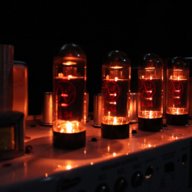
Black or bare aluminum would be cool on the Red Bird but, @JIO has a better eye for these things than eye doPart of me things a pick guard swap could look cool, especially on the Red Bird!


TalkBass has been independent since 1998. Add your voice.
Create a free account to reply to discussions, view embedded media, and browse with fewer display ads.
Join free Log in
Want zero display ads or expanded classifieds tools? Compare plans.
Black or bare aluminum would be cool on the Red Bird but, @JIO has a better eye for these things than eye doPart of me things a pick guard swap could look cool, especially on the Red Bird!

Black or bare aluminum would be cool on the Red Bird but, @JIO has a better eye for these things than eye do

 My concept has to do with the body seen as a whole entity, (one black, one red) to define the shape/mass of that form. The pg is there for function (covering and venting the LED) and otherwise it stylistically disappears/blends in with the body.
I love a red & black combo.

Or to put it another way "Form follows function - that has been misunderstood. Form and function should be one, joined in a spiritual union. — Frank Lloyd Wright"As always I appreciate your interest and idea's guys.
Or to put it another way "Form follows function - that has been misunderstood. Form and function should be one, joined in a spiritual union. — Frank Lloyd Wright"
So I'm just starting to get a feel for it's sound. The Novak DS/BS is in the same location and configuration as the Teiscobird, same strings, same body/neck wood and 500K pots/.047 cap, and wired the same. Differences are maple vs ebony fb, and nuts; Teiscobirds > plastic/DB II > brass. Initially the bass sounds on the bright side - not in a bad way, but definitely more focused/crisp. The tone pot sweep is subtle - there is a treble roll-off, but not to dub. I read up on capacitors last night to get a fuller understanding there but the TB's and DB IV are all .047 caps so they should be very similar if not the same. They don't go to 'dub' either, but seem to offer more roundness. With all this in mind, the ebony fb and brass nut combo seems to be where the brightness is coming from. I will test it at rehearsal volume with my pop-rock trio (that gets a bit loud) before I make a full call on it. If it still feels like it needs more fatness, I have a few options to start with. The pu poles are at 4" (from the saddles) and by flipping the pu they can move to 5". I can also change out the nut to bone. Changing out the cap would be my last choice.
One thing that is often missed is that the caps work with the pickup to form an LCR (Inductance - L, Capacitance - C, Resistance - R) resonant circuit. People usually just look at the DC resistance (DCR) of the pickup (9.5k ohms, etc) as the primary indicator of tone. The real player in the tone realm is the inductance of the pickup, but of course, inductance is harder to measure (and a 5.0H pickup just doesn't sound as cool as a 9.5k pickup in marketing speak) Whereas the relationship between the DCR and the winding is pretty straight forward, determined by the wire gauge, number of turns and the length of a single turn, the inductance is influenced by additional factors such as the magnet type, structure etc.
The resonant frequency of the LCR circuit is proportional to 1 over the square root of the C capacitance times the inductance of the pickup. So lowering the inductance of the pickup or raise the resonant frequency of the circuit, leading to a brighter tone for the same capacitor value.
OK, so there's my pedantic explanation of inductance vs resistance as it pertains to pickups. So what does that mean? What it means is that while a 0.047 uF cap may be just the ticket for a TBird pickup, if the DS/BS has a lower inductance than the TBird, it might be too low for the DS/BS to acheive a Dub tone.
Also, using a 250k pot may be more appropriate for the DS/BS since it's a single coil.

Hey @JIO would you be willing to share your source for those neck bolts? They look really sharp...
+1 on not using stainless and stainless. Speaking from bitter experience of M24 size bolts galling/seizing (at work, not on a giant bass) and having to grind through a load of them :-|The collars/sleeves are readily found on eBay from a number of sellers or from Stew Mac and come in black also. Some, if not all are brass. The flat-top inset hex-head machine bolts are from Ace Hardware, are metric (and stainless steel if I remember correctly) and go into threaded steel mollies/inserts that I order from McMaster Carr. [E-Z LOK 329-332 / 10-32x3/8-16] tap drill:5/16" / tap:3/8-16. Works best to use a drill-press but can be done without if care is taken to drill a straight hole/shaft. I used to use the brass inserts but they are soft - I like the steel ones better. Threading the molly hole with the tap is imperative - once that's done it threads right in and can be glued in or just left as a pressure fit. Don't get stainless inserts because using stainless bolts w/stainless inserts can seize up. I've also used black flat-top inset hex-head bolts but you have to order those through Mc-C. Hope this helps -
Both are legit. The pot is being used as a variable resistor, one thing that may happen with the reversed direction is that the taper will be different; you'll notice this (or maybe not; it's subtle) in between the extremes.Anyway - since you are well versed in electronics I'll present you with a question. In the Teisco Del Rey, the 2 500k pots have the cap in an unusual configuration, which I've mimicked in my Teiscobirds. I am aware that normally a cap is connected to the tone pot on one end and soldered to the pot-top on the other lead (ground).
'66 Del Rey - reversed T/B (500k) tone-pot direction (tabs reversed), cap connected to center tab on the T knob and +/hot tab on the V knob.
View attachment 3368868
This is Teiscobird's (#1) in which #1 mimics the Del Rey with reversed tone (full on=bass, full off=treble) and #2 goes the usual direction
View attachment 3368879
So this cap hook-up is different than the norm but all of these basses sound really good. Curious as to your thoughts on this.
The polarity (directionality) of the caps shouldn't come into play unless you have DC voltages in your bass which shouldn't happen in an all passive instrument unless your amp is misbehaving in a really bad way.Another thing I learned last night delving into caps what the (red) ring (indicating outside foil) on one side being important directionally. (as in, it's there to designate which side goes where) However, the guy describing it was speaking more about electronic equipment (not guitar/bass application) and he illustrated the adverse effects if not connected the right direction which I have not experienced regardless of not knowing which direction it's supposed to be installed in. After becoming aware of this, I checked the basses I have used them in and they are in fact not all the same direction (as seen in top pic) - but again - with no adverse effect.
One last question on my Black Beauty caps. They are all 600v, look alike but are different sizes and 2 are .047, and 2 are .0047 - so does the size or extra '0' (.0047) create a difference?

Both are legit. The pot is being used as a variable resistor, one thing that may happen with the reversed direction is that the taper will be different; you'll notice this (or maybe not; it's subtle) in between the extremes.
The polarity (directionality) of the caps shouldn't come into play unless you have DC voltages in your bass which shouldn't happen in an all passive instrument unless your amp is misbehaving in a really bad way.
Yes, thats' a factor of 10 -- it will raise the resonant frequency by a factor of ~3 and will make the bass brighter. That's actually about where you might get a 'cocked wah' type of response.
 My removable strap-peg extender works as planned/designed! Easily engaged - it's rock solid and it's just as easily removed so the bass can fit in a standard HSC for travel/storage. (and shipping to it's owner...) Need to do a bit of cosmetics; coating it satin black (so it disappears wearing a black shirt), and creating a nice firm but soft interface to fill the space between bass and unit. (where the cork is now)
Nice slick solution, sir!Success!
It's a system that could work on any bass that is upper horn.., er, challenged.
View attachment 3369169
Used T-nuts to attach the inset Strap-Lok cups
View attachment 3369170
View attachment 3369173
View attachment 3369176
Nice slick solution, sir!
Thanks! Hey man - you nailed it! I changed the cap and it's where it should be tonally with a nice fat bottom end with with the tone knob rolled off. But as much as the other cap didn't have the bottom or much tonal variance - it had a nice rich mid sound so I'm considering adding a two-way mini-switch to give the option to go from one to the other. I saw it on a Seymour Duncan page.