• TalkBass has been independent since 1998. Add your voice.
    Create a free account to reply to discussions, view embedded media, and browse with fewer display ads.
    Join freeLog in
    Want zero display ads or expanded classifieds tools? Compare plans.

Define a quality bass guitar.

Since affordable CNC quality has definitely levelled up. Things that can go wrong with a bass guitar these days are mostly MALFUNCTIONS because of poor quality materials (noisy electronics, broken tuners, broken truss rods/nuts, broken saddles, scratchy cheap pots, etc.) or plain bad design decisions (which eventually consumers will filter out). I've rescued several cheapos, put up a kit (very modded over time), also a cheap parts bass, and as long as the thing stays in tune and can be setup to play decently (working truss rod, reasonably levelled frets) it's quality enough.

I've had almost 30 basses in 33 years playing them and of course can appreciate (and eventually pay for) "extra mile" stuff: threaded inserts for pickup screws, better adjusted nuts (too often high on most sub 1000$ instruments), IDK, anything that will reveal a more careful craftsmanship.

I read an article somewhere (don't recall exactly but I think it was centered around car quality) that mentioned there's divergent meanings for what quality is depending on culture. For us westerners it might be linked more to features, while for the Japanese it might have more to do with reliability.

IME, there's dependable good sounding instruments starting at laughable prices these days.

This is my cheapest bass, an 89€ parts Jazz Bass (38€ for a donor bass -unusable neck/body- + 51€ for cheapest neck and body I could find in AliExpress)...


... and this is my most expensive, 1997 all birdseye EBMM Stingray5...


Yes, the SR5 plays better and mixes better with a band, has more EQ posibilities, but by no leap of the imagination it plays or sounds 15x better, while still going used for 15x what that rat rod Jazz cost me.

I might be closer to the "does what it's created to do for a long time with no hassles" zeitgeist when it comes to quality as a measure. Probably also a "traditionalist", not usually impressed with eccentric design/fancy features, except when it really makes sense for playability or tone reasons. So in the current context I see quality all around, for real cheap. At almost 47 and semi-retired from gigging life I really doubt I'll ever buy USA Musicman budget level basses anymore. It's realy hard to find a bass produced nowadays that I wouldn't play after restrung and setup to my comfort. And the ones I don't like tend to be because of them sounding generic to me, a question of plain personal taste, not because of quality flaws really.
 
Last edited:
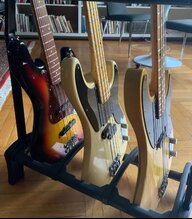
People on this message board are probably sick of me talking it up, but the bass on the right - my 1982 Yamaha BB2000 - is for me the very essence of a quality bass guitar, so much so, that it has become the instrument against which I measure all others. It is superior in every aspect to all other basses I've owned; i.e. two EB MM stingrays, a Sadowsky metro, several fender jazzes - both US and Japanese, a '62 reissue and a CS '59 P. It even edges out the BB3000 to its left.

Why?

Well, for several reasons: 1) It fits me like a glove - I'm 6'5 and it's a BIG bass. I love the way it feels and sits against my chest when it's strapped on. 2) The tone is sublime. Open, airy and warm with a big bottom end and a fat juicy midrange. Front pickup yields the perfect rock tone. Pickups blended is perfect for pop/funk/fusion and the bridge is jazz bass city, only twice as good. No matter what setting I use, it just has the sweet harmonic richness and warmth to the tone that's a joy to hear, especially in a band. 3) The neck is THE MOST COMFORTABLE neck I've ever laid my hands on. Wide but fast, almost plays itself. 4) It's built like a tank.


DSC04026 (2).JPG
 
  • Like
Reactions: Hummergeist
Obviously, there's going to be a mix of subjectivity and objectivity in defining one's idea of a quality bass, but for me, the key criteria to what contributes to a "quality bass" for me are the following: comfort (weight and how the body rests), playability (a neck whose shape and size don't result in hand/finger strain), tonal versatility (most of your tone is controlled by fingers and on-board controls), aesthetics (yes, it's definitely a bit lame and superficial, but if it doesn't look nice, it's hard to get pumped about playing it). For me, those are the criteria. Not sure if I'm even answering the question correctly.
 
  • Like
Reactions: marchone
I see threads here frequently saying this brand is garbage, or that brand only made a few good basses and you have to try them all to find a good one.

Put into words what a good bass is.

Do the same for a decent bass.

Now describe a bad bass.

If you can, articulate what is garbage, and what is not.

Try hard to leave out unadulterated opinion and subjectivity.

Be objective.

I submit it is in the hands and mind of the player.

Blind taste tests in the wine world have upset many apple carts and embarrassed many professional sommeliers. I lived tangentially as a chef in that world. You can’t quantify opinion.

A blindfolded test of top bass makers would be the end-all to this conversation.
I will bite… sort of.

i think there are many well playing bases. But quality can be further defined by cosmetics like wood, paint, finish, other cosmatic touches. Same for hardware.

I will avoid pickup discussions (electronics matter!!!). Or tone conparisons.

A good bass can meet you needs for setup and play, intonate properly, balance well, produce sound you like without significant drama (typical single coil issues ok, but a good bass may shield cavities). Cosmetically and for construction there will be no obvious flaws. Wood choices will be utilitarian, but handsome.

A bad bass will lack in some or all of the above.

A great bass is highly subjective. It may come from vintage wear and tear, a personal history/story, fancy exotic woods or options that the owner lovingly picked with the builder.. making it “unique”, being the bass used by your hero, being able to find that perfect tone in your head, feeling special when you look at it or play it, knowing it is one of only a few, etc.

So, there are good and less than good bases. To be “great” is all very much individual taste. One mans furniture bass is another mans dream.
 
  • Like
Reactions: marchone
A quality bass is one that makes you want to pick it up and play it...all the time. The reasons are individually subjective. It all boils down to how it feels, how it plays and how it sounds (and sometimes how it looks) to YOU.

For me it has to be a 4 string, 32" scale with 24 frets. Must have tummy cut and 19 mm string spacing, active or active/passive electronics and I'm a big fan of Bart and Pbass pickups. I also like walnut core basses and cocobolo tops with maple necks and Madagascar ebony (or ebanol) fingerboards. Once again, it's very subjective. I have 2 that meet these requirements and play them for at least an hour a day!
20210605104952.jpg
FB_IMG_1598704520365.jpg
 
  • Like
Reactions: marchone
You use the word "quality" in the thread title but simply "good" and "bad" in your post. They are not quite the same. Quality encompasses materials and construction, whereas good and bad are answers to the question: Can I do everything I want to do with this item?
Quality = fit for purpose.
That purpose is whatever suits your needs.
In my case some characteristics I look for include
smaller body, lighter weight, slim profile neck, visually appealing, simple colours and inexpensive.
I do not own a bass that has all the characteristics I want.
If it has most it will do…just like a girlfriend.
But ultimately the sum of its parts.
All choices are subjective and prone to change.
I like a bass that has personality, it speaks to me before I play a note.
If Once picked up we engage in meaningful conversations we then become friends.
 
Last edited:
  • Like
Reactions: marchone
Impossible to de-fine really. I had a 1970 P bass which was heavy and the E string was real quiet, beat to hell and back, but the entire guitar felt smooth and creamy with all the edges worn and tactile feeling, chunky neck and heavily sanded frets with a crazy low action. Quite simply the best feeling bass I'd ever played, and then Ive picked up various high end all singing and dancing basses which have left me cold. I now play something in the middle of the two...but man I miss that old P bass.
 
  • Like
Reactions: marchone
We all have our own flinch points when it comes to this topic. I find a great bass one that instantly is comfortable the first time I play it, has at least one tone that is great, and is made to last, not cheap parts that will need to be replaced. Looks good and makes me want to play it. A good bass is one step down from that. Maybe it has cheapo dime pots and a flimsy output jack. Still sounds great, is comfy and not quite as inspiring. A decent bass is the kind you end up using for a song when you sit in with someone on stage. It's usually a Squier or equivalent, not set up to your liking but gets the job done. Nothing to write home about, but everything on it works. Garbage is just that. Twisted or warped neck, broken truss rod, troublesome electronics, weighs more than your van, sharp edges, little or no sustain, poor tone, high action that can't be adjusted any lower, buzzing frets, can't be intonated, etc. Just horrible.

A lot of garbage was what what most of us started out on back in the '60's and '70's. By the '80's there were some inexpensive decent basses around. Now you have to hunt down firewood. Most instruments are at least decent and many are good regardless of price. The difference in price versus quality seems to expand greatly when you get into custom shop and boutique instruments. The idea of paying thousands of dollars for a bass doesn't mean it will be a better instrument than the one that costs a few hundred. In some cases ,the cheaper instrument (though built on an assembly line) is superior.
 
I started off with a Pbass , and felt it was a quality instrument .
Many years later I bought a Dano Longhorn , and it completely changed my opinion on just what a quality instrument was .
A good instrument will fulfill the basic functions . It will intonate , hold tuning and be reasonably comfortable to play . A bad instrument will fail one or more of the functions . A quality instrument will not just cover the the basics , but will also bring pleasure . Quality is present in my appreciation , and the instrument itself .
 
  • Like
Reactions: marchone
I dunno. Language changes and the word select appears to have morphed into something else since the nuns taught me in the early ‘60s.
This is the longest conversation I’ve had on talk bass. It must be a quality one. Yes the nuns. I also succumbed to there dogma, opinions and cane. Language is changing for the worse , it amazes me how words are substituted into inappropriate context. I suppose that’s the change.