• TalkBass has been independent since 1998. Add your voice.
    Create a free account to reply to discussions, view embedded media, and browse with fewer display ads.
    Join freeLog in
    Want zero display ads or expanded classifieds tools? Compare plans.

Deglossing a Squier VM Fretless Jazz

Apr 19, 2011
1,828
1,232
Iowa
I had an interesting experience trying this out before on a Squier Affinity that had 6 layers of paint.
But this time all I'm doing is removing the gloss and giving it a satin look. No relic'ing 's or anything of that nature. My candidate is a fretless Squier VM. I thought it would be perfect since I don't have to mess with a pickguard.
It arrived on Thursday and I started the project today.
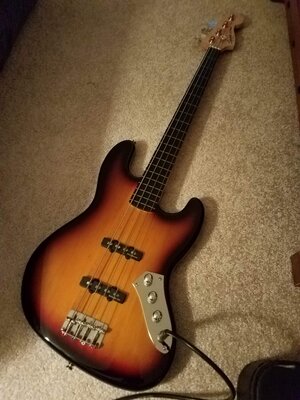
20161103_181413.jpg
It plays nicely. Decent setup with flats already installed. I bought it somewhat cheap from GC's used site.
20161105_113858.jpg
Removed the hardware and neck.

20161105_130501.jpg
Working on the back with Scotch Brite pads and grade #0000 steel wool. It gets pretty dusty. Have to stop occasionally and wipe it off.

20161105_131914.jpg
Starting on the front. It looks super dull in this picture because of the layer of finish dust.
The sides are coming up soon and they're going to be tricky, but going slowly will help. We'll see how it goes.
So this is where I'm at.
I've got two dilemmas (if you can call them that.) Even after hitting it with the steel wool, the black part of the finish shows miniscule scratches. They're very hard to see, and can only be seen on the black, but if you look closely, they're there. It's almost like I need something finer to go over it with. Any thoughts?
Secondly, I was digging through my old hardware and found a set of old MIM J pickups. Should I stick with the Duncan Designed, or put the MIMs in? The Duncans seem pretty nice...

I'll post back later with further progress.
Thanks!
 
Last edited:
  • Like
Reactions: Brio
It's getting really close to where I want it to be!

20161105_152900.jpg
I hit the whole thing and didn't do well enough on a few spots, so went over most of it again and then cleaned it up.

20161105_153105.jpg
It looks really good from a distance, but up close...

20161105_152931.jpg
You can see the scratches in direct light. I'm thinking either hit it with the steel wool again with more pressure on the darker parts or... Any other ideas?

I'm calling it quits for today. Gotta get some other things done! :thumbsup:
 
Last edited:
2 more options :)
1) use wet sand paper, grid 1000-1500-2000 , perhaps after the 1000 you are at the finish line...if you don't want to buy it via internet, ask local car shops/laquerer shops.
edit: try to sand in straight motion with the grain, not in circular motion, if you sand in circular motion it will scratch in circles

2) if it rest too scratchy or too shiny:
buy one or two rattle cans of clearcoat matte...if too scratchy, the clearcoat will hide the scratches..if too shiny, the matte clearcoat will dull the superficie ;)
 
2 more options :)
1) use wet sand paper, grid 1000-1500-2000 , perhaps after the 1000 you are at the finish line...if you don't want to buy it via internet, ask local car shops/laquerer shops.
edit: try to sand in straight motion with the grain, not in circular motion, if you sand in circular motion it will scratch in circles

2) if it rest too scratchy or too shiny:
buy one or two rattle cans of clearcoat matte...if too scratchy, the clearcoat will hide the scratches..if too shiny, the matte clearcoat will dull the superficie ;)

Thanks for replying! Forgive my ignorance but how do you use wet sandpaper? Do I need to keep reapplying water to the sandpaper?
Also I think I'm going to skip the clearcoat idea. The less finish on it the better. I don't want to relic it, but I like the idea of it distressing over time if I get enough of the poly off.
 
Thanks for replying! Forgive my ignorance but how do you use wet sandpaper? Do I need to keep reapplying water to the sandpaper?
Also I think I'm going to skip the clearcoat idea. The less finish on it the better. I don't want to relic it, but I like the idea of it distressing over time if I get enough of the poly off.

Considering you've only dulled the gloss, not much finish was actually removed. If you are really interested in getting the finish so thin it will naturally wear faster, you'd have to use sandpaper first. But this is tricky because you could start removing sunburst layers, so it would have to be done slowly watching the finish as you sanded. Also, on a body there will usually be more buildup on the edges than the top/back.

"Wet" sanding is done using emory cloth wet. You can have a bowl of water w/a sponge while you work. Emory cloth is grey/black with a cloth-like flexibleness that comes in fine grades. The finer the grade the more it will polish a finish.
 
  • Like
Reactions: RyanJD
You can google how to wet sand - but essentially you get some black sand paper of very fine grit, and a little bucket of water. Keep wetting the sandpaper to keep the surface clean and wet.

The water will make it kinda still seem glossy, but dry the surface with a clean paper towel, and you'll see just how dull you've made the clear coat. (and smooth!)

I wonder how a Magic Eraser (kitchen cleaning sponge) would do? I've removed headstock decals with ease with one of those. They are surprisingly abrasive without leaving any deep scratches.
 
  • Like
Reactions: superheavyfunk
If you have the Duncan designed pickups....leave them they sound very good...But if you want to try a tone comparision then go for it....Record them both (with band if possible) and see what you think...
Just a thought.
Besides it comes down to your taste.
And body is looking better.
 
Decent setup with flats already installed.

I don't know whether or not it matters to you, but that tough-as-nails ebonol fretboard can withstand some/most of the ravages of roundwound strings. Also, if/when you polish it, don't use lemon oil. Just use the same polish you'd use on a glossy-finshed body.
 
Thanks for all the replies guys. It didn't really occur to me that I'm really just dulling the gloss more so than actually removing it. I think I'm going to go over it again with another Scotch Brite pad and a little more pressure. Not sure if I really want to mess with wet sanding...

I don't know whether or not it matters to you, but that tough-as-nails ebonol fretboard can withstand some/most of the ravages of roundwound strings. Also, if/when you polish it, don't use lemon oil. Just use the same polish you'd use on a glossy-finshed body.

Yeah, that's what I've read. Ebanol is basically a stronger, synthetic Ebony or something and it's made to resist wear better than Ebony. I was planning to try out a set of rounds on it before I default to flats. I really like the flats that came on it though, so we'll see.
 
Last edited:
  • Like
Reactions: Malak the Mad
Yeah, that's what I've read. Ebanol is basically a stronger, synthetic Ebony or something and it's made to resist wear better than Ebony. I was planning to try out a set of rounds on it before I default to flats. I really like the flats that came on it though, so we'll see.

I've heard Ebonol described as "layers of paper and phenolic resin" that's been compressed into a wood-like substance. I've also heard it's incredibly resistant to the ravages and stresses caused by changes in temperature and humidity. I, for one, would love to have a fretted neck with a vintage-radiused (7.25") ebonol fretboard. I've even considered grabbing one of those fretless, VM necks and having it re-radiused and fretted by a local guitar tech I know. (I know Squier makes fretted ebonol necks, but for some reason they only make them in a super-flat 12" radius.)

Good luck with your project, Ryan! Speaking as a fellow tinkerer, I hope it turns out exactly as you want it to. :thumbsup:
 
  • Like
Reactions: RyanJD
.... I think I'm going to go over it again with another Scotch Brite pad and a little more pressure. Not sure if I really want to mess with wet sanding...

if you go with Scotch Brite and MORE pressure it will be more and more scratchy the dark/black parts, but no more dulling...
you have only the 2 options..or a 2 1/2 one...
1) wetsanding in different high grind, until you reached the desired dullness
2) clearcoating with Matte clearcoat
2 1/2) stripping the whole body via Heatgun, and than refinish with a thin matte CLearcoat
 
i did the same thing to ... tried pads, steel wool ... but then went to wet sanding ... that removed the swirly scratch marks ... it does get cloudy looking ... so after the degloss , i started polishing a bit to remove the cloudiness and find that happy medium ...

i also sanded a few of the typical wear spots down to the wood ...

View attachment 983436 View attachment 983437 View attachment 983439 View attachment 983441

Awesome! That looks great. I'm curious what grit you used to wet sand... And how did you polish it afterwards?
 
i used whatever i had laying around ... 600-b wet sanding paper

polished with a 4" foam pad on drill ... and some Fine Guitar Polish stuff from StewMac ... when i was polishing i also sprayed some Meguire's spray was on it ... i did get a bit carried away and actually brought a bit to much shine back ... but didn't feel like wet sanding again ... ! ha

i was worried about whatever chemicals where in stuff ... as i never plan on stripping it down to the wood for any reason ...

i recently picked up a cheap slightly damaged fretless ... polish out the ebenol fretboard in the same manner ... now it has 2 necks .. !! put a few more coats of satin poly on the other neck also ... stickers i had laying around ...
DSC01240.JPG
DSC01232.JPG
DSC01233.JPG
DSC01084.JPG
DSC01239.JPG


i also gave try to aging the hardware ... using a fuming method with muratic acid .. ( we have a pool )
didn't really like the way that worked ... came out weird looking ... so after that , i put everything in an old coffee can along with some sand and gravel ... shake , shake , shake ... until scratched enough ... worked OK ...

finished with CTS pots , orange cap , used Fender Super 55 split coils ...
 
  • Like
Reactions: RyanJD
Haven't had much time to work on this lately, but here's an update.
I purchased some 600 grit wet/dry sandpaper since it was the highest grit I could find after checking a couple places. I went over the whole bass with 600 grit dry to remove more of the poly. Afterwards, I attempted to go over it wet.
As a result, the finish is a little duller than before and still has noticable scratches. However, I sanded with the grain this time, so it at least looks a little better.

20161206_223305.jpg
20161206_223324.jpg

Well, I'm not happy with the result yet. I'm going to purchase some 1000 or 1500 grit sandpaper online and wet sand it again to see if I can get a better result.
Thanks for all the advice, guys.