I had several soundman complain about the low output level with my JDI (using a fairly low output active bass). I started using a J48 and have since had no issues.

TalkBass has been independent since 1998. Add your voice.
Create a free account to reply to discussions, view embedded media, and browse with fewer display ads.
Join free Log in
Want zero display ads or expanded classifieds tools? Compare plans.

Be careful with some class-D amps when taking the signal off the speaker out with a Countryman Type 85. Depending on the amp doing that can result in damage to the amp. @agedhorse had an explanation of why that is in another thread which I’ll try to locate.
When you plug in to a passive transformer based DI, there is something called insertion loss. So a passive bass combined with a passive DI will have a lower signal level that an active bass would. The issue is, how much lower and does it have to be cranked up too much at the mixing board to compensate. Some passive basses do better than others. An active DI has a gain stage to boost the instrument signal level before it hits the DI transformer to compensate for the transformer’s losses. Some argue that that gain stage affects the tone. It really depends on the design.
As you said, try it and see how your passive bass and passive DI sound together.
See my above explanation for why.I like the JDI for the way it connects to a speaker signal in parallel, and for the way it has no active circuitry to worry about.
With the Countryman I have to keep a 9V handy in case phantom power is not available. (And while on 9V be careful plugging & unplugging from the "input" jack - it will send a loud "pop" through the XLR. Most PA owners really hate that.)
I did a bunch of testing and found my JDI sounds noticeably worse with my passive basses going straight in. (Less treble, not as even, just kind of "stale" overall.) It would of course be better than nothing in a pinch, but I would definitely prefer to insert a good active buffer circuit before it (onboard pre, outboard pre, rack pre, amp, etc) or use the Countryman

Yes true. But since we’re talking about a tube head here it’s ok to use a speaker DI.Be careful with some class-D amps when taking the signal off the speaker out with a Countryman Type 85. Depending on the amp doing that can result in damage to the amp. @agedhorse had an explanation of why that is in another thread which I’ll try to locate.
Yes true. But since we’re talking about a tube head here it’s ok to use a speaker DI.
There’s no real point using a speaker DI off a Class D head anyway, as far as I understand it. The idea being to capture character from the power amp section of a tube head. If a Class D amp is designed for clean power amplification, then you get no tonal benefits from the power amp , and a preamp DI out would be all you need.Fair enough.
I use my Countryman off tge speaker out with my small tube amps all the time. I’m not all that chuffed about chancing it with my class-D amps however, since I don’t know enough about their internals to know if I’m at risk or not.
My other feeling (possibly wrong) is that if the speaker outs on an amp are Speakon jacks, then it’s probably wisest to only plug them into a device that has Speakon inputs.
There’s no real point using a speaker DI off a Class D head anyway, as far as I understand it. The idea being to capture character from the power amp section of a tube head. If a Class D amp is designed for clean power amplification, then you get no tonal benefits from the power amp , and a preamp DI out would be all you need.


I understand what you’re saying. But I don’t completely agree with you in some minor respects. There are solid state amps that have strong “tube” type characteristics. I’m thinking the old warhorse A/B amps like Acoustic and Sunn. So tagging into the speaker out on those amps could also be beneficial.
But I see using a speaker out input into a DI as mostly a convenience for getting the sound of older solid-state and tube gear into a board without resorting to using a mic. And for live sound at stage volume I seriously doubt anyone could tell the difference.
FWIW I’ve began exploring a more modular approach over the fast few years. So I have several different preamps with distinctive sonic characteristics that are separate from the power amp.
As far as power amp character goes there are also IR based amp/cab emulations that have gotten quite good recently. So it’s fairly easy to park an amp/cab emulator right before the DI and put both in the effects loop or between the preamp and power amp if you’re using separates.
There’s also a new breed of effects like Supro’s current series of pedals that include circuitry and a transformer to model the sound of their class-A tube amps that are beginning to appear. Add they nailed it to my ears. So a dedicated separate amp emulator isn’t always needed either. And let’s not forget those DIs that also incorporate a transformer to capture some of that tube vibe.
Lots of different ways to approach it. Life is good!
Fair enough.
I use my Countryman off tge speaker out with my small tube amps all the time. I’m not all that chuffed about chancing it with my class-D amps however, since I don’t know enough about their internals to know if I’m at risk or not.
My other feeling (possibly wrong) is that if the speaker outs on an amp are Speakon jacks, then it’s probably wisest to only plug them into a device that has Speakon inputs.
The transformers used in most DIs do not contribute to “tube vibe”, they are unrelated to tubes and those characteristics commonly associated with “tube vibe” (which varies with whoever is describing it anyway).I understand what you’re saying. But I don’t completely agree with you in some minor respects. There are solid state amps that have strong “tube” type characteristics. I’m thinking the old warhorse A/B amps like Acoustic and Sunn. So tagging into the speaker out on those amps could also be beneficial.
But I see using a speaker out input into a DI as mostly a convenience for getting the sound of older solid-state and tube gear into a board without resorting to using a mic. And for live sound at stage volume I seriously doubt anyone could tell the difference.
FWIW I’ve began exploring a more modular approach over the fast few years. So I have several different preamps with distinctive sonic characteristics that are separate from the power amp.
As far as power amp character goes there are also IR based amp/cab emulations that have gotten quite good recently. So it’s fairly easy to park an amp/cab emulator right before the DI and put both in the effects loop or between the preamp and power amp if you’re using separates.
There’s also a new breed of effects like Supro’s current series of pedals that include circuitry and a transformer to model the sound of their class-A tube amps that are beginning to appear. Add they nailed it to my ears. So a dedicated separate amp emulator isn’t always needed either. And let’s not forget those DIs that also incorporate a transformer to capture some of that tube vibe.
Lots of different ways to approach it. Life is good!

The transformers used in most DIs do not contribute to “tube vibe”, they are unrelated to tubes and those characteristics commonly associated with “tube vibe” (which varies with whoever is describing it anyway).
The Supro Tremolo features preamp and power amp sections, including an actual output transformer deployed to recreate the magnetic saturation characteristic of historic Supro amps
If the PEDAL is designed to create this tone, there are many ways to do this without a transformer. If they designed (or selected) a transformer for the characteristics that exploit such defects in linearity, that too is a possibility. The claims and explanations of the marketing (of any product) may not be technically accurate or even correct.In this case it was Supro who said:
If I misinterpreted their words “magnetic saturation” to imply a “tubey vibe” (which was my choice of words - and to me means: a vintage type of warmth, breakup, and mild compression) then my bad.
However, that pedal (with the tremolo dialed completely out) does sound an awful lot like I’m going through an old Supro or one of their new Blues King tube amps. Or at least it does to my ears. Others may hear it differently.

If the PEDAL is designed to create this tone, there are many ways to do this without a transformer. If they designed (or selected) a transformer for the characteristics that exploit such defects in linearity, that too is a possibility. The claims and explanations of the marketing (of any product) may not be technically accurate or even correct.
This is NOT a characteristic of transformers used in virtually every general use DI that I have examined, not a characteristic of any (commercial product) DI that I have ever designed either.
Woah! Not arguing with you. No need to use CAPS. Just trying to have what I thought was a casual conversation.
I’ll show myself out now.
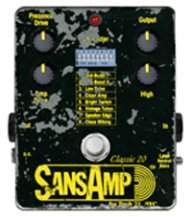
... I have a Sansamp as well, it's a good pedal but it definitely colors you sound and can add noise depending how you adjust it...
... You could XLR out of the sans amp. Sans amps actually work very well direct into the PA and doing that wouldn’t cost you a nickel. But it would pretty much mean leaving the sans amp on all the time. If you’re ok with the sans amp being on all the time I’d go that route. If not I would recommend getting a clean Di type pedal to use as an always on pre amp and using the sans amp more as an on and off overdrive. ...t.

Thanks for the additional info! I do love the 3 Sansamp pedals I own and will likely buy another. Really good quality, thoughtfully designed and great phone supportOur SansAmp Bass Driver, Para Driver and VT Bass DI "are" DI's. If you don't want any tube emulation or tone shaping just leave the pedal in bypass and it will operate like any active DI. It converts the high impedance signal of your instrument to low impedance for direct to mixer applications. If you switch on the pedal and keep the Blend control off you have a DI with active tone control. Turn up the Blend and you can adjust the amount of your instrument with the SansAmp tube emulation.