Without trying to sound too naive...
Surely the sound coming out of a bass is from the strings vibrating, and being picked up by the pickups.
Where does the wood of the body, or even the neck, come into this mix? as-in, realistically, and humanly-detectable.
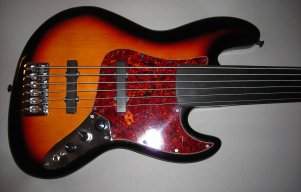
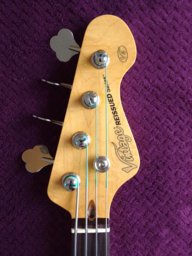
I currently have an Ibanez active bass (SDGR) which has been great for a good couple of years now, but I'm keen on getting a p-bass (prob a special with the additional jazz pickup), and been eyeing up some Squiers on ebay.
The 2 big questions are, a) will I really notice much difference between a Squier p-bass and my ibanez active bass, and b) is there going to be much between a custom Fender and a Squier Affinity (granted I don't think you can get an affinity with a jazz pickup).
Hopefully the answer is "unless you're filling Wembley or Madison Square Garden everynight, you can get most tones out of most basses.
(I'll still get the p-bass regardless - just want to know whether I'll be blown away by the sound difference or not).
Cheers,
Rob
The things that most affect your tone are, not necessarily in order: strings, pickups (including pickup location) on-board EQ/pots/caps, ears, fingers/pick/slap/bow, preamp/pedals, power amp, speaker(s), room acoustics, listener bias and expectations, the internal structure of individual pieces of wood and their impact on frequencies bleeding off or being reinforced back into the string vibrations, pickguard, color, and finally the species of woods used. Think of things in terms of their being either a limit/filter/cut, a boost (gain stage), or a pass through for different harmonics. Gain stages boost the signal or a part of the signal. Your fingers (or pick, or bow, etc) are the first gain stage. Mostly it is your string attack, the strings, the pickups, and everything in the electric signal path to the speaker output, then the air vibrating in the room between you and the speaker.
Your question doesn't seem to be about wood though, but whether *you* will notice a difference between two different basses.
So, to start, no, you absolutely cannot get most tones out of most basses. A passive P bass with a SPB-1 pickup and flatwound strings sounds completely different than an active Ibanez , even with everything else being as equal as possible. Different frequencies are going to be boosted, cut, or passed through when you use different electronics, and when your pickups are in different places.
And a custom shop Fender P bass is going to sound different than a Squier P bass. They're both P basses, so they'll be in the same ballpark, but there's "adequate" and then there's "oh my effing GEE!!!" If you factor in a J pickup on the Squier, then that's another significant difference. Still same ballpark, but that's another significant difference. Same ballpark because two big parts of what makes a P bass sound like a P bass is the pickup placement relative to the middle of the strings and the fact that it's a split coil pickup. However, the CS will have pickups in it that are definitely worth the $150 or whatever you'd pay for them alone brand new, and the Squier will have pickups that are worth the $20 you'll sell them for on the used market when you upgrade them. Which you 9/10 will do, unless you just sell the whole bass instead. Aside from that, build quality matters beyond just sound, into areas like longevity, playability, looks, etc. Not knocking Squiers, they're 100% great values and I wish they were around when I started playing bass, I've bought a few in the past year even and will likely buy more in the coming year, but they're not in the same class of instrument as a Custom Shop Fender. If you can't tell why a CS is worth what they're going for, any reasons anyone gives you are just not going to resonate, but stick around for a few years and you'll have a better perspective.