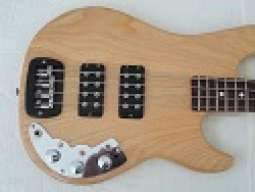
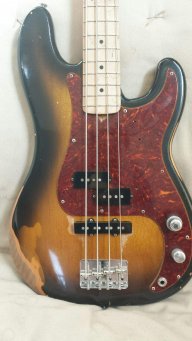
The Made In Mexico Fenders have better quality woods; hardware, and electronics than Squiers.
In this case there is also a vast clear cut difference between the passive Fender vs the active Squier. Only $80 of separation. I much prefer passive. If active is your thing then the Squier is your baby.
After taking a closer look, the Squier has the five screw contoured heel for the bolt on neck. The MIM has the traditional 4 screw neck plate. Also the Squier has the Hi-Mass Fender bridge while the MIM has the traditional Fender L-plate bridge. The pick-ups appear to be identical. The Squier's body is basswood which is much lighter and also softer than the Fender's alder body. I much prefer alder as a tone-wood over basswood. All-in-all some very clear cut differences.
Interesting. I'm new to Squires (Own my share of American Standards however.) And I was never overly impressed by the MIMs. I'd occasionally find a really good one. But most of the ones I tried over the years were just 'ok' and nothing special.
The CV Squires I've recently tried (and bought) were the exact opposite. They played great, sounded great, and more than held there own against their more expensive American counterparts. But maybe I was just lucky.
There is a question of how well they'll hold up over time. It would be fun to flash forward 50 years to see if the Squires held up as well as some of the real vintage Fenders from the 50's and 60's have.
As far as the 'tonewood' used bit goes...I'll pass on commenting since people believe what they want believe on that subject. And all discussions about the importance of the
type of wood used (as opposed to the
quality of the wood used) invariably get ugly. So I'll stand mute and move along.
Hardware? Sure. We're not looking at Hipshot tuners or Babicz bridges here. But what's on there seems to work smoothly, hold the tuning, and get the job done. And the new hi-mass bridge is actually not bad. Far better than the original bridge Fender used back in the day on all those basses that are still spoken of in hushed tones wherever Fender bass lovers gather. So hardware didn't seem to me to be much an issue. It's true there's a lot of people who feel the need to immediately replace the hardware on their Squires. But a lot of people put salt on their food without tasting it first too, so that's no surprise. I haven't found it necessary to replace any hardware myself. But YMMV.
re: that 5-bolt neck. Hmm...that's a tougher one since there's as many theories about the best way to attach a bolt-on neck as there are bass builders. Some say 4, some say 6...or 8. At least Squire gets props for being a little different here. Be interesting to see if it makes any difference in overall neck stability over the long term. As it stands, it doesn't seem to have any adverse effect on either the tone or sustain.
Passive vs active? Yeah. I'll agree with you. I much prefer passive over active basses too.
So yes, there are clearly
observable differences between the construction of Squire vs the MIM models. But I wonder how many significant
real differences there are in playability, tone, and stability.
To me the really big selling point with the Dimension Bass was it's easily adjustable truss rod (pull the neck to do it on an old Fender just once and you'll know why you'd want that) and the asymmetrical neck. Unfortunately, that slick asymmetrical neck is (currently) only available on the full-blooded American model. (Not that it costs any more to shape an asymmetrical neck than it does a standard one with today's CNC automated milling machinery. Hear me Fender? Just sayin' <wink>) But if you insisted on that feature, you wouldn't be looking at the Squire version to begin with would you?