• TalkBass has been independent since 1998. Add your voice.
    Create a free account to reply to discussions, view embedded media, and browse with fewer display ads.
    Join freeLog in
    Want zero display ads or expanded classifieds tools? Compare plans.

Dingwall Owners Club

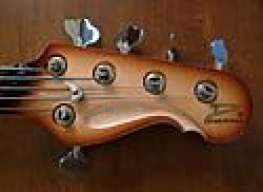
Dear friends, the new roasted maple neck for my ABII has finally landed, and was soon fitted on.

The neck is a work of art, maple with maple has made the whole instrument come alive, it has that distinctive clarity and attack typical of maple necks and you can tell its a much more resonant and responsive timber.

You only need to feather the harmonics and they jump right out nearly everywhere on this neck. I have also noticed a before / after weight where the new neck is 0.7lbs lighter

This maple timber sets the ABII apart from the rest, it gives it a completely new frequency range, the only way I can describe it, is that now this bass feels much more alive, with plenty of growl and bite, oh yes that GROWL man! which in my views was not so pronounced with the walnut / wenge combination.

It looks as though I had this vision of how a whole maple neck could have improved the sonic range of the ABII and by gosh I was both right and lucky that the investment and the long wait, were worth it in the end.

This bass was already a keeper from day one but that wenge fingerboard was not fully to my taste, and now this has become one of my favourites on par with the Super J/P, the ABZ and my 27 years old cherished PRS.

Here are some pics of it.

a4a0262a.jpg

46a949f3.jpg

1d58cc4a.jpg

d528d87d.jpg

41373bcc.jpg

02a2088f.jpg
 
Wow. I didn't know that Sheldon was on the 'roasted neck' bandwagon. It looks cool. I'll have to take your word on the sound differences since you didn't post before & after sound clips. ;)

Singlemalt - I feel the same way about my Super P/J-4 - it is so far, the most perfect bass for me that I have found. I actually sold my AB-1 recently to fund a five string version. When I was speaking with Barry, he said they are typically 8 1/2 lbs. Is yours chambered like the current model?
 
Wow. I didn't know that Sheldon was on the 'roasted neck' bandwagon. It looks cool. I'll have to take your word on the sound differences since you didn't post before & after sound clips. ;)

Singlemalt - I feel the same way about my Super P/J-4 - it is so far, the most perfect bass for me that I have found. I actually sold my AB-1 recently to fund a five string version. When I was speaking with Barry, he said they are typically 8 1/2 lbs. Is yours chambered like the current model?


Yes my Super P/J-5 is chambered like my ABII, I believe the Super P is not chambered, however Sheldon uses a thinner body to compensate for the weight issue.

I didn't have any recording means or to be honest it didn't really cross my mind to do a before and after, that neck has been 9 months between ordering to receiving that by the time it arrived, I was gagging to fit it that I did it that very night it got here, instead of going to bed, I got to work on it and swapped necks there and then. You know I mean mate, I just coudn't wait another nano second.
 
It is very normal for wood to adapt to different climates, humidity and of course to adjust to string tension. Bear in mind it's a new neck and it had never been fitted to a bass yet, so since it was fitted in the early hours of Thurs morning 5th of July, at the time it fitted perfectly and only needed a minor trussrod adjustment to take off some excess relief, i.e. to make it a little straighter and lower the action. I got it down to the exact same action as it was before with the walnut/wenge neck, then this morning Sat 7th July, two days after the neck was fitted, the wood has finally settled I have had to do the same thing again to take the action back down. Now it plays like a dream, I have compared it with the action on my ABZ 5 and they are identical, very fast necks and perfectly balanced tension / action from 1st to 24th frets.

I have to praise the excellent manufacturing skills of Sheldon and his team, the neck was a very accurate fit, it slotted in the neck pocket perfectly, not too tight and not too wide and I was pleased to find that when I removed the original neck there were no shims in the neck pocket and so when I installed the new neck I didn't need to fit any shims to achieve the same seating of it. This speaks volumes in terms of quality of constructions.

You know I've owned in my time, some very expensive Ernie Ball MM basses like their 25th Anniversary model, and even that bass had a shim in it, which to me is always a compromise between design and functionality, if a bass is built properly it should never need a shim, it should just fit perfectly and all the other MM basses I've had such as the Bongo, the Big Al, and the Stingray all had shims in their neck pocket. I guess that is a result of mass production when necks and bodies are built separately and then forced to match.

Which is the opposite of how things are done with Dingwall every part of their instrument is built to purpose and they are relentless with their accuracy.

Kudos to Sheldon & Co. I am totally devoted to their performance and quality
 
I don't think my Super P/J 5 is chambered, it's a solid 9 lb and a few ounces. Swamp ash body.

Oh sure, make me drag out the before and after pictures!
One of Sheldon's fine images, the before picture:

[Invalid or Expired Link Removed]

Here's the after image, new pup and classy white pearloid to go with the blocks:

[Invalid or Expired Link Removed]

Here's the four string, batteries under the pickguard:

[Invalid or Expired Link Removed]

Picture by Kittyboy. This one started the Dingwall journey for me, no looking back!

Played this one last night, passive P pup all night long, the GK 1001 rb 2 and the fEarful 12/6 cube. I've added a 105Q bass cry baby. Very cool pedal! it returns to zero by itself and shuts off when I let it go.
 
I've been looking for some info on Payson's strings. I've already chatted with him by PM, and now I'd like some input from the rest of the Ding-bats out there. I'm trying to decide between the nickel and the flat strings. Anyone with first-hand experience with *both* of these? (Preferably on an ABZ5). Any compare/contrast feedback would be great.

Currently, I play a range of styles from industrial-metal to blues/jazz. I find the stock setup on my ABZ to feel a bit too breathy and aspirated on the attack (playing with fingers, but not slap). While it records nicely, for live playing it feels too polite and I find myself going toward my ruder Nash PB 63 (P-bass), where I tend to roll the tone knob back to 50%. I believe that bass came strung with Dunlop strings but I'm not certain of that, though my gut says they are stainless. I'm looking to get more oomph, and dont mind sacrificing some top-end, though I would like some so the fuzz cuts through a bit.

For reference, my ABZ5 will be going into a TecAmp Black Jag 900 then into a fEARful 15/6. I'll possibly be adding an MXR Blowtorch and/or Micro POG to the chain. I'm also considering going to the P-tone PU in the future.
 
:hyper:One of the older ones, I believe this was manufactured in '98...I purchased it locally in 2000, and have had it ever since..I absolutely love it! Serial #2059. I also own a Squier Vintage Modified V, I have change the bridge to a Babicz and "blacked out" the bass, including Hipshot tuners and black tape strings.... ;) Will post a pic of that one too...
 

Attachments

  • Jim Dingwall 2.jpg
    Jim Dingwall 2.jpg
    139.1 KB · Views: 69
  • Jim Dingwall 1.jpg
    Jim Dingwall 1.jpg
    128.8 KB · Views: 93
:hyper:One of the older ones, I believe this was manufactured in '98...I purchased it locally in 2000, and have had it ever since..I absolutely love it! Serial #2059. I also own a Squier Vintage Modified V, I have change the bridge to a Babicz and "blacked out" the bass, including Hipshot tuners and black tape strings.... ;) Will post a pic of that one too...

Zero Fret, don't see too many of 'em.
 
Hello all, I bought a new Combustion in January of this year and took several months to really get comfortable with it. I am now thoroughly enjoying the bass but for one thing... I have to boost the heck out of the midrange on the amp to get a decent rock bass sound. (the Combustion comes with a two band active pre that sounds wonderful but lacks a midrange knob...) The bass sounds sweet in my praise band but in the rock cover band not so much. I am thinking it needs a three band tone stack/new preamp with a midrange control. Any suggestions? I would love to buy a Z1 but a preamp for the Combustion is much more budget-able so to speak... Thanks to all for your opinions, I must modify my Dingwall Combustion and would like some input.
 
I'm on a similar tone quest to get more oomph out of my ABZ5. My first step has been to go with a set of Payson's strings, which I just ordered. My next move will be a P-tone pickup. I'm not sure what the end result will be, but those are my considerations. However, simple is best. If you are cranking your mids on the amp and getting what you want, there is no law against cranking knobs. If you are a pedal guy, perhaps a booster and/or EQ could help. What is your current signal chain?
 
Bassmeknick, there are a couple of things you can try.

The simplest is to roll off the neck pickup. The less neck pickup in the mix, the more the bridge mids are going to come through. Leaving the treble in the center position and boosting the bass gives the bridge pickup a real nice thickness.

The other thing you could try is rewiring the neck pickup in series. This is something you'll need a qualified tech to do but it's a 10 minute procedure. It does come with the risk of wrecking your pickup which is why you need a good tech.
 
Bassmeknick, there are a couple of things you can try.

The simplest is to roll off the neck pickup. The less neck pickup in the mix, the more the bridge mids are going to come through. Leaving the treble in the center position and boosting the bass gives the bridge pickup a real nice thickness.

The other thing you could try is rewiring the neck pickup in series. This is something you'll need a qualified tech to do but it's a 10 minute procedure. It does come with the risk of wrecking your pickup which is why you need a good tech.

My lands, yes! The Dingwall stock-in-trade is the inherent midrange presence unless dialed out somewhere else in the signal chain....all too common a practice. IMO, there is no need to upgrade the pre nor re-wire the neck pickup. For that fact, I've found you can dial back the treble control(with default setting of 1.2 khz) and not lose the signature sonic footprint.

Sidenote & update: I stuck an Audere 3ZB in an older AB-1...man, that thing is a strange agent!

Riis
 
I never played a Dingwall so can anyone tell me how the playing is on the fretboard, since the frets are all slant? Is it easier then fretboards with the frets straight?

Depends where on the neck. Some positions are easier for some, others are harder. Chord shapes high on the neck can be both easier and harder. Same goes for low on the board. From the third fret to the 12th, it is prettey fast and easy to adapt. I've done it, and others who pick up my bass cold usually grab the hang of 90% of it in about five minutes of playing.
 
I never played a Dingwall so can anyone tell me how the playing is on the fretboard, since the frets are all slant? Is it easier then fretboards with the frets straight?

It gets easier after a couple of beers and 30 minutes worth of orientation. There is some degree of acclimation and you'll find yourself glancing at the fingerboard until you get the feel of things. On the plus side, you'll also find you're able to achieve improved attack, sustain, and balance with significantly less effort. IOW, you can play fast runs in the lower registers (...okay, anywhere on the neck) and actually hear what the heck is going on.

Money a little tight? Start with a Combustion 5 and build from there.

Riis