
Enjoy the benefits of a premium membership!
Upgrade Account
-
TalkBass has been independent since 1998. Add your voice.
Create a free account to reply to discussions, view embedded media, and browse with fewer display ads.
Join free Log in
Want zero display ads or expanded classifieds tools? Compare plans.
You are using an out of date browser. It may not display this or other websites correctly.
You should upgrade or use an alternative browser.
You should upgrade or use an alternative browser.
Dingwall Owners Club
- Thread starter FroggyOne2
- Start date
More options
Who Replied?

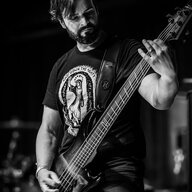
It's amazing 30 years after starting it all Sheldon has never lost the passion for his creation, and still loves talking about it.
He interviews so well! Outside of music he seems like he lives an amazing life as well.

Hi All - New to the Dingwall world and starting some research. Just 2 quick questions to start if anyone can share their opinion/experience.
1. I play seated classical style with bass between my legs (bass on left leg). Does the longer scale make it harder to reach the lower frets? How comfortable is this position with fan frets?
2. I play 5 strings tuned low E to high C - Any issues tuning a 5-String Dingwall this way?
Thank you.
1. I play seated classical style with bass between my legs (bass on left leg). Does the longer scale make it harder to reach the lower frets? How comfortable is this position with fan frets?
2. I play 5 strings tuned low E to high C - Any issues tuning a 5-String Dingwall this way?
Thank you.

Hi All - New to the Dingwall world and starting some research. Just 2 quick questions to start if anyone can share their opinion/experience.
1. I play seated classical style with bass between my legs (bass on left leg). Does the longer scale make it harder to reach the lower frets? How comfortable is this position with fan frets?
2. I play 5 strings tuned low E to high C - Any issues tuning a 5-String Dingwall this way?
Thank you.
1- Maybe, the bridge is a lot further back than on something like a Fender so you might not find the reach much different in that position. That said you may find the jack position is a much bigger issue for you than reach.
2 - None whatsoever.
Good news is there are usually a few in stores in Montreal so you can go play one.
1- Maybe, the bridge is a lot further back than on something like a Fender so you might not find the reach much different in that position. That said you may find the jack position is a much bigger issue for you than reach.
2 - None whatsoever.
Good news is there are usually a few in stores in Montreal so you can go play one.
Thank you so much. I didn't think about the jack position.

Hi All - New to the Dingwall world and starting some research. Just 2 quick questions to start if anyone can share their opinion/experience.
1. I play seated classical style with bass between my legs (bass on left leg). Does the longer scale make it harder to reach the lower frets? How comfortable is this position with fan frets?
2. I play 5 strings tuned low E to high C - Any issues tuning a 5-String Dingwall this way?
Thank you.
Welcome to the cult.
I believe you would find fret access and ease of playing quite convenient. A lot of us play this style.
Random dingbat photo attached
with the long scales it perhaps even more natural.
any tuning is easy I’ll accomplished on Dingwall’s.
Ah! I was looking for a picture. Thank you!Welcome to the cult.
I believe you would find fret access and ease of playing quite convenient. A lot of us play this style.
Random dingbat photo attached
View attachment 5017350
with the long scales it perhaps even more natural.
any tuning is easy I’ll accomplished on Dingwall’s.

Note that is not a long scale in the photo, and some of the long scales have the output at the end down by the bridge, and some have an additional flush mount on the backsideWelcome to the cult.
I believe you would find fret access and ease of playing quite convenient. A lot of us play this style.
Random dingbat photo attached
View attachment 5017350
with the long scales it perhaps even more natural.
any tuning is easy I’ll accomplished on Dingwall’s.


Hi All - New to the Dingwall world and starting some research. Just 2 quick questions to start if anyone can share their opinion/experience.
1. I play seated classical style with bass between my legs (bass on left leg). Does the longer scale make it harder to reach the lower frets? How comfortable is this position with fan frets?
2. I play 5 strings tuned low E to high C - Any issues tuning a 5-String Dingwall this way?
Thank you.
My Fretless ABII is set up E to high C - no issues

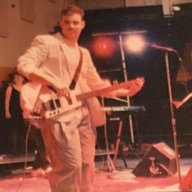
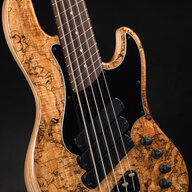
Greetings, Dingwall owners. I have a question for y'all. As a recent convert to this wonderful Dingwall madness, I have recently (a few months ago) acquired an older (serial #42XX) Super J 5. I believe it has an older-style bridge on it. I have put my favorite strings (TI flats) on it, and I've got the set-up 99% to where I want it to be. (Side note- I'm an experienced set-up guy, with a well-stocked workbench, a few parts builds in my past, and a good understanding of how everything is supposed to work.) My question is regarding the bridge saddles. The A string buzzes ever so slightly, so I need to raise it just a hair. I cannot, for the life of me, do so. Am I right that the way to do this is with the two little screws that the string goes over? The bag of tools included a variety of Allen wrenches, and the one with the blue band on it seems right. However, neither screw will budge, and I'm worried about stripping the hole with the tool if I go harder at it. I'm right that the blocks beneath the screws slide back and forth to adjust intonation, and have nothing to do with raising/lowering action, right? Please let me know how I can make this adjustment, and if (as I suspect) the screws are locked up and I need a) to loosen them somehow or b) a new bridge. Thanks!
Pix:


Pix:

You are doing it right. The screw may be down through the block and tight against the body of the bridge. Or, it may have a bit of lock tight on it.
I’ve run into this issue, especially with strings that have no taper at the ball end. With TI flats in particular, I ended up buying some shorter replacement screws to get the strings lower. The good news is that these stainless cap heads are available at any well stocked hardware. My local Ace had them for a few cents each.
There are two even smaller allen screws in the block that hold the block in place for intonation. Back these off, and loosen saddle cap heads. Check to see if the saddle screws have marked the bridge body. If so, they are just too long. And setting intonation and action height will be frustrating. The saddle screws bottom out and lift the block, and you can’t slide the block for intonation.
My one quibble with this bridge is setting intonation, it’s a bit of hit or miss since the block slides instead of having a screw adjustment. I stick a bit of blue tape on the bridge so I can see how far I’ve moved a block, and lock it down with the tiny screws once I get it right.
All my Supers end up with a set of TI flats. Yesterday, the Super P needed that half a turn on the truss rod that marks the true arrival of spring. I’ll be doing the same adjustments today on the bridge to dial intonation since I changed from extra light rounds back to the TI flats.
I started dialing in a patch on the HD500X based on the B15 model, and I’ll be messing around with some ideas for a foam mute. I’m already 90% to the funk machine sound.
My last Super 5 string was set up E-C with TI flats. Fret Nation sells single C strings fit about $14. The nut was fine, or close enough anyway, I might have needed a bit of shrink tubing on one string at the nut to stop an open string rattle. Super fun.
Good luck, and congrats on the new Dingwall!
I’ve run into this issue, especially with strings that have no taper at the ball end. With TI flats in particular, I ended up buying some shorter replacement screws to get the strings lower. The good news is that these stainless cap heads are available at any well stocked hardware. My local Ace had them for a few cents each.
There are two even smaller allen screws in the block that hold the block in place for intonation. Back these off, and loosen saddle cap heads. Check to see if the saddle screws have marked the bridge body. If so, they are just too long. And setting intonation and action height will be frustrating. The saddle screws bottom out and lift the block, and you can’t slide the block for intonation.
My one quibble with this bridge is setting intonation, it’s a bit of hit or miss since the block slides instead of having a screw adjustment. I stick a bit of blue tape on the bridge so I can see how far I’ve moved a block, and lock it down with the tiny screws once I get it right.
All my Supers end up with a set of TI flats. Yesterday, the Super P needed that half a turn on the truss rod that marks the true arrival of spring. I’ll be doing the same adjustments today on the bridge to dial intonation since I changed from extra light rounds back to the TI flats.
I started dialing in a patch on the HD500X based on the B15 model, and I’ll be messing around with some ideas for a foam mute. I’m already 90% to the funk machine sound.
My last Super 5 string was set up E-C with TI flats. Fret Nation sells single C strings fit about $14. The nut was fine, or close enough anyway, I might have needed a bit of shrink tubing on one string at the nut to stop an open string rattle. Super fun.
Good luck, and congrats on the new Dingwall!
Last edited:
You are doing it right. The screw may be down through the block and tight against the body of the bridge. Or, it may have a bit of lock tight on it.
I’ve run into this issue, especially with strings that have no taper at the ball end. With TI flats in particular, I ended up buying some shorter replacement screws to get the strings lower. The good news is that these stainless cap heads are available at any well stocked hardware. My local Ace had them for a few cents each.
There are two even smaller allen screws in the block that hold the block in place for intonation. Back these off, and loosen saddle cap heads. Check to see if the saddle screws have marked the bridge body. If so, they are just too long. And setting intonation and action height will be frustrating. The saddle screws bottom out and lift the block, and you can’t slide the block for intonation.
My one quibble with this bridge is setting intonation, it’s a bit of hit or miss since the block slides instead of having a screw adjustment. I stick a bit of blue tape on the bridge so I can see how far I’ve moved a block, and lock it down with the tiny screws once I get it right.
All my Supers end up with a set of TI flats. Yesterday, the Super P needed that half a turn on the truss rod that marks the true arrival of spring. I’ll be doing the same adjustments today on the bridge to dial intonation since I changed from extra light rounds back to the TI flats.
I started dialing in a patch on the HD500X based on the B15 model, and I’ll be messing around with some ideas for a foam mute. I’m already 90% to the funk machine sound.
Good luck, and congrats on the new Dingwall!
This is super helpful - thanks so much! I am loving this bass, so I want it to be perfect. Good to know that if I FUBAR the screw I can get another.
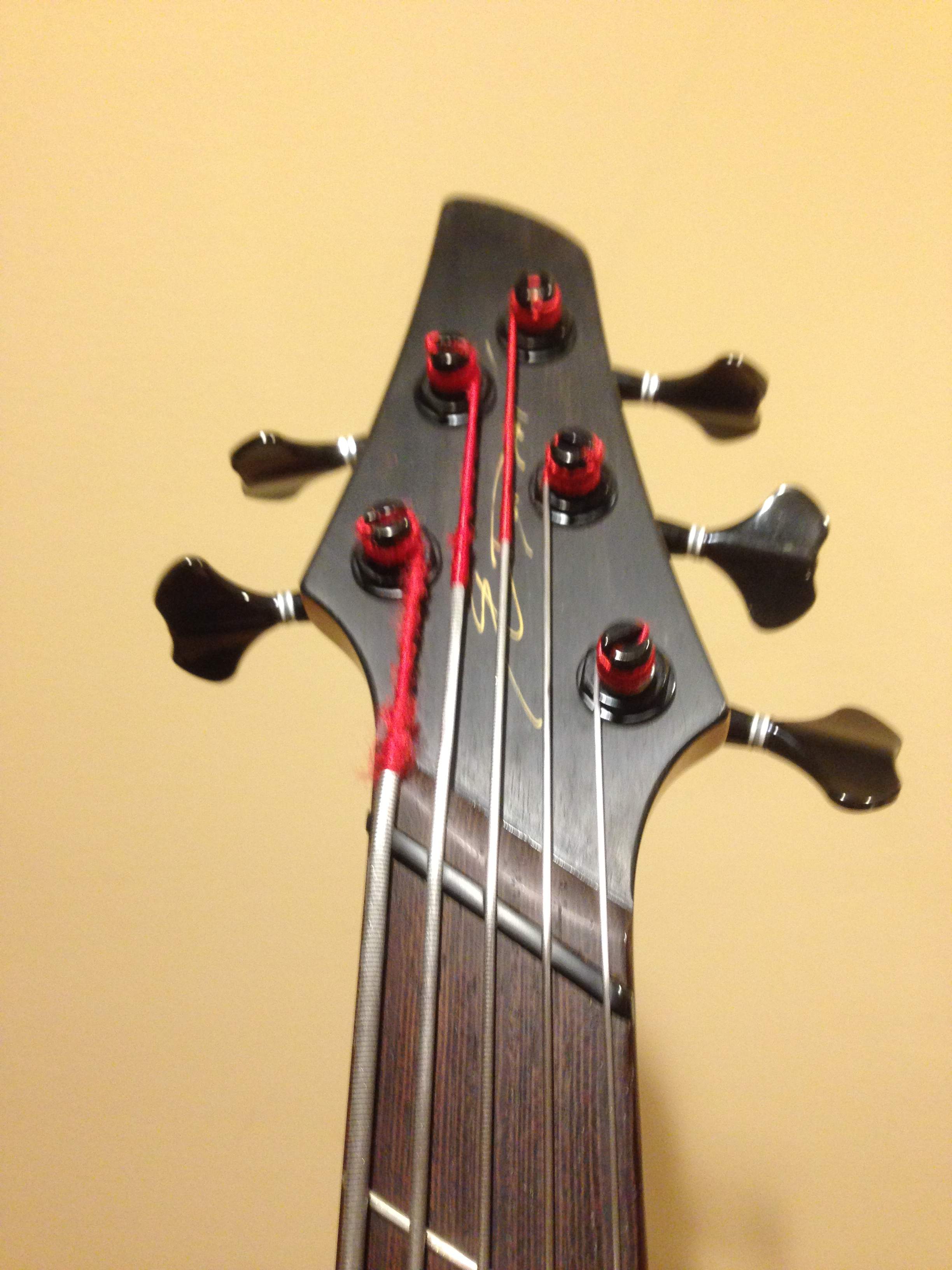
As for TI flats, a Dingwall dealer told me that TI flats wouldn't fit, so I tried other strings, but never got "my sound." I eventually threw an old set I had lying around for an upcoming build on the bass and was delighted to see that they actually do fit, even the B-string, which was the anticipated issue - I was told that long scale was too short, but super-long were too long. Long scale fits fine! Now I sound like me and the bass is even more amazing.
I've bot a Super P 4 in the build queue now, and I'll be putting TI Rounds on it when it's done in November. Can't wait!
Sweet! Last minute edit about setting up E-C with TI flats.
Is your Super active or passive?
We are going to need some pictures of the whole bass.
Is your Super active or passive?
We are going to need some pictures of the whole bass.

The extra/ super long scale does indeed fit but the G winds beyond the silk.
Hi Again -
A kind local member has been helping me out. Very friendly and helpful club here!
My main concern is string action. I recognize many fans of these basses play hard and require higher action.
I'm at the complete other side of a spectrum where I am a jazz player and require ultra low action for soloing. Can Dingwalls get to almost kissing the fret low action without buzzing?
Also, playing classical style, the position of the output jack would require an L shape of 90 degree jack end for it to not get in the way in a Z3 correct? Is it still doable on a Z3?
A kind local member has been helping me out. Very friendly and helpful club here!
My main concern is string action. I recognize many fans of these basses play hard and require higher action.
I'm at the complete other side of a spectrum where I am a jazz player and require ultra low action for soloing. Can Dingwalls get to almost kissing the fret low action without buzzing?
Also, playing classical style, the position of the output jack would require an L shape of 90 degree jack end for it to not get in the way in a Z3 correct? Is it still doable on a Z3?

IvanBassist
Commercial User
- Jun 8, 2008
- 3,744
- 11,128
- Disclosures
- Content Manager at Darkglass Electronics, Dingwall Guitars Artist
The setup done by the Dingwall shop definitely allows for a very low action without buzzing.Hi Again -
A kind local member has been helping me out. Very friendly and helpful club here!
My main concern is string action. I recognize many fans of these basses play hard and require higher action.
I'm at the complete other side of a spectrum where I am a jazz player and require ultra low action for soloing. Can Dingwalls get to almost kissing the fret low action without buzzing?
Also, playing classical style, the position of the output jack would require an L shape of 90 degree jack end for it to not get in the way in a Z3 correct? Is it still doable on a Z3?
Hi Again -
A kind local member has been helping me out. Very friendly and helpful club here!
My main concern is string action. I recognize many fans of these basses play hard and require higher action.
I'm at the complete other side of a spectrum where I am a jazz player and require ultra low action for soloing. Can Dingwalls get to almost kissing the fret low action without buzzing?
Also, playing classical style, the position of the output jack would require an L shape of 90 degree jack end for it to not get in the way in a Z3 correct? Is it still doable on a Z3?
Dingwall action can get super low depending on the bass.
you do not need a right angle jack to play in this manner on a Z. You do need to be mindful that you have a cable sticking out of the back of the bass but it’s not reall a concern… unless of course somehow you play in a weird knees close together type manner… but with knees spread apart in a normal sitting position you’ll be totally fine.
I now use a transmitter pack with a straight end cable and have no issue sitting at my desk.


