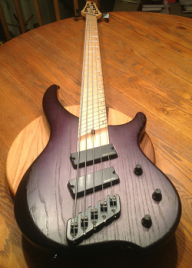
Here's a demo of the DROC Custom 5 with wenge neck and FB; finger style without heavy distortion.


TalkBass has been independent since 1998. Add your voice.
Create a free account to reply to discussions, view embedded media, and browse with fewer display ads.
Join free Log in
Want zero display ads or expanded classifieds tools? Compare plans.
Here's a demo of the DROC Custom 5 with wenge neck and FB; finger style without heavy distortion.

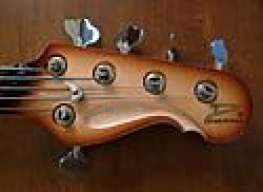
Nice. It also has these [imo, weird] non-hipshot tuners, as you can see by their not-quite-Y-keys. Maybe those have shorter posts, like the ones on the Afterburners?

I did. Also filmed some playing with it for DW’s social channelsSo if I may ask, did you play the prototype and if so how did it compare to your Canadian made Super PJ?


Here's a demo of the DROC Custom 5


Beautiful bass and great demo. Looks like a really fun bassline, inspired to learn it now! But still not enough to impress your cat.

Dingwall made a prototype 37" 4 string AB. Photos have been posted in the thread a few times. I would think that too few people are interested in 37" BEAD 4 strings to make it worth adding it to the options list because it would take redesigning the neck and changing the bridge/pickup layouts since Dingwall doesn't compromise (as in, they're not just going to design a 37" neck that can mate with the same body as a 36.25" neck).Why doesn't anyone offer a four string 37-35"?
Would be a great offering even if it was only a custom option. It's established that the 37" was when it became sonicly superior so why only offer the 36.25" four string and offer BEAD from the factory.

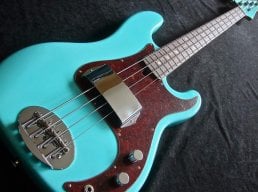
Deposit placed with my friends down at The Bass Shop on my next custom Dingwall. They had build slots available, so hopefully it doesn’t take a massively long time. I’m still estimating 18-24 months.
Should be a killer machine that’s more simple than my Super J which has all the bells and whistles.
- 4-String Super P
- Shell pink
- 3-ply white/black/white pickguard
- Maple neck and fretboard
- Black hardware with Y keys
- P-Tone pickup
- Passive Tone Fusion electronics


I've not seen one online, but The Bass Shop had a current one printed out that we worked through. You might be able to get a dealer to send you one.Does anyone know of a Super P/Super J price/options list online? FretNation has them for the Afterburners but I dont see one for the supers.
I've not seen one online, but The Bass Shop had a current one printed out that we worked through. You might be able to get a dealer to send you one.

Well........... let's see what this fanned fret stuff is all about.
Was delivered yesterday. D Roc Standard. First impressions are it is well balanced, has a fast neck, and seems be
lighter than my Ric 4003s 5-er. The D Roc B string is also way better then the Rics. Not a flabby mess.
Taking it to rehearsal tonight! Can't wait to hear how it sounds in a band setting.
View attachment 5203673
I email head office every year or two, to get an update.I've not seen one online, but The Bass Shop had a current one printed out that we worked through. You might be able to get a dealer to send you one.
I email head office every year or two, to get an update.
That way I now that it's current and correct...

Ok cool, thanks!
This is a request based wholly in ridiculousness but-
Can someone talk me out of paying £300 to have someone rip the fretboard off and replace it with an ebony one, refret with the smallest evo gold (or similar brass/brass-like) frets I can find, and maybe a brass nut.
I want to change the overall character of the attack of the note, D-bird/D-rocs do this raspy thing in the mids on the attack of each note that I love but sometimes I wonder about the more quick, yet smoother attack something like a thumb bass (bubinga/wenge/ebony) has. The characteristics im longing for are moreso inherent to instruments construction rather than tone shaping, I can get 90% of the way to where I want to be with early signal chain eq and compression, but there's a part of me that wants the actual instrument to respond a little different under my fingers.
Should I just make the decision I need to start saving for another bass, or could I strike gold modding the hell out of an already incredible instrument ?

This is a request based wholly in ridiculousness but-
Can someone talk me out of paying £300 to have someone rip the fretboard off and replace it with an ebony one, refret with the smallest evo gold (or similar brass/brass-like) frets I can find, and maybe a brass nut.
I want to change the overall character of the attack of the note, D-bird/D-rocs do this raspy thing in the mids on the attack of each note that I love but sometimes I wonder about the more quick, yet smoother attack something like a thumb bass (bubinga/wenge/ebony) has. The characteristics im longing for are moreso inherent to instruments construction rather than tone shaping, I can get 90% of the way to where I want to be with early signal chain eq and compression, but there's a part of me that wants the actual instrument to respond a little different under my fingers.
Should I just make the decision I need to start saving for another bass, or could I strike gold modding the hell out of an already incredible instrument ?
I’m not one to talk anybody out of anything when it comes to GAS, but you might want to consider ordering a replacement neck, or send it back to the factory for the mod if they’re willing.This is a request based wholly in ridiculousness but-
Can someone talk me out of paying £300 to have someone rip the fretboard off and replace it with an ebony one, refret with the smallest evo gold (or similar brass/brass-like) frets I can find, and maybe a brass nut.
I want to change the overall character of the attack of the note, D-bird/D-rocs do this raspy thing in the mids on the attack of each note that I love but sometimes I wonder about the more quick, yet smoother attack something like a thumb bass (bubinga/wenge/ebony) has. The characteristics im longing for are moreso inherent to instruments construction rather than tone shaping, I can get 90% of the way to where I want to be with early signal chain eq and compression, but there's a part of me that wants the actual instrument to respond a little different under my fingers.
Should I just make the decision I need to start saving for another bass, or could I strike gold modding the hell out of an already incredible instrument ?