• TalkBass has been independent since 1998. Add your voice.
    Create a free account to reply to discussions, view embedded media, and browse with fewer display ads.
    Join freeLog in
    Want zero display ads or expanded classifieds tools? Compare plans.

Dingwall: Won't Settle For Less

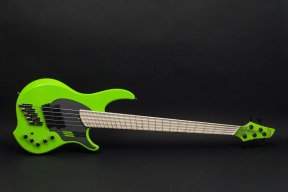
Just played a Combustion yesterday and there's a good chance a Dingwall could be my next bass.

Liked the ergonomics and the string tension compared to other five strings. My brief time plugged in didn't give me much feel for the amplified tone, but what I felt seemed a little, well, "flat" for my tastes. I'm definitely a fan of an aggressive growly tone and it certainly didn't feel capable, even after cranking the onboard pre.

Any owners with more experience with Dingwalls have a feel for the aggressiveness of the electronics?

If you're looking for an aggressive tone, I'd recommend one of our other basses - ABZ perhaps. Or, upgrade the Combustion pickups to the Neodymium FD-3's.

The FD-3A pickups in the Combustions have more of a Throwback smooth tone.
 
Sheldon, I know in the past the answer has been no to the possibility of a six string Combustion, but has there been any change in your thinking lately? I know it would sell well, but probably nowhere near as well as the fivers, so I suppose from your perspective it probably wouldn't make sense to start producing them. It would be really nice, however, for those of us that would kill for a six string Dingwall but can't afford one ;)
 
Sheldon, I know in the past the answer has been no to the possibility of a six string Combustion, but has there been any change in your thinking lately? I know it would sell well, but probably nowhere near as well as the fivers, so I suppose from your perspective it probably wouldn't make sense to start producing them. It would be really nice, however, for those of us that would kill for a six string Dingwall but can't afford one ;)

The Combustions require sizeable order quantities. For now 6's don't have the numbers. We do them in an ABZ though which don't cost a whole lot more.
 
I have owned a few basses in my young life. I was a Tobias guy, but I had a classic 5 stolen from a gig and was playing my back up high end jazz 4. I was in San Diego and went to get a lakland to get another 5. I saw the Dingwall and picked it up and it was everything I wanted. As a fulltime musician I thought the loss of my Tobias would never have an upside, but the Dingwall is awesome, and I have had more questions and attention because of how the combustion looks and sounds I think i've converted a few musicians I know.

!!!!!--- About the agressive tone. Sheldon if you are still checking this post. I love the tone but I play bluegrass to electronica. What's the answer to get the low B to Bump more?

Thanks Rob
 
I had a Dingwall Z1 & sold it ~ I do plan on ordering another one this year with a different pickup configuration~ basically I need to get the bridge pickup farther away from the bridge. When I had my Z1 I would play it about 50/50 with my Lakland 55-94~IMHO the Dingwall had more of a hi fi tone that did not sit as well as the Lakland in every tune I played. I don't think a Dingwall the last bass that should ever be in your hands, but my God~ that B string~ there is nothing like it.
 
Originally Posted by Sheldon D.
Try rolling the neck pickup all the way off or at least 80% off, roll on some bass and adjust treble to taste. Let me know how this works.

Thanks for the quick answer-

I've found that my favorite tone is 80-50% neck 100% bridge, bass pre turned up all the way, and treble in the middle. It sounds amazing and the low B is clear, but not dominant. In almost all cases in past the lower tone string the louder the sound produced... On my combustion the low B is present, but doesn't punch harder than everything else. I really want to get that B to be louder so I can use it and really get people to move. Last night I played and I tweaked my head to try and squeeze more deep bass out, not much help.... I currently use a Mesa Boogie M-pulse 600 and Glockenklang 4x10.

I don't have the ability to experiment different sets of electronics/pick ups to make it do what I want($$). From what I have learned about you and your company in the last month(once I played the combustion I read everything I could find on you and your company... your reputation had just as much weight on my choice as your product) you are the man with the answers. Before seeing a Dingwall in San Diego just before the New Year I had only seen a picture or two wondering how it played(never honestly thought I'd own or love one) and the thought... Charlie Hunter's got something like that!?

My thoughts on getting a fatter sound was, changing to preamp out to an aguilar (+18db bass), extremely concerned what it would do to the tone that it was given in Canada. Pickups also crossed my mind, wiring(series/parallel), and/or external fix(preamp or cabinet... I gig at least 3 times a week, In the band The Situation or side projects, I hate to move heavy gear, I'm sure u understand. The glockenklang 4x10 really is fabulous.)

This bass is almost everything I could want except some how I have to.... I sure would like it..... get the volume of the low B louder...to dominate... to Boom... punch you in the chest, and I love the look of woods with minimal finish.

Anything that you could think of to help would be awesome.

Rob
Camarillo, CA
[email protected]
 
Thanks for the quick answer-

I've found that my favorite tone is 80-50% neck 100% bridge, bass pre turned up all the way, and treble in the middle. It sounds amazing and the low B is clear, but not dominant. In almost all cases in past the lower tone string the louder the sound produced... On my combustion the low B is present, but doesn't punch harder than everything else. I really want to get that B to be louder so I can use it and really get people to move. Last night I played and I tweaked my head to try and squeeze more deep bass out, not much help.... I currently use a Mesa Boogie M-pulse 600 and Glockenklang 4x10.

I don't have the ability to experiment different sets of electronics/pick ups to make it do what I want($$). From what I have learned about you and your company in the last month(once I played the combustion I read everything I could find on you and your company... your reputation had just as much weight on my choice as your product) you are the man with the answers. Before seeing a Dingwall in San Diego just before the New Year I had only seen a picture or two wondering how it played(never honestly thought I'd own or love one) and the thought... Charlie Hunter's got something like that!?

My thoughts on getting a fatter sound was, changing to preamp out to an aguilar (+18db bass), extremely concerned what it would do to the tone that it was given in Canada. Pickups also crossed my mind, wiring(series/parallel), and/or external fix(preamp or cabinet... I gig at least 3 times a week, In the band The Situation or side projects, I hate to move heavy gear, I'm sure u understand. The glockenklang 4x10 really is fabulous.)

This bass is almost everything I could want except some how I have to.... I sure would like it..... get the volume of the low B louder...to dominate... to Boom... punch you in the chest, and I love the look of woods with minimal finish.

Anything that you could think of to help would be awesome.

Rob
Camarillo, CA
[email protected]
I'm not Sheldon, but I've had the same desire and this is what I've found - wire to series and pluck the B string a bit closer to the bridge. Like, if I'm plucking the E string with the thumb anchored on the neck pickup, I pluck the B string slightly more to the bridge but without un-anchoring my thumb, where it's comfortable.

I don't know, I feel like the low B stands out in series even more. Could be that the increased low mids of the series mode benefit the string, I don't know. Play with the EQ. Just don't forget that most string definition comes not from the fundamental, but from overtones - such radical boosting of bass might ruin definition and punch. The Dingwall B string provides the overtones that give the definition - other basses lack them, more or less - don't ruin them, but use them to your advantage. If you've got a parametric eq, narrow a band, boost it greatly, and move it around the lower mids to learn about where the punch is. Than make it less radical.

This is on an AB-II though. If you want to, maybe Sheldon could create you a 4-position pickup selector like on other Dingwalls so you could go series. You'll lose some tone variability that way, though.

This is all IMO, and I'm still learning a lot. I could be wrong very easily.
 
The SuperJ is among my fave instruments, most of which are pretty spectacular.

I find it hard to justify buying anything else when it comes to +$1500, and that's mostly now because I'm trying to figure out my needs when it comes to a new bass.

If Dingwall were to make a 'superP' I think it'd be the new classic.

Other fave basses:

Lakland Decade
Lakland DJ5
Lull 5 string Jazz
Framus Star 4 (vintage, through an ampeg B18...wow...)
Warwick Thumb BO5
Musicman Sterling Fretless

I have a spot in my heart for Fenders and for the Italia Mondial...but when it comes down to build quality, they're not in the same league, pound for pound.

Looking forward to Summer NAMM to see the Canadian Guitar Company's offerings...I think there should be a nice surprise there.
 
I'm not Sheldon, but I've had the same desire and this is what I've found - wire to series and pluck the B string a bit closer to the bridge. Like, if I'm plucking the E string with the thumb anchored on the neck pickup, I pluck the B string slightly more to the bridge but without un-anchoring my thumb, where it's comfortable.

I don't know, I feel like the low B stands out in series even more. Could be that the increased low mids of the series mode benefit the string, I don't know. Play with the EQ. Just don't forget that most string definition comes not from the fundamental, but from overtones - such radical boosting of bass might ruin definition and punch. The Dingwall B string provides the overtones that give the definition - other basses lack them, more or less - don't ruin them, but use them to your advantage. If you've got a parametric eq, narrow a band, boost it greatly, and move it around the lower mids to learn about where the punch is. Than make it less radical.

This is on an AB-II though. If you want to, maybe Sheldon could create you a 4-position pickup selector like on other Dingwalls so you could go series. You'll lose some tone variability that way, though.

This is all IMO, and I'm still learning a lot. I could be wrong very easily.


Thank you very much for the info. I think the After Burners are pretty cool. You have an awesome bass.

Finger placement is a great way to get depth and tone. I will run my hand up and down the strings to get a deeper or brighter tone. I even rest my thumb on the edge of the neck sometimes.

I think the AB-II is passive, and I think that the pickups are different. I do like active electronics. If it would make a huge difference then a knob would be awesome if you could change it on the fly. Does it make any noise when switching?

I have a semi parametric EQ on my head, and I have played with it and got it to give me the best tone available, but I'm missing the punchy B even the E isn't as powerful as some, but it's punchy enough. It's not really a concern.

You do have a huge point. I do not want to ruin the tone that is there. I just want to be able to use the B for effect when playing. I play in a power trio and play up and down, top to bottom on the neck in almost every song. I'll adjust the on board preamp through out songs. We do weird stuff. For example we have a song that starts with reggae jumps to bluegrass, and then depending on how we are feeling it ends up with ambient to heavy electronica or can end in smooth easy fluid sound with cool arrangements that sound beautiful and pretty(for lack of a better word). I love my Band we touch every style of music backwards, upside down, any way to get someone to have fun and enjoy themselves.

Thanks for your help.
Rob
 
Thank you very much for the info. I think the After Burners are pretty cool. You have an awesome bass.

Finger placement is a great way to get depth and tone. I will run my hand up and down the strings to get a deeper or brighter tone. I even rest my thumb on the edge of the neck sometimes.

I think the AB-II is passive, and I think that the pickups are different. I do like active electronics. If it would make a huge difference then a knob would be awesome if you could change it on the fly. Does it make any noise when switching?

I have a semi parametric EQ on my head, and I have played with it and got it to give me the best tone available, but I'm missing the punchy B even the E isn't as powerful as some, but it's punchy enough. It's not really a concern.

You do have a huge point. I do not want to ruin the tone that is there. I just want to be able to use the B for effect when playing. I play in a power trio and play up and down, top to bottom on the neck in almost every song. I'll adjust the on board preamp through out songs. We do weird stuff. For example we have a song that starts with reggae jumps to bluegrass, and then depending on how we are feeling it ends up with ambient to heavy electronica or can end in smooth easy fluid sound with cool arrangements that sound beautiful and pretty(for lack of a better word). I love my Band we touch every style of music backwards, upside down, any way to get someone to have fun and enjoy themselves.

Thanks for your help.
Rob
Hey,

It sounds like a great band :D

The AB-II has passive pickups, the same ones on an AB-I, but also has a preamp that can be turned on or off. I keep it on, but only slightly adjust the sound. It's controls are very sensitive. The active/passive switch is noiseless as far as I know, but I rarely use it mid-song. I've tried to use it as a "boost switch", but got bored of switching it on and off :p

Besides the active-passive switch, my AB-II can also switch the neck pickup between parallel and series. I don't know why current AB-IIs don't have that anymore, I find it great, with the neck pup soloed and in series it's the best P sound I've heard. I don't play with a pick, but that sound has made me try :D

Also, a semi-parametric EQ is a great feature, but to find "that" frequency, a fully-parametric EQ is best. See if you can borrow a pedal or something with it. Just so you can narrow the band down; once you find "that" freq, you can start expanding around it and see what you get.

Regards,
Bo
 
I'm missing the punchy B even the E isn't as powerful as some, but it's punchy enough. It's not really a concern.

You do have a huge point. I do not want to ruin the tone that is there. I just want to be able to use the B for effect when playing.
Rob

It sounds like you need to raise the bass ends of the pickups. Try 1-2 turns on each mounting screw. Double check to make sure the string isn't going to hit the pickup shell when playing.
 
I would wager anything that Dingwall basses sound so good because of superior construction more than the fanned frets. I've tried basses with 35" that had bad b-strings (worst example the Yamaha JP2) and 32" basses that have amazing b-strings. I'm currently waiting for deliery on my custom 5-string, 32" bass.
 
I would wager anything that Dingwall basses sound so good because of superior construction more than the fanned frets. I've tried basses with 35" that had bad b-strings (worst example the Yamaha JP2) and 32" basses that have amazing b-strings. I'm currently waiting for deliery on my custom 5-string, 32" bass.
I have said it before, I'd probably be playing a Dingwall, even if it were a parallel fret bass. That being said, there's no way I can dismiss the advantages of a 37" Bb string, and maybe more importantly the consistent tension that only a variable scale length can provide. In the realm of high-end basses and the small advantages that separate them it just can't be overlooked, although it's not for everybody.
 
I would wager anything that Dingwall basses sound so good because of superior construction more than the fanned frets.

Yes and no. Construction is very important as are pickups and strings.

We've built parallel basses in the past and have come to the conclusion that for the performance we are looking for, fanned-frets and extended scales are key components. Remove them and you remove their benefits too.
 
In the past 20 years I have gone through Fender P and J's, Ibanez (Prestige),Warwick, Bongo's, Laklands, Sadowsky and a few others, last year I picked up a Dingwall Afterburner I and let me tell you there is nothing like a Dingwall!
They are so comfortable and they really cut through at gigs, I have actually sold all my other basses and now only have the Bongo 5 and the Dingwall and I plan on buying a Combustion or maybe an Afterburner II this year, so yea I am not really interested in other basses at the moment.