This is a great read of a thread guys! I'll add a few thoughts. I repair portable generators with my wife and I's small engine business.
"Dirty Power" means a few things. Mains frequency is 60hz here in US, 50HZ in Europe. Dirty is said when there are voltages at higher frequencies/harmonics such as 120hz, 240hz, etc. This is known professionally as
"Total Harmonic Distortion." This in basic terms means there are voltages at higher frequencies is not utilized by the device/load and since the energy cannot be utilized, it is wasted as excess heat. Over time this can cause devices to fail. In practice however with audio gear, the power supplies are overbuilt to handle this. Also the NEC spec here in the USA is utility grid power will not exceed 5% THD Total Harmonic Distortion. As such this is less of an issue in general. There are filter devices caled line/load reactors that present high impedance/resistance to these higher harmonics with voltages at them, but they are physically crazy large and expensive. Not practical at the residential level.
Dirty power when referring to
electromagnetic interference / radio frequency interference (EMI/RFI) is more commonly associated with Dirty Power. This is caused by other devices radiating trash signals back through the audio device and mains circuitry you are using and that is harder to track down. Despite the difficulty, there are many devices to help filter and solve this.
Power Conditioners are not all created equal.
- Some only provide MOV (Metal Oxide Varistors) that are meant for surge protection. They are connected between the line and neutral wires, and will only start conducting at a far higher voltage (in the thousands of volts) than 120/240, basically shorting those spikes to ground. Too much of a surge and those MOVs sacrifice themselves to save your gear. These may or MAY NOT cause the branch breaker to trip.
- Other power conditioners add an inductor, AKA common mode choke to present a high resistance in the kilohertz range to suppress any EMI/RFI on the AC lines that can be found on AC lines where other devices are inducing this interference such as Wifi Routers, wireless devices, inferior SMPS, and many others.
- A "line voltage regulator" can have all the above, and use an autoformer, a type of transformer with different taps to keep the incoming line voltage going to your equipment in a safe range, and disconnect the mains when it is unable to be regulated as the line voltage incoming is too low/high.
Finally on gear in general, some switchmode power supplies that run them are not properly filtered, even expensive gear. If not filtered the internal DSP chips clock frequency (normally way above the audio spectrum) and switch mode frequency thats converting the mains voltage to lower VDC will modulate into the audio spectrum back through the power lines. A phenomena called "heterodyning" where two or more high frequency signals combine to create a lower frequency of the source ones, that is often known as the switch mode power whine, pulsing, warbling, buzzing commonly described as. There are special filters from Corcom that deal with fixing these issues, but may not be cheap. Some are though.
There plenty of ground loop isolators via audio interconnect, and I know a few AC line products people have reported success. Even ground loops through your rack gear is an issue, lookup Hum-Frees. Always try to power all your gear on one circuit, or if you need more power, make sure your studio is run by a separate sub panel where all the ground wires converge to one common bus bar. If all the earth grounds are at the same voltage potential, there will be no ground plane noise
Finally, always shield your guitars. Adding copper tape or copper based paint to an electronics cavity acts as a Faraday cage to shield any outside interference. Videos below of how much that can make a difference.
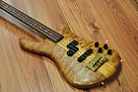
Fender Ultra Precision bass






 (it's more of an issue with my Strat [humbuckers are 8-9dB quieter, but not completely bucked]).