
Enjoy the benefits of a premium membership!
Upgrade Account
-
TalkBass has been independent since 1998. Add your voice.
Create a free account to reply to discussions, view embedded media, and browse with fewer display ads.
Join free Log in
Want zero display ads or expanded classifieds tools? Compare plans.
You are using an out of date browser. It may not display this or other websites correctly.
You should upgrade or use an alternative browser.
You should upgrade or use an alternative browser.
DIY: Making Short Scale Strings out of Long Scale Strings
- Thread starter ray_castro
- Start date
More options
Who Replied?
- Sep 9, 2007
- 5,309
- 4,977
- Disclosures
- Endorsing Artist: Eventide, GHS Strings, G&L Guitars, NS Design, Tsunami Cables
Has anyone tried that method successfully on flats?
Doubtful. Also, please check out response #10 which directly answers your question.

Has anyone tried that method successfully on flats?
I tried it once, and it quickly came apart. I've considered trying it again with physically crimping the string instead of glue and heatsink, or possibly spot welding. When I tried Jim Dunlop Flatwound Short Scale strings, they worked perfectly for me, so I just went with those instead.

I don't think this is necessary for flats unless they physically can't fit in the tuner hole.
I'm pretty sure the JMJ Mustang ships with Fender 9050s (long scale) cut to fit the short scale with no unraveling. Chromes also can withstand being cut short and wrapping around the E post with the thick part.
I'm pretty sure the JMJ Mustang ships with Fender 9050s (long scale) cut to fit the short scale with no unraveling. Chromes also can withstand being cut short and wrapping around the E post with the thick part.

I did a test of your method on a Dunlop flatwwound .105 that was already short scale off my Mikro. I started where the silk started ( i'd removed the silk itself even though you wouldn't encounter silk with the beginning of it being past the Mikro tuners with long scale strings, just for an exercise in doing it). Anyhow I ended up snipping some wrapping and I got a flat winding seperation. So I abandoned it. I like the look of peg end silks anyhow. I'd already started down the path of shortening strings via the ball end. In this case, I wasn't shortening them per se, because they were already shorties. I just used as a platform for a modified technique that I got the idea from here The Official Short Scale Bass Club -- Part 2I tried it once, and it quickly came apart. I've considered trying it again with physically crimping the string instead of glue and heatsink, or possibly spot welding. When I tried Jim Dunlop Flatwound Short Scale strings, they worked perfectly for me, so I just went with those instead.
In that post, the poster mentions that solder would prob be unsuitable for flat wounds. So I thought about it and thought I'd replace the solder with Superglue ( I thought I would ultimately go on to use PC-7 epoxy paste, but it takes 48 hrs to cure, whilst CA with bicarb is quick curing and is cheap and appears robust). I also decided to ditch using the ball ends themselves due to the need for drilling them out if using 115+ gauges. Anyhow, I am going to see how things hold up. But so far so good. Cheap, relatively quick. I have had a comment elsewhere about this approach being a potential eye injurer if the string pulled thru, but the glue really bonds to the exposed 1cm of round wrap at the end. The flat wrap is locked in place by the glue and heat shrink. The core is locked from being pulled in from the peg winding by seepage of glue into the round wrap and at the exposed core tip. I think if this holds up for a considerable period of time I would consider it viable. I mention that a solder blob could be an alternative to a superglue blob, but thinking bout it, as you mention, superglue can seep into the round wrap, where solder wouldn't. I did a kind of write up about it here "Official" Mikro Bass Club Part 3
Initial test with ball on a 050 Chrome flatwound
Subsequent tests on Dunlop flat 085 and 065 and Chrome 050 with heat shrink and glue blob with no balls..
Bear in mind that this is coming from a guy who isn't the greatest DIY'er. In future goes ( if tests hold up) I will create uniform glue globs of the smallest size that won't get pulled thru the bridge holes, and I will colour them too, prob black. Whilst playing, to be on the safe side, I wear some safety glasses. At least till I am sure that Hecules couldn't pull the string out of the glue glob. Cheers
Last edited:

@ray_castro
I tried again with your technique on a section of the Dunlop 105 flatwound I tried it on yesterday but screwed up. I found that using the super glue where you didn't want the flat wrap to unwrap beyond and using bicarb to cure it quickly, and doing the same at the point the round wrap was unwrapped too seem to stop any flst wrap separation. And then the heat shrink put in place. I guess you could place shrink wrap over all of the exposed round wrap an emulate the missing silk. I think your approach is probably a better thing to do than shortening from the other end that I have been trying out. Think I might hone both approaches now Cheers
Some pics showing a succesful go


Yesterday. Flat wrap chaos

I tried again with your technique on a section of the Dunlop 105 flatwound I tried it on yesterday but screwed up. I found that using the super glue where you didn't want the flat wrap to unwrap beyond and using bicarb to cure it quickly, and doing the same at the point the round wrap was unwrapped too seem to stop any flst wrap separation. And then the heat shrink put in place. I guess you could place shrink wrap over all of the exposed round wrap an emulate the missing silk. I think your approach is probably a better thing to do than shortening from the other end that I have been trying out. Think I might hone both approaches now Cheers
Some pics showing a succesful go
Yesterday. Flat wrap chaos
Last edited:

My cutters work on both long and short scale. Pro tip, you can always cut shorter but you can’t make it longer.
My cutters work on both long and short scale. Pro tip, you can always cut shorter but you can’t make it longer.
Have you tried Ray's method? Do you see it as superfluous? If so, do you just cut long scale flatwounds to length on a short scale and wind on irrespective of fat wrap around post? If so have you had any hassles with flat overwrap coming apart
My bass below. And I 100% admit to it, I grabbed the wrong set of strings out of my bin and cut one before I realized these were long scale on my short scale bass. These are TI flats. And they have been perfect for going on 3 years of heavy use. I know better. I still have the short scale set I bought and meant to use lol. But they are fine.Have you tried Ray's method? Do you see it as superfluous? If so, do you just cut long scale flatwounds to length on a short scale and wind on irrespective of fat wrap around post? If so have you had any hassles with flat overwrap coming apart
Ok. A chap mentioned in the Mikro club thread that he had put TI short scales ( which confusingly are actually medium scale winding lengths for a 32" scale) on his Mikro. He saw no ill effects of non silked string around the posts. The speculation being that you can get away with it with the fatter strings because of the silk wrap around the core of the the TI's. By the look of the silks visible on your A and D posts, it is the medium winding length set (32" bass) you used too I have been a Dunlop flat guy, but I am trying out some labella DTF 49-109's. No way that you'd wanna wind fat sections of the fattest strings of either around a post. Kiss em goodbye if you did I reckon. And there in is the rub. For a sub shortie like the Mikro, string sets are already limited in flatwounds. If a set you like is in long scale only, you just can't use them. For example, I wanna try the original 54 set of Labella 52-110 that have a bigger core to wrap ratio and stiff and might give me a less sloppy D in dgcf tuning. But I can't use em without shortening as the short scale set was discontinued. No chance of wrapping fat string around a post with those strings without damage
Last edited:
If anyone wants to try out doing this on flatwounds but doesn't want to waste expensive flats if things go wrong , you can buy Alice A628 45-101 nickel flats for around $20usd (around 30 aussie dollars, post inclusive) on Aliexpress ( I've used Aliexpress for some cheap parts with no problem. Research the rating and comments about the seller before buying, and it works out good). This is what I plan to do to hone my shortening chops with long scale flats without going bankrupt. https://m.aliexpress.com/item/1005003123927827.html?spm=a2g0n.productlist.0.0.15639a5byvQer5&browser_id=a74b1ad97fc2498bb18eef2a796480e6&aff_platform=msite&m_page_id=oxnlhdieeocaqgqa1899e33ebfae641a3352627240&gclid=&pdp_npi=3@dis!AUD!25.66!20.54!!!16.92!!@211bf14716905763502096641d0760!12000024225146072!sea!AU!0&isseo=y&algo_pvid=5dc394fe-aa4b-41e4-9f78-e95ecf00fd0b
Here are a few little tips others might find handy using ray's shortening method, be it for rounds or flats.
1. Preserving super glue. You know the feeling, you go to use that last drop of glue you thought would still be ok, only to find it has hardened in the dropper nozzle. Solution. When you puncture the seal on the glue, don't put the nozzle tip on to dispense the glue. Only use the dropper nozzle as an airtight lid when done. Place a little blue tac picture hanging putty under the bottom of the glue tube, so when you are using it you can set it down with the tube standing up. When you are done using, wipe the tube thread making sure to remove glue from grooves. Screw nozzle with cap on and store in upright position with the blue tac.
2. Measuring your winding length. A good rule of thumb is halfway between nut and tuner post. Mark it with a marker pen. Next measure the distance from that mark to tuning post and from post to a point that allows enough string to be wound around post and down the hole. I currently measure 85 mm past posts on my Mikro, which has 11mm diameter posts on the stock tuners. This provides 25 mm to go down the hole, and 60 mm around the post. (2.5 wraps) Mark this point with marker pen. This is where you will be cutting the string to the length you want. Place a length of heat shrink on your string and position it below the first mark. If you want things nice and pretty and emulate silk , you measure the distance between your first mark and the cutting point mark and cut a piece that long. If you are happy with the bare look just cut a piece long enough to cover whatever length the collar is with 1 cm coverage extende either side of collar.
3. Things are ready for super glue collar. This prevents any initial unravelling of the outmost wrap below your first mark point. Have a working surface, something you can put drops of glue on. A plate you don't eat off is good. Don't use tissues or paper towel as it will stick to string and scatter your bicarb all over the place trying to separate string and tissue/ paper. A paper plate is fine though. Place a drop of glue on your working surface. Hold string either side of mark and swivel it thru glue so that a centimetre collar of glue is formed. Take a pinch of bicarb and sprinkle it on the glue collar to rapid cure. Done. Time to move onto to cutting string at second mark and removing outer wrap down to the glue collar.
4. Cut your string at the desired length second mark. Unwind outer wrap down to the collar and cut off. Flatten any snipped wrap that is sticking up. If this is the only layer removed, than extend collar 1 cm towards the cut end of string to secure the snip point. If a second wrap layer is to be removed than don't extend collar. Unwind second wrap to 1 cm above the point of where you unwrapped first layer to. Snip and flatten any protruding wrap. Extend collar to cover the 1cm of remaining second layer wrap and the snipped end of first wrap. If you need to remove a 3rd wrap for a humungus gauge than do as per second layer.
5. Final heat shrink stage. Position heat shrink to cover collar at least 1 cm below and 1 cm above or all the way to end of string if desired.
Some pics. This is on a Chrome guitar jazz flat 050 which really would be ok put on as is ( I can use guitar strings on my current Mikro bridge without washers or stuff to stop the smaller ball end pulling thru. Basically use this string as a platform for trying this out without botching it on expensive fat bass strings. Cheers
Equipment I used

Glue collar with unwound outer wrap

Finished ( the heat shrink is a bit lumpy due to being oversize for the string wrap diameter involved. But you get the idea.A variety of shrink sizes is the go)

1. Preserving super glue. You know the feeling, you go to use that last drop of glue you thought would still be ok, only to find it has hardened in the dropper nozzle. Solution. When you puncture the seal on the glue, don't put the nozzle tip on to dispense the glue. Only use the dropper nozzle as an airtight lid when done. Place a little blue tac picture hanging putty under the bottom of the glue tube, so when you are using it you can set it down with the tube standing up. When you are done using, wipe the tube thread making sure to remove glue from grooves. Screw nozzle with cap on and store in upright position with the blue tac.
2. Measuring your winding length. A good rule of thumb is halfway between nut and tuner post. Mark it with a marker pen. Next measure the distance from that mark to tuning post and from post to a point that allows enough string to be wound around post and down the hole. I currently measure 85 mm past posts on my Mikro, which has 11mm diameter posts on the stock tuners. This provides 25 mm to go down the hole, and 60 mm around the post. (2.5 wraps) Mark this point with marker pen. This is where you will be cutting the string to the length you want. Place a length of heat shrink on your string and position it below the first mark. If you want things nice and pretty and emulate silk , you measure the distance between your first mark and the cutting point mark and cut a piece that long. If you are happy with the bare look just cut a piece long enough to cover whatever length the collar is with 1 cm coverage extende either side of collar.
3. Things are ready for super glue collar. This prevents any initial unravelling of the outmost wrap below your first mark point. Have a working surface, something you can put drops of glue on. A plate you don't eat off is good. Don't use tissues or paper towel as it will stick to string and scatter your bicarb all over the place trying to separate string and tissue/ paper. A paper plate is fine though. Place a drop of glue on your working surface. Hold string either side of mark and swivel it thru glue so that a centimetre collar of glue is formed. Take a pinch of bicarb and sprinkle it on the glue collar to rapid cure. Done. Time to move onto to cutting string at second mark and removing outer wrap down to the glue collar.
4. Cut your string at the desired length second mark. Unwind outer wrap down to the collar and cut off. Flatten any snipped wrap that is sticking up. If this is the only layer removed, than extend collar 1 cm towards the cut end of string to secure the snip point. If a second wrap layer is to be removed than don't extend collar. Unwind second wrap to 1 cm above the point of where you unwrapped first layer to. Snip and flatten any protruding wrap. Extend collar to cover the 1cm of remaining second layer wrap and the snipped end of first wrap. If you need to remove a 3rd wrap for a humungus gauge than do as per second layer.
5. Final heat shrink stage. Position heat shrink to cover collar at least 1 cm below and 1 cm above or all the way to end of string if desired.
Some pics. This is on a Chrome guitar jazz flat 050 which really would be ok put on as is ( I can use guitar strings on my current Mikro bridge without washers or stuff to stop the smaller ball end pulling thru. Basically use this string as a platform for trying this out without botching it on expensive fat bass strings. Cheers
Equipment I used
Glue collar with unwound outer wrap
Finished ( the heat shrink is a bit lumpy due to being oversize for the string wrap diameter involved. But you get the idea.A variety of shrink sizes is the go)
Last edited:
Yes, they have two sets in short scale out in the U.S at least. The heavier of the two being 50-110. 110 is still too small a gauge for a Mikro in tunings below standard E. Hence string shortening and reducing diameter of wrap around post and certainly taking flatwound outer wrap out of the equation. No way you want to wrap a gargantuan flat non tapered section of string around the small diameter post on a Mikro in particular. Some get away with a TI doing it but I doubt the gauge is more than 100. Doubt anyone is game enough to blow a 136 doing itI think Ernie ball has cobalt flats in short scale now. Need to go try those.
This string shortening thing opens up more options for using a gauge over 110, without having to buy a whole set of 5ivers to get. Eg. If you like Chromes, the 132 in long scale is out of bounds on short scale basses. Like wise if you like rotosound 77 flats the 125 single is only in long scale. Who wants to buy a whole set to just get one or maybe two strings
p.s make sure not to make collar with heat shrink so large in diameter that it won't pass thru bridge holes. If glue collar turns out a bit too large you can carefully sand it to reduce diameter or alternatively make bridge holes a little bigger
Last edited:
Yes, they have two sets in short scale out in the U.S at least. The heavier of the two being 50-110. 110 is still too small a gauge for a Mikro in tunings below standard E. Hence string shortening and reducing diameter of wrap around post and certainly taking flatwound outer wrap out of the equation. No way you want to wrap a gargantuan flat non tapered section of string around the small diameter post on a Mikro in particular. Some get away with a TI doing it but I doubt the gauge is more than 100. Doubt anyone is game enough to blow a 136 doing it
This string shortening thing opens up more options for using a gauge over 110, without having to buy a whole set of 5ivers to get. Eg. If you like Chromes, the 132 in long scale is out of bounds on short scale basses. Like wise if you like rotosound 77 flats the 125 single is only in long scale. Who wants to buy a whole set to just get one or maybe two strings
p.s make sure not to make collar with heat shrink so large in diameter that it won't pass thru bridge holes. If glue collar turns out a bit too large you can carefully sand it to reduce diameter or alternatively make bridge holes a little bigger
Yeah I guess there isn’t market for low-B short scale. Definitely need a heavy gauge. Your method may be the only way to go.
I do have regular long scale EB flats on two 30” scale bases and the E and A wraps the full thickness on the tuning peg. Good for several months now but I don’t need a .135 either.
Credit where credit due. The method was originally posted by the OP ray_castro. I take no credit for. He may have tried this on flatwounds by now. Now that I have a good handle on this technique I will likely ditch the original approach I had of shortening the string at the other end, even though I think it is less rigmarole as far as retaining the original silks if any and not having to unwind much or find you can't fit a glue and heat shrink collar thru a bridge hole. Those are the pros. The cons are that in the back of your mind you think the string will pull out of its glue blob at the end of the string. With ray's approach you can relax. Maybe I just do both . Neither approach seems to affect the string via tuning stability or killing the string sound wise as far as I can tell. Weird as it sounds, it is quite satisfying unwinding string wrap layers.Yeah I guess there isn’t market for low-B short scale. Definitely need a heavy gauge. Your method may be the only way to go.
I do have regular long scale EB flats on two 30” scale bases and the E and A wraps the full thickness on the tuning peg. Good for several months now but I don’t need a .135 either.

I have a different and, I believe, much easier solution to this problem. I went to my nearest home improvement store and bought a couple of electrical copper lugs for 14 ga wire (about $1.50 each). I put them in a vise and ground off the flat lug part so that it was just the cylinder. I put my long scale string on the bass so the silk is in the correct position on the headstock above the nut. The ball end is now sticking out from the back of the bridge since the string is too long. I cut the ball end off the string and slide the copper lug on the cut end of the string up to where it meets the bridge and tighten it down holding onto the lug with some large pliers and using a flat screwdriver to tighten the screw. I snip off the excess string from the back and I’m done. The lugs are reusable when you change strings and I have never had one slip off. It’s fast and easy and has allowed me to use Cobalt Flats on my Hofner Ignition Club Bass and they have made it into a beast. Before I came up with this workaround, I broke an E string and an A string trying to get them to work on this bass since the unwound portion of many strings will not bend sharply enough around these tiny tuners without breaking. I suppose you could also add some super glue to the new “ball end” for added security but I’ve used this method for three years without a failure.

Ah, I really like the shrink wrap. I recently did this process with a Bass VI conversion and Fender Super 250 strings, but left the exposed wire just beyond the super glue. So far it's worked beautifully but it's not as clean looking. I also kept the middle wind on the 0.100 E string. So far so good, but I'll update this thread if I ever run into a problem.
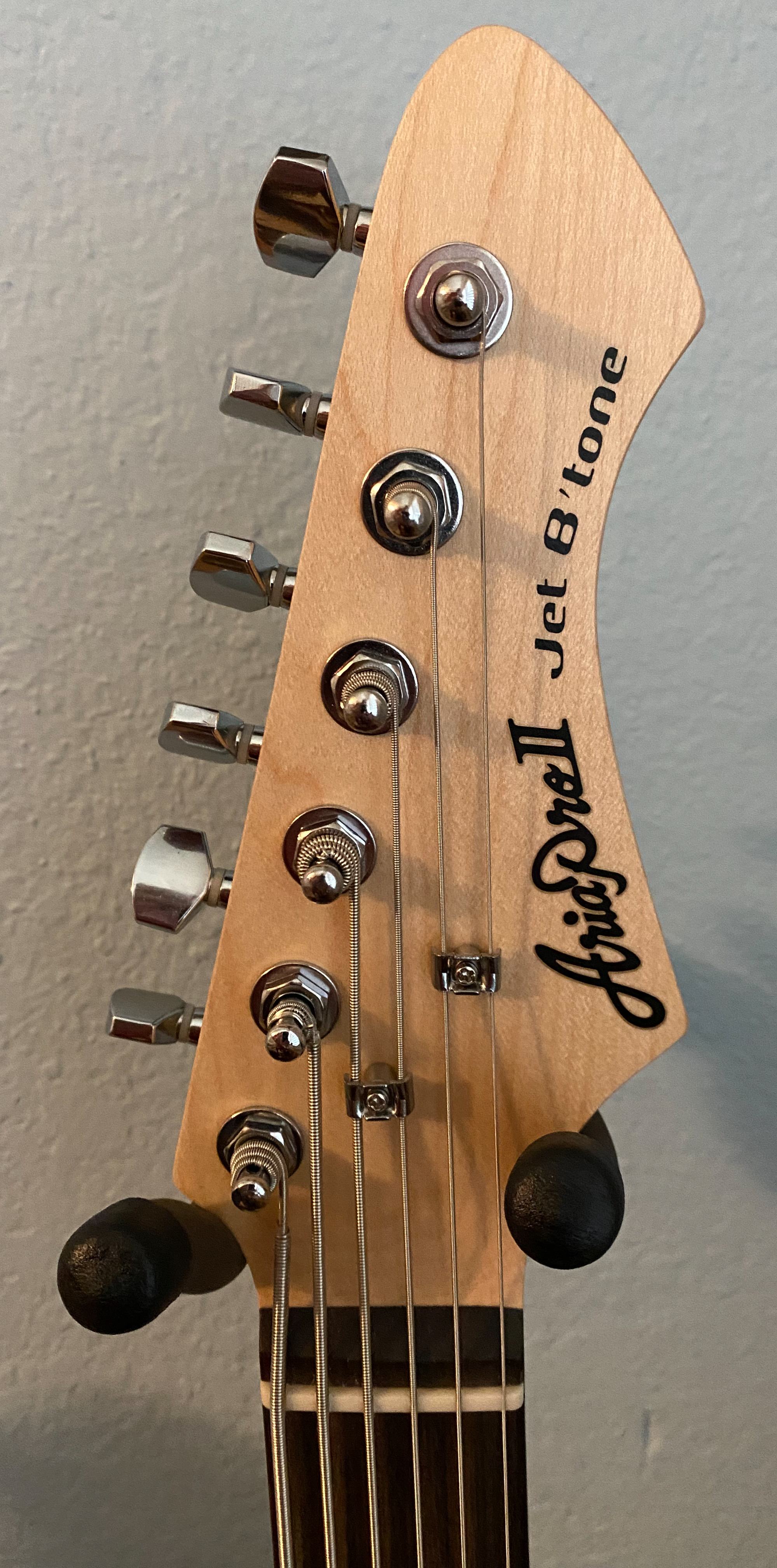
FYI the first two strings were unwound in this picture, I've since unwound the D string too. And yes, I cut things too close on the A string but it works.
FYI the first two strings were unwound in this picture, I've since unwound the D string too. And yes, I cut things too close on the A string but it works.
Last edited:
One more thought: instead of locking down the ball end, I held the string with vice grips over tape near where I put the super glue- just enough pressure to hold the string without doing any damage. It worked well, allowed me to use needle nose pliers to pull the wrap wire. I did most of the unwrapping by hand, just uncoiling it- slow but effective.Ah, I really like the shrink wrap. I recently did this process with a Bass VI conversion and Fender Super 250 strings, but left the exposed wire just beyond the super glue. So far it's worked beautifully but it's not as clean looking. I also kept the middle wind on the 0.100 E string. So far so good, but I'll update this thread if I ever run into a problem.
I have a different and, I believe, much easier solution to this problem. I went to my nearest home improvement store and bought a couple of electrical copper lugs for 14 ga wire (about $1.50 each). I put them in a vise and ground off the flat lug part so that it was just the cylinder. I put my long scale string on the bass so the silk is in the correct position on the headstock above the nut. The ball end is now sticking out from the back of the bridge since the string is too long. I cut the ball end off the string and slide the copper lug on the cut end of the string up to where it meets the bridge and tighten it down holding onto the lug with some large pliers and using a flat screwdriver to tighten the screw. I snip off the excess string from the back and I’m done. The lugs are reusable when you change strings and I have never had one slip off. It’s fast and easy and has allowed me to use Cobalt Flats on my Hofner Ignition Club Bass and they have made it into a beast. Before I came up with this workaround, I broke an E string and an A string trying to get them to work on this bass since the unwound portion of many strings will not bend sharply enough around these tiny tuners without breaking. I suppose you could also add some super glue to the new “ball end” for added security but I’ve used this method for three years without a failure.View attachment 5144716View attachment 5144717
Def wanna give your method a go. Easier than shortening at peg end and the way I have tried doing shortening from the ball end using glue.
Regarding the peg end shortening method, I had a crack at a Chrome 132 today, so I could get better tension for low D on a Mikro in D standard. No dramas. Removed outer flat wrap, and 1st layer of round wrap. Piece of cake


