
I’ve rediscovered Demeter preamps and Bag End cabs … like the ones I used to lust after in the mid-‘90s. And I’ve got a soft spot for old peavey heads/combos, even though I never really gave them much respect in the ‘80s.

Enjoy the benefits of a premium membership!
Upgrade Account
-
TalkBass has been independent since 1998. Add your voice.
Create a free account to reply to discussions, view embedded media, and browse with fewer display ads.
Join free Log in
Want zero display ads or expanded classifieds tools? Compare plans.
You are using an out of date browser. It may not display this or other websites correctly.
You should upgrade or use an alternative browser.
You should upgrade or use an alternative browser.
Do amps ever come back in style?
- Thread starter JazzyJacuzzi
- Start date
More options
Who Replied?
For me, they do, or could;
I bought a used V4B in the early 80s. All it did was blow up. The store I got if from was great, but they'd fix it, and it would blow again. That was it for me and tube amps for about 20 + years, when i got an SVT.
5 years ago I got the V4B Reissue. Maybe it never went away, but it sure seems like the V4B has had a resurgence the last 10 years or so.
In the late 80s, I got a GK800RB. I moved on to an SWR from there, and I don't see the SWR coming back (at least not in "my world") but there seems to be renewed interest in the GK800RB, and I'd love to try the reissue.
Then again, I've never been as close to the sound I want as I am now with my Aguilar, Genzler and Mesa gear.
I bought a used V4B in the early 80s. All it did was blow up. The store I got if from was great, but they'd fix it, and it would blow again. That was it for me and tube amps for about 20 + years, when i got an SVT.
5 years ago I got the V4B Reissue. Maybe it never went away, but it sure seems like the V4B has had a resurgence the last 10 years or so.
In the late 80s, I got a GK800RB. I moved on to an SWR from there, and I don't see the SWR coming back (at least not in "my world") but there seems to be renewed interest in the GK800RB, and I'd love to try the reissue.
Then again, I've never been as close to the sound I want as I am now with my Aguilar, Genzler and Mesa gear.

I really enjoy my Acoustic 370/301 and it looks super cool!
I also have a Peavey Super Festival 800B
And a GK 800RB
As far as they all go, I think they definitely hold up today and they definitely have come in and out of style.
I also have my trusty Darkglass MT900 and a Fender Super Bassman that are definitely what I would consider both modern classics
Even though I’ll most likely take the Darkglass out, the others for sure each have their own undeniable flavors that only they can pull off
I also have a Peavey Super Festival 800B
And a GK 800RB
As far as they all go, I think they definitely hold up today and they definitely have come in and out of style.
I also have my trusty Darkglass MT900 and a Fender Super Bassman that are definitely what I would consider both modern classics
Even though I’ll most likely take the Darkglass out, the others for sure each have their own undeniable flavors that only they can pull off
I have a 90's Minnesota Eden Metro, great EQ, warm, punchy and will drive a 2 ohm load...the 'enhance' knob can work wonders with some basses like 'mudbucker' Gibson & Epiphone..... but mostly i leave the enhance in the middle as do others but there are a LOT of tone shaping possibilities overall.How old is old? I just picked up a hand-built Eden from the mid-90s. As long as you don’t tweak the “enhance” knob, the amp has tone in spades. Chock full of features, too. Honestly I think the amp was ahead of its time.
This pretty much says what I know too. I have a LAB4 that if I could get it repaired I would happily use it. Hell, when I bought it I didn't even know it was a solid state amp (late 1980's) or I might not even have purchased it. It got loud enough and that was that. (I'm stupid that way) The LAB4 had a fan that was pretty loud so I unplugged it (it had a 120v plug on the back of the amp) for some quiet time while working out some arrangements and when rehearsal time came I forgot to plug it back in and I think the heat caused some damage. I had an SVT before that and just wanted an amp that sounded like it.Inherent in this "classic amps coming back" thing is the fact bass amps have gone through various phases throughout history, some changes were due to technology, others were due to changes in musical styles. Consider that:
1. Early era - vastly underpowered, didn't sound very good, but typically used with old basses with flatwound strings because that was what bass guitar was supposed to sound like.
As venues became large and the Marshall stack appeared to fill said venues (from the late 60's to the early 70's the stage amps filled the venue if it was indoors usually, the small, low powered PA's of the time had the vocals, maybe keys and the drums) you had the dawn of stuff like the Acoustic 360/371 and it's follow ons and the SVT. To a lesser extent the Sunn Coliseum.
The thing was unless you had the cash for one of these top flight rigs you wound up with one of the "little brother" versions, and these were in reality underpowered, typically 100 to 150 watts.
2. The 5-String "Hi-Fi" era - Hartke was the initial brand to use speakers with more high end response, and soon it became obvious a double 15" bass cab was not suited to the new styles of music of the era.
This was the era of SWR, Eden, Gallien-Krueger, etc. ; fairly high powered amps using cabs with 10" speakers, often a pair of 4 x 10" cabs.
The 2 x 10" cab came out of this era as a cheaper alternative when you did not need a full 4 x 10" for a smaller venue.
These cabs usually had horns for the high end, and porting arrangements to suit the low B strings of the 5 string basses in vogue.
This is when the SVT actually made a bit of a comeback, because while expensive it was not that much more than a top flight rig from the other guys with a pair of 4 x 10" and had a sound with top end, and a sound associated with metal and grunge and other popular styles of the era
3. The modern Class D era, with smaller/lighter cabinets.
Big drivers for this era people seem to be missing:
a. The number of rock bands, rock venues, etc. shrank and the audience started aging out of going to see bands all the time in the local joint. Different styles of music became popular with younger people, many of these styles did not even use a bass player. DJ's, bass lines on synths that sort of thing
I would bet you the number of young bass players out there today is probably 10% of what it was in say 1990.
b. The aging of the bass player market - this place is a good example, seems to be mostly old dudes (guilty as charged here) and these old dudes, with their iffy rotator cuffs and bad backs didn't want to haul that 100 pound 4 x 10" around anymore.
BUT there were not as many young guys who would be fine with heavier gear, and for the younger guys cost is an issue.
Some of you guys change amps and cabinets like underwear; that's a side effect of old boomer money....they gots it to spend so they get GAS and are flipping gear all the time.
I saw a recent thread where this guy just bought a new cab, and said he had owned 6 Genzler cabinets prior to his purchase.
c. Cost per watt - Class D allowed amp companies to effectively outsource the power amp part of their products (yes I know there are exceptions to this but for the most part this statement is true) so all they had to do was do the preamp part, and put that into a much smaller case (which costs less).
Today you can buy a really nice Mesa D800+ for what, a grand? And it's 800 watts?
That $1,000 backdated to 1990 would be under $500. I don't recall any Mesa bass amp product that only cost $500 in 1990.
Go back further and the price differential becomes even more dramatic.
My Acoustic 220 from 1978 (125 watts at four ohms, $330) would be a near $1,400 head today. A 320 head would probably be nearly $2,000 today.
Consider too a $1000 Mesa is more at the top of the class, you can buy less regarded brands with fewer watts for $500 or less today.
So this reduction in real world pricing allows the boomers to swap out amps all the time, while the far smaller number of young guys can at least get a decent, powerful amp within their more limited budget.
Consider the (regular price) $279 Acoustic B300HD I recently purchased, that amp would have been $65 back in 1978.
Back then there was NOTHING, flat out NOTHING in the bass amp world that was that cheap.
d. Used gear - this old stuff has proven to be pretty damn reliable and the marketplace and the world is full of amps from the 1970's to the 1990's that still work just fine and in some cases are in really good shape.
People who want the older type gear will just buy used over new gear. ESPECIALLY if you are a younger player without a lot of money.
You can sell a young guy today a used $300 SWR pretty easily but you would never sell him a new $1,500 SWR, they don't have the disposable cash like the boomers.
Now more performance, more watts, lighter weight sure these are all good things but the economics of the market and the fact playing bass in a band is not the thing it once was (so fewer new players) is the big driver of the market.
So to summarize, the reason why these classic amps don't come back is a combination of:
1. Cost
2. Limited market
3. Plenty of viable choices on the used market
That's why the few remaining products from the olden days still on the market (SVT, V4B and the like) don't have competition; there is simply not enough market to make companies want to reintroduce their old products.
Analogeezer
Now I have a Rumble 800H. Sounds fine.
I'm stupid that way.


Maybe you encounter more "professionals" than I do but short of top drawer touring sound (and those guys started making live sound suck ballz ever since they got lots of power to turn up the bass) my experiences with said "professionals" have been mediocre to horrible.
Last festival gig I did (was a wine festival) and for some damn reason the guy decided our setup (drummer, two guitar players, an acoustic guitar feed, an electronic drum pad feed, and my bass DI) was too complex or something and starting pulling out all the mic cables out of the stage box and rearranging them.
Two weeks before the gig I had sent the guy a stage plot, with the inputs needed, how many drums in the drumkit, etc. with additional information, set lists, etc.
He had things so screwed up I had to go to the mixing station during the break from our first set and straighten his **** out.
Not as bad but similar experiences with a large venue (1,000 seats) opening up for a national (well one was international, albeit with only two of the original members). Two separate gigs, about three years apart, two different bands I was in.
Sure you get the short shrift as the opening act but you also get the house guys who should know their system and their ****.
So maybe your experiences in Germany have been more professional or you are dealing with a higher quality of venue.
I can't imagine depending only on IEM's in many of the situations I have encountered.
Analogeezer
Might be that FOH is run a bit tighter over here - but when I said festival, I actually meant music festival, where the music is the main act and people come because of it. I don't know how it is in your place, but when you need FOH for a 1000+ people open air festival, then you know you can't tinker around with what you and your mates have sitting in the garage.
You know you will have to rent from professionals.
They will ask how big the festival is and choose the FOH system accordingly.
These people will usually not send FOH equipment of that size without someone to run (and supervise) it, unless you can somehow prove that you're capable of doing that yourself.
This eintails that music festivals usually have good people manning the desks.
Our band contract specifies that the FOH system must be 'adequately sized' and up to the task. One of us actually does a lot of FOH on the side and owns very good gear, ranging from a 15" active sub with two 12" satellites that can do a bar all the way up to line arrays and 18" subs that can do open air gigs for 3k people.
When we reach a place and the house system looks and sounds like something they dragged in from the dumpster, there are two options:
1. We bring in our system (for $$$, obviously).
2. We turn around and walk.
It is easy for this band, though. Our drummer plays electric. There simply is no way around proper PA support.
With acoustic drums, electric bass and guitar(s) and amps on stage, you can simply run the vocals only through a crappy system and somehow wiggle through the evening.
With electric drums you need a PA that can do the whole drum kit. That PA will also be able to do everything else.
Maybe you encounter more "professionals" than I do but short of top drawer touring sound (and those guys started making live sound suck ballz ever since they got lots of power to turn up the bass) my experiences with said "professionals" have been mediocre to horrible.
Last festival gig I did (was a wine festival) and for some damn reason the guy decided our setup (drummer, two guitar players, an acoustic guitar feed, an electronic drum pad feed, and my bass DI) was too complex or something and starting pulling out all the mic cables out of the stage box and rearranging them.
Two weeks before the gig I had sent the guy a stage plot, with the inputs needed, how many drums in the drumkit, etc. with additional information, set lists, etc.
He had things so screwed up I had to go to the mixing station during the break from our first set and straighten his **** out.
Not as bad but similar experiences with a large venue (1,000 seats) opening up for a national (well one was international, albeit with only two of the original members). Two separate gigs, about three years apart, two different bands I was in.
Sure you get the short shrift as the opening act but you also get the house guys who should know their system and their ****.
So maybe your experiences in Germany have been more professional or you are dealing with a higher quality of venue.
I can't imagine depending only on IEM's in many of the situations I have encountered.
Analogeezer
Might be that FOH is run a bit tighter over here - but when I said festival, I actually meant music festival, where the music is the main act and people come because of it. I don't know how it is in your place, but when you need FOH for a 1000+ people open air festival, then you know you can't tinker around with what you and your mates have sitting in the garage.
You know you will have to rent from professionals.
They will ask how big the festival is and choose the FOH system accordingly.
These people will usually not send FOH equipment of that size without someone to run (and supervise) it, unless you can somehow prove that you're capable of doing that yourself.
This eintails that music festivals usually have good people manning the desks.
Our band contract specifies that the FOH system must be 'adequately sized' and up to the task. One of us actually does a lot of FOH on the side and owns very good gear, ranging from a 15" active sub with two 12" satellites that can do a bar all the way up to line arrays and 18" subs that can do open air gigs for 3k people.
When we reach a place and the house system looks and sounds like something they dragged in from the dumpster, there are two options:
1. We bring in our system (for $$$, obviously).
2. We turn around and walk.
It is easy for this band, though. Our drummer plays electric. There simply is no way around proper PA support.
With acoustic drums, electric bass and guitar(s) and amps on stage, you can simply run the vocals only through a crappy system and somehow wiggle through the evening.
With electric drums you need a PA that can do the whole drum kit. That PA will also be able to do everything else.

I have used an active bass into a DI into my party band's digital board for years now - no amp, just a hot spot monitor for vocals and keys.Attention, controversial opinion:
I think amps in general are on the way out....

- Feb 12, 2006
- 60,978
- 5
- 220,737
- Disclosures
- Development Engineer-Mesa Boogie, Development Engineer-Genzler (pedals), Product Support-Genz Benz
Real festival rigs are always wet rentals with a system engineer and support crew. I have never seen a dry rental for real rigs used at real festival gigs. That’s the industry I lived in and made my living in.

Yes! Get ahead of the curve while you can and pick up a nice SWR Redhead.

Yes! Get ahead of the curve while you can and pick up a nice SWR Redhead.
The same thing that kept me away in the 90s would keep me away now. Even for a 2x10 combo, it was plenty to wrestle with, a big clunky boulder with a pair of handles. Everything does have its devotees, however.
Real festival rigs are always wet rentals with a system engineer and support crew. I have never seen a dry rental for real rigs used at real festival gigs. That’s the industry I lived in and made my living in.
Ok, I've got it set up.
Here's the keys, I'll be back in a few hours to pick it up.

I think it could be said, that among it's aficionados the Ampeg B-15N has never really gone in and out of style in the used market. There was a time when you couldn't get repair parts, but that was
long ago. The number of B-15N's for sale here on Talkbass and Reverb, tells the story for better or worse. Just my take however.
long ago. The number of B-15N's for sale here on Talkbass and Reverb, tells the story for better or worse. Just my take however.
The same thing that kept me away in the 90s would keep me away now. Even for a 2x10 combo, it was plenty to wrestle with, a big clunky boulder with a pair of handles. Everything does have its devotees, however.
Excuse my lame attempt at humor.
Excuse my lame attempt at humor.
But you know there’s somebody somewhere with a garage full of them.

Some amps never seem to go out of style (Ampeg SVTs, for example), while others that were once ubiquitous have gone the way of Chorus pedals. I’m thinking here of Acoustic, Trace Elliot, Eden, SWR, Sunn and Vox. You could arguably add GK and Markbass to that list as well. But while some basses and effects do come back in style, I can’t think of any examples with regard to amps (B15, maybe?). I’m aware most of the aforementioned brands no longer exist, but that’s never stopped anyone. Why is that, do you think?
An amp that sounds good is always "in style".
And who cares? You're the bass player, you make this decision.
Guitar = Lo-Fi / Bass = Hi-Fi
Many guitar amps recycle, but few Bass amps will other than tube amps, in general. If you are a tube player, there is no substitute for what you like!
Orange, Hiwatt, Trace Elliot (Ashdown) are all BRITISH amp companies that have had various distribution situations over time. What may appear as a comeback is only due to availability in the domestic US market after the "British Invasion" at some point in popular music. If you love Trace Elliot, you know the slam and the tone...
Big speakers...I was talking with ISP the other day about their D-CAT amp (not an engineer, here) and 1 x 18" + 2 x 8" Vector Pro 1000 watt cabinet and the BETA preamp. Appearently, Stanley Clarke is a fan boi...! There will always be players looking for an edge, while others will roll with the fad d'jour. Steve Lukather also has a sub-guitar cabinet with ISP.

(Tom Bowlus is also a fan...its nice!)
I play with a couple of very good 7 string melodic hard-rock guitarists that will not go the way of a Helix or similar. A PRS Archon and MESA cabinets are what they play. They don't want a Class D sound around. I'm more than happy to oblige them. I love tubes as much as they do and don't mind lifting smart and using the casters.
Here is a pic before I started to customize the sound with a separate distortion signal path with the ISP BETA Preamp.
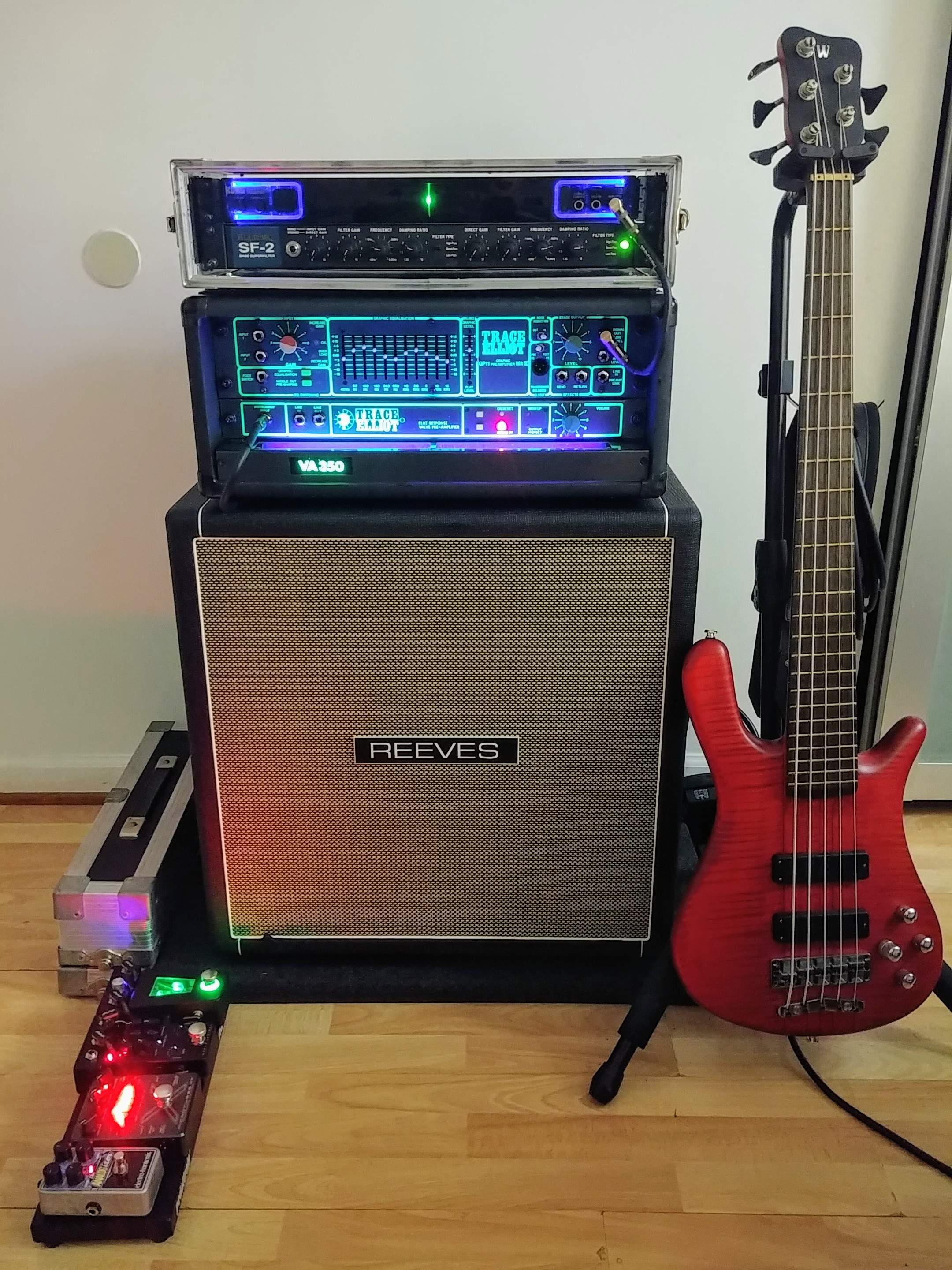
Tone is where you find it, when you are able to find it, however you go about finding it!
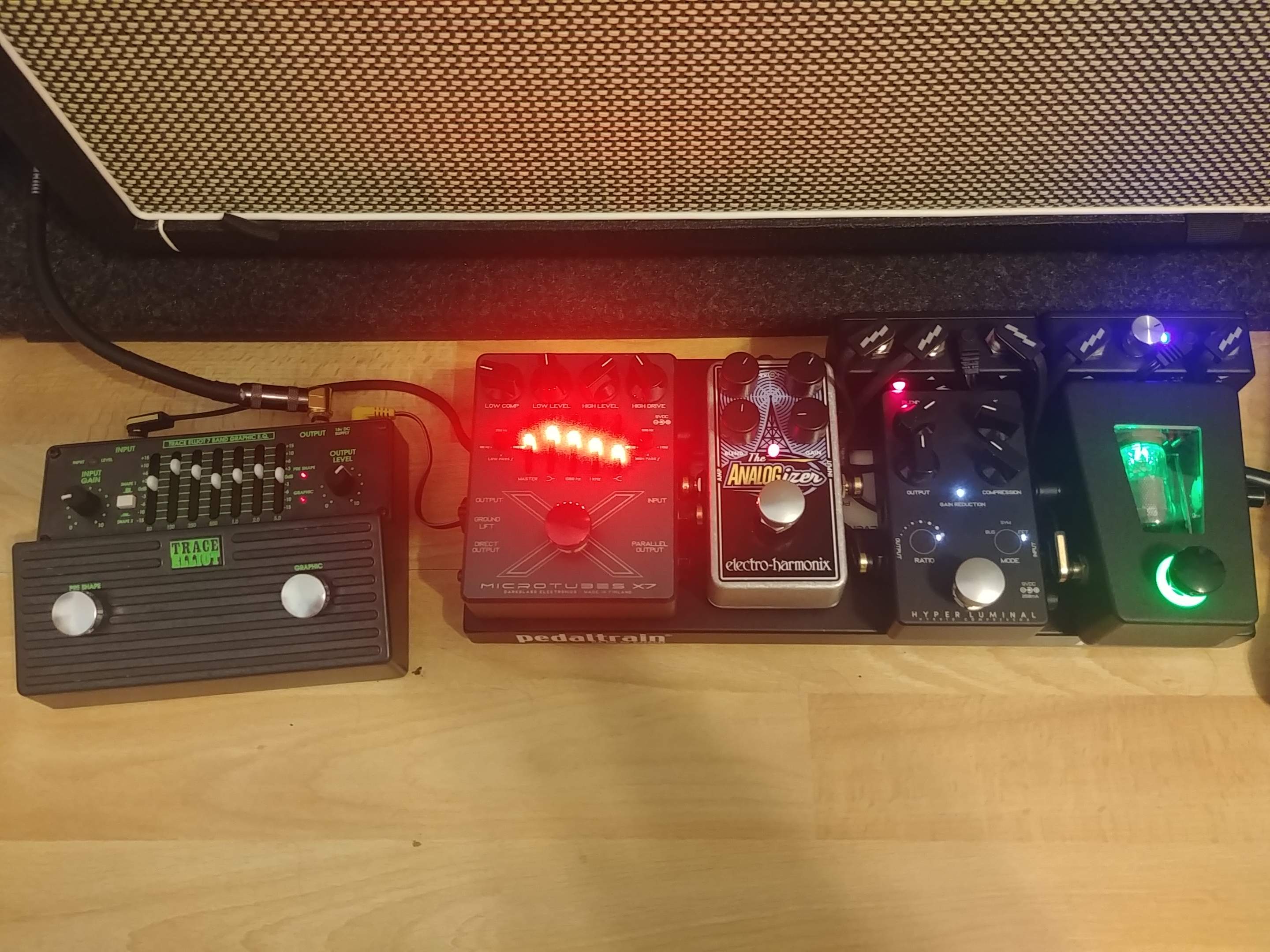
I've replaced the TE GP11 Mk V sound with the third generation SM/SMX Pre-Shape #2 off this "vintage" TE SM7 EQ Preamp Pedal. I prefer it especially with the 3 x 12AX7 Flat Response Valve Preamp section on the VA350...!
Many guitar amps recycle, but few Bass amps will other than tube amps, in general. If you are a tube player, there is no substitute for what you like!
Orange, Hiwatt, Trace Elliot (Ashdown) are all BRITISH amp companies that have had various distribution situations over time. What may appear as a comeback is only due to availability in the domestic US market after the "British Invasion" at some point in popular music. If you love Trace Elliot, you know the slam and the tone...
Big speakers...I was talking with ISP the other day about their D-CAT amp (not an engineer, here) and 1 x 18" + 2 x 8" Vector Pro 1000 watt cabinet and the BETA preamp. Appearently, Stanley Clarke is a fan boi...! There will always be players looking for an edge, while others will roll with the fad d'jour. Steve Lukather also has a sub-guitar cabinet with ISP.
(Tom Bowlus is also a fan...its nice!)
I play with a couple of very good 7 string melodic hard-rock guitarists that will not go the way of a Helix or similar. A PRS Archon and MESA cabinets are what they play. They don't want a Class D sound around. I'm more than happy to oblige them. I love tubes as much as they do and don't mind lifting smart and using the casters.
Here is a pic before I started to customize the sound with a separate distortion signal path with the ISP BETA Preamp.
Tone is where you find it, when you are able to find it, however you go about finding it!
I've replaced the TE GP11 Mk V sound with the third generation SM/SMX Pre-Shape #2 off this "vintage" TE SM7 EQ Preamp Pedal. I prefer it especially with the 3 x 12AX7 Flat Response Valve Preamp section on the VA350...!
Last edited:

Nope. There was a brief time when SLM wasn’t making them, but it was only because they had just bought Ampeg from MTI and had to tool up and get a solid design happening. Otherwise it’s been produced continuously since 1969.Not only did it fall out of favor, production was stopped entirely twice if I recall correctly. Some SVT experts here may want to clear that up.

Well, there was the period of MTI Japanese SVTs, then from 1990 to 1994 the SVT-II replaced the original altogether. The SVT-CL arrived in 1994 but with a significant redesign of the original preamp, dropping the second channel. Then production moved again to Vietnam. If you want to call that "continuous", OK, I'll accept that.


