

Enjoy the benefits of a premium membership!
Upgrade Account
-
TalkBass has been independent since 1998. Add your voice.
Create a free account to reply to discussions, view embedded media, and browse with fewer display ads.
Join free Log in
Want zero display ads or expanded classifieds tools? Compare plans.
You are using an out of date browser. It may not display this or other websites correctly.
You should upgrade or use an alternative browser.
You should upgrade or use an alternative browser.
Do Chromes lose their sound over time?
- Thread starter project_c
- Start date
More options
Who Replied?
I use Chromes (ECB84) almost exclusively. I love them but they can go totally dead. This is another level way beyond the clank mellowing. It has only happened to me a couple of times. Twice actually that I remember and on strings several years old. But when it happened it was like a black hole and all tone was lost. Some may still find that usable but I need a little definition.


I have a set that is easily 20 yrs old. Yea a little tired but sound great, no mud. I have come to love flats for everything including slap. For the people saying they are stiff, play them in, mine are super supple and no more stiff than a standard gauge set.

It's hard for me to put it in proper words, but my experience is this:
Chromes will have a harsh brilliance (for a flatwound string, that is) when freshly installed, and of course that fades with time. When they settle in, they sound like well used flats.
However, If I compare them to those flats I played long enough to get them properly dead, here are my impressions:
LaBella Deep Talkin' Flats:
They get very mellow. Their thump feels like it sits lower than that typical flatwound thump, with more bass and less low mids.
TI flats: They keep their singing midrange sound for a very long time. I sold the bass with TI's on before I could fathom how long that stays (I had them on for two years).
Optima Flats:
I always described them as a good middle-of-the-road choice. They lose treble content like every other flatwound string, but the result feels very wooden and organic, reminding a bit of a double bass (I said reminding of a double bass, not sounding exactly like one!)
Chromes:
They are a bit like the Optimas when they settle in, but instead of that wooden, organic timbre and feel, they still sound like a metal string vibrating. There is more treble content left in them, too - but they sound like worn in flats, nonetheless.
Chromes will have a harsh brilliance (for a flatwound string, that is) when freshly installed, and of course that fades with time. When they settle in, they sound like well used flats.
However, If I compare them to those flats I played long enough to get them properly dead, here are my impressions:
LaBella Deep Talkin' Flats:
They get very mellow. Their thump feels like it sits lower than that typical flatwound thump, with more bass and less low mids.
TI flats: They keep their singing midrange sound for a very long time. I sold the bass with TI's on before I could fathom how long that stays (I had them on for two years).
Optima Flats:
I always described them as a good middle-of-the-road choice. They lose treble content like every other flatwound string, but the result feels very wooden and organic, reminding a bit of a double bass (I said reminding of a double bass, not sounding exactly like one!)
Chromes:
They are a bit like the Optimas when they settle in, but instead of that wooden, organic timbre and feel, they still sound like a metal string vibrating. There is more treble content left in them, too - but they sound like worn in flats, nonetheless.

I’m pretty sure Laura Lee from Khruangbin has 15+ year old Chromes on her SX J bass.

Question for those who keep Chromes on a bass for years - how do these strings age? I'm really interested in what happens to that 'metallic' character that these strings have as they age, do they keep that tone forever, or do they end up sounding like other flats if left on for years?
I have them on a short scale and I loved them as soon as I put them on there (despite that slightly weird harmonic thing they do), but after a few weeks they seem to have settled into this growly / punchy tone which is still surprisingly bright and crunchy for a flat wound. Sounded great at rehearsal tonight, so I'm wondering if this is where Chromes settle, or if they will die and lose that tone over time.
I don’t know anything about this particular brand of strings, but I do know all strings eventually wear and as they do, the tonal characteristics will change. How much and how fast depends on how they are used. It will happen sooner as your hours of play add up compounded by how hard you pluck the strings. If you have a light touch and play a couple of hours a week, it could be a very long time. On the other hand, you’re a dedicated player racking up 40 hours a week with a technique where each note looks like you are drawing a bow, it could be like next week.
So a lot an individual experience from sting set to string set and what is or isn’t a preferred sound is based on the individual’s tastes. Some like them out of the box, some like them much better with some miles on them. Only you can figure out what your “sweet spot “ is.
As I said, strings do wear out and it’s ok to replace them when they aren’t sounding good. As far as I know none of the major brands are passing out plaques for years of service. I’ve had more than a few conversations with sound engineers about bassists using their beloved well worn strings which “ are broken in” and trying to get a serviceable track out of them.

FullumMusic
Commercial User
- Oct 13, 2022
- 2,010
- 5,686
- Disclosures
- Audio/Music software developer, contracted with a company you've heard of and deving my own stuff.
All strings' sounds change over time. It's a matter of metal fatigue.Do Chromes lose their sound over time?
A string vibrating back-and-forth is akin to bending a paperclip back and forth until it breaks. Of course, bending a paperclip 90 degrees in each direction repeatedly will fatigue it to failure much faster than a string vibrating. Paperclip metal is way less elastic than bass string metal. The string metal is specifically designed to vibrate and is only deforming a few degrees either way. But it's still gonna fatigue over time, and that fatigue physically changes the metal with microscopic cracks and molecular changes. As the metal changes, so does the tone.
Some types of strings and metal fatigue less, and other fatigue more. Every metal type and winding type and core diameter will vary how much it fatigues over how much time.
On some strings the tonal change that comes with the metal fatigue is considered a feature, like 20 year old flats on a P bass. Flats and tapes also let less moisture and corrosives reach the core, and it'll fatigue less over time.
On other strings, they fatigue until they're dead or break, like nickel Rounds after being slapped and popped for a few months. Rounds also let more corrosives through to the core, so that'll also quicken the deterioration of tone.
It's just the nature of the physical characteristics of metal. So yes, the tone of your chrome strings will change over time.
All that said, every player is gonna like their strings at different stages of fatigue. Some ears only like the tone of brand new strings. Some like the sound of broken in strings. Some like the sound of flats or chromes or tapes after some number of years. The qualitative part is up to each player. The quantitative part is, all strings change tone over time due to metal fatigue.

I've used chromes for years as well, and they do get less metallic sounding pretty quickly, but I find with my own playing and body chemistry they can still continue to degrade for around a year. I've had a set on a mustang for abour six months now, and they have entered the "broken in" zone, but they still have a ways to go before they are settled.
Different strokes for sure. I have used Chromes on a variety of basses, and had them on one bass for about 7-8 years. To me they do not get better with age, certainly not like my preferred Labellas. Granted they're a completely different sound, but that component is not there with the Chromes for me. They get kind of lifeless and dull sounding over time, whereas the Labellas just keep getting better sounding with plenty of detail, heft, and character. But again, two very different sounding strings, so it's almost apples to oranges.

I may be one of the only people who liked chromes only when they were fresh. When I used them, I would change them every 6 to 8 weeks.

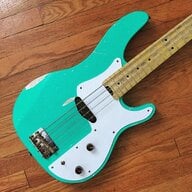
I’ve got a set on my P for probably 10 years now. They’re just starting to sound like labellas (super thuddy).
I kinda like them a little snappier so I may swap them out, but they still sound good!
I kinda like them a little snappier so I may swap them out, but they still sound good!
From 2009 to at least 2020. She mentions she hasn't changed the strings at all since she got her SX. The interview is in 2020 as she mentions an EP coming out with Leon Bridges (Texas Sun) and upcoming Australian tour with Tame Impala which was cancelled in 2020 Show & Tell: Laura Lee from Khruangbin - Mixdown MagazineI’m pretty sure Laura Lee from Khruangbin has 15+ year old Chromes on her SX J bass.
I have read she uses La Bella now, but who knows
Last edited:

I had a set on my P bass for 3 and a half years before they got to a point where I didn't want to play them. I'm sure someone would have loved them in the condition they were in, but the tension was gone and I just didn't like playing them anymore.
I just put some on my J bass and I give them at least 10 minutes a day of playing so they get to that sweet spot because they are a bit abrasive for what I want out of them in the long run when they're new.
I just put some on my J bass and I give them at least 10 minutes a day of playing so they get to that sweet spot because they are a bit abrasive for what I want out of them in the long run when they're new.
Eventually, they all come around to Labella.....I have read she uses La Bella now, but who knows
 . JK, but IMHO Labellas are simply far more refined sounding than Chromes, and truly do get better and better with age.
All strings' sounds change over time. It's a matter of metal fatigue.
The quantitative part is, all strings change tone over time due to metal fatigue.
Metal fatigue may be involved if you string breaks, but I sincerely doubt that it's what's making your strings sound dead. Metal fatigue doesn't add damping, and damping is what takes away the liveliness of strings. Round wounds tend to have shorter lives, because there's lots of space for gunk to get in and add damping. Boiling/soaking your strings in certain solvents is know to "reset the clock" to some extent on strings - it's dissolving some (probably not all) of the gunk between windings, removing some of the damping. If metal fatigue was the cause of strings going dead, boiling/soaking them in solvent would not make them sound fresher. But....it does.


