

Enjoy the benefits of a premium membership!
Upgrade Account
-
TalkBass has been independent since 1998. Add your voice.
Create a free account to reply to discussions, view embedded media, and browse with fewer display ads.
Join free Log in
Want zero display ads or expanded classifieds tools? Compare plans.
You are using an out of date browser. It may not display this or other websites correctly.
You should upgrade or use an alternative browser.
You should upgrade or use an alternative browser.
More options
Who Replied?It happens rarely, but of course it does happen. Maybe once a month. Twelve sales a year is certainly not often enough to keep a retailer from going out of business. And all too often they'll come in, play that thing they weren't intending to buy, decide they like it, thank me for my time and then go order it elsewhere because it's fifty cents cheaper and it's not a floor model. None of that benefits the store in any way.But you do read stories (especially on here) where people walk into a store and try a bass that they were not intending to buy and it just spoke to them.
I have gone to music stores and tried basses out with no intention to buy, but in having done so, it planted the seed and I bought one later on.
The problem with the new "we can order it for you" business model on higher end stuff is that I think to myself, "well so can I"
I know that stuff happened all the time, because guess who they'd call when they needed help with whatever they'd purchase. It wasn't Mr. Online Salesguy. It was me.
Anyone can order anything these days, which is the most compelling argument against keeping the expensive things in stock. There's little incentive to buy the thing from any place for reasons other than price.
A few of us are sticklers for putting something in our hands to make sure we love it first, but you see a lot of discussion here that indicates this is not really important to most people anymore. In our world of mass-produced, cookie-cutter CNC stuff, that's no longer really something that matters.
I recall the Markham store having some high end basses at one time.
I guess if you're in the $6,000 region what's a couple more thousand $$?
The first Long & McQuade that was remotely close to me in Ottawa had a Modulus and some German Warwicks. Having tried both out is what put me off of them! (The Modulus feeling sterile and the overweight and horrible balance of the Warwick Thumb).
Last edited:

Theres other differences besides cosmetics and parts. SBMM is a perfect example - on American models, the pickups are wired parallel while the non-USA models are wired series. I personally do not like series-wired MM style pickups
I would like to think that even if the shape, design, parts and finish are identical, that at least the quality of the wood (or how it is seasoned and aged) would be higher on the domestic models.
It happens rarely, but of course it does happen. Maybe once a month. Twelve sales a year is certainly not often enough to keep a retailer from going out of business. And all too often they'll come in, play that thing they weren't intending to buy, decide they like it, thank me for my time and then go order it elsewhere because it's fifty cents cheaper and it's not a floor model. None of that benefits the store in any way.
I know that stuff happened all the time, because guess who they'd call when they needed help with whatever they'd purchase. It wasn't Mr. Online Salesguy. It was me.
Anyone can order anything these days, which is the most compelling argument against keeping the expensive things in stock. There's little incentive to buy the thing from any place for reasons other than price.
A few of us are sticklers for putting something in our hands to make sure we love it first, but you see a lot of discussion here that indicates this is not really important to most people anymore. In our world of mass-produced, cookie-cutter CNC stuff, that's no longer really something that matters.
All else being equal, I will try to support the local retailer first before going to an alternate source. Now, just about everything is available online and it is impossible for the each retailer to have everything. Often, my wants are very specific and I have no choice but to order.
I've also noticed that you don't have to pay provincial taxes if you order out of province (or used to anyway) and international orders can be hit-and-miss if you get dinged for taxes. That puts local retailers at a disadvantage right off the bat.
Last edited:

I remember playing a Modulus at L&M years ago. I wonder if it was the same one? (it was used)The first Long & McQuade that was remotely close to me in Ottawa had a Modulus and some German Warwicks. Having tried both out is what put me off of them! (The Modulus feeling sterile and the overweight and horrible balance of the Warwick Thumb).
The problem with the new "we can order it for you" business model on higher end stuff is that I think to myself, "well so can I". These days, I often know the products better than the staff and having done my research before I get to the retailer, they don't have to make the sale as I have already done that work for them. And, with my experience I can predict very well if a bass will work for me.
Exactly. What do you need the store for? It just seems like an unnecessary intermediary.

I have to say that you write the most interesting post on TalkBass. Always full of wisdom, truth, and humor, without being rude or offensive. That is rare these days.The only time recently that I shopped for an instrument and didn't buy from the store I demoed at was when I was looking for my Fender 5 string. I was ready to drop a decent chunk of change on this because I had seriously pressing needs, but I wanted to demo it first, so I went to the local independent store. I played what they had, which was nice, but sunburst was not the finish I wanted. I asked the salesman if he would be willing to negotiate price with me.
From my own rather extensive experience in MI sales, I know the correct answer to this question is always, "Of course." In fact, I'd been in there a couple of weeks prior with a locally well-known guitarist I worked with and the sales staff fawned all over both of us to give us the deepest possible discounts.
I can't remember which dismissive phrase the salesman used this time, but it was something along the lines of "it depends," or "maybe."
Unfortunately for that guy, I used to be in a band with the regional sales manager of Guitar Center so I just went online to their used site, picked out the one I wanted, and got my friend to handle the sale for me.
The moral of this story is this: The fact that someone looks like your grandmother is not a reason to underestimate their ability to screw you over. Be nice and fair to everyone and you will earn your commission.

Nope.I would like to think that even if the shape, design, parts and finish are identical, that at least the quality of the wood (or how it is seasoned and aged) would be higher on the domestic models.

There's quite a few reasons why it's cheaper to build products overseas and ship them to the US than it is to just build them here. Last time I named a few of those reasons, I offended someone. So I'll just mention one:
Labor costs.
At this point, it's the same materials, same tooling, same processes, same assembly line level skill, etc. Actually, probably more production overseas and at a fraction of the labor cost.
I remember playing a Modulus at L&M years ago. I wonder if it was the same one? (it was used)
I seem to remember it being yellow or trans yellow (maybe natural). It was probably the same one. Modulus was my dream bass at the time (in theory). Getting one in my hands changed that. I didn't have the money for it at the time anyways, but I am glad I was able to try it in person to be able to make that decision without having to spend a lot of money.
Conversely, I played a Roscoe bass in Toronto once that forever solidified them as amazing instruments and it was the best bass I had ever played up to that point.
Exactly. What do you need the store for? It just seems like an unnecessary intermediary.
It's great to have a place that you can grab some strings, accessories or whatever and not have to wait. Even though Amazon is incredibly fast, if you need a pair of drumsticks or strings for tonight's gig, you're out of luck!
Plus, it is really nice to be able to try before you buy. I went into my local L&M to try an EHB to convince me that I didn't want one. It turns out I did and playing it (and ultimately buying it) only happened because I was able to play it in person. Plus, had I ordered one, I would have went with a fanned fret model. To my surprise, I preferred the straight fret model. Again, brick and mortar helped me immensely with that decision. I didn't bother going online and trying to find the cheapest one, I wanted that one and I was (gulp!) happy to pay for it from the store that stocked it and had it available for me to try.
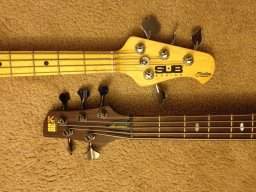
The SBMM Ray34/35’s pickups are wired parallelTheres other differences besides cosmetics and parts. SBMM is a perfect example - on American models, the pickups are wired parallel while the non-USA models are wired series. I personally do not like series-wired MM style pickups

As per the original question, I don't know. I personally make a clear distinction in my mind between, say an NYC Sadowsky and a Chinese Warwick/Sadowsky. What has changed for me is that I have a harder time seeing the value in any $7000 (US!) bass. It was one thing when, for example, an NYC Sadowsky could be had for $4000-$4500 but there are too many good, cheaper options out there today for me to be prepared to spend that much on an electric bass now.
What's happened to shops such as Long & McQuade is disappointing, but understandable given how things have gone with the internet and direct sales. In the early 2000s I drove to the L&M in Ottawa to check out Warwicks because I didn't know of anywhere in Montreal that stocked them. Not long afterwards, Italmelodie (in Montreal) began stocking both Warwick and Modulus (though the only time I saw a new neck-through Warwick in stock was at the L&M in Ottawa). In Montreal a neck-through Warwick could only be had via special order. Archambault (Montreal) stocked F basses but it seemed like it was the same one or two that they had on the wall forever. There was one in particular (an Alain Caron model) that was in terrible shape for a new bass, partly because it had been there for so long. Anyway, the selection of high end basses was always pretty bad in Montreal and it struck me as odd, given the number of musicians we have here.
What's happened to shops such as Long & McQuade is disappointing, but understandable given how things have gone with the internet and direct sales. In the early 2000s I drove to the L&M in Ottawa to check out Warwicks because I didn't know of anywhere in Montreal that stocked them. Not long afterwards, Italmelodie (in Montreal) began stocking both Warwick and Modulus (though the only time I saw a new neck-through Warwick in stock was at the L&M in Ottawa). In Montreal a neck-through Warwick could only be had via special order. Archambault (Montreal) stocked F basses but it seemed like it was the same one or two that they had on the wall forever. There was one in particular (an Alain Caron model) that was in terrible shape for a new bass, partly because it had been there for so long. Anyway, the selection of high end basses was always pretty bad in Montreal and it struck me as odd, given the number of musicians we have here.
As per the original question, I don't know. I personally make a clear distinction in my mind between, say an NYC Sadowsky and a Chinese Warwick/Sadowsky. What has changed for me is that I have a harder time seeing the value in any $7000 (US!) bass. It was one thing when, for example, an NYC Sadowsky could be had for $4000-$4500 but there are too many good, cheaper options out there today for me to be prepared to spend that much on an electric bass now.
What's happened to shops such as Long & McQuade is disappointing, but understandable given how things have gone with the internet and direct sales. In the early 2000s I drove to the L&M in Ottawa to check out Warwicks because I didn't know of anywhere in Montreal that stocked them. Not long afterwards, Italmelodie (in Montreal) began stocking both Warwick and Modulus (though the only time I saw a new neck-through Warwick in stock was at the L&M in Ottawa). In Montreal a neck-through Warwick could only be had via special order. Archambault (Montreal) stocked F basses but it seemed like it was the same one or two that they had on the wall forever. There was one in particular (an Alain Caron model) that was in terrible shape for a new bass, partly because it had been there for so long. Anyway, the selection of high end basses was always pretty bad in Montreal and it struck me as odd, given the number of musicians we have here.
That's one of the two they have at my L&M (Alain Caron F-Bass)! I have a feeling it might be there for a while. At least they have it up high and out of reach of prying hands.
Conversely, I played a Roscoe bass in Toronto once that forever solidified them as amazing instruments and it was the best bass I had ever played up to that point.
I own 2 Roscoes, they are fantastic basses. I ordered one from Club Bass, the other I bought from a local TBer.
It's great to have a place that you can grab some strings, accessories or whatever and not have to wait. Even though Amazon is incredibly fast, if you need a pair of drumsticks or strings for tonight's gig, you're out of luck!
Plus, it is really nice to be able to try before you buy. I went into my local L&M to try an EHB to convince me that I didn't want one. It turns out I did and playing it (and ultimately buying it) only happened because I was able to play it in person. Plus, had I ordered one, I would have went with a fanned fret model. To my surprise, I preferred the straight fret model. Again, brick and mortar helped me immensely with that decision. I didn't bother going online and trying to find the cheapest one, I wanted that one and I was (gulp!) happy to pay for it from the store that stocked it and had it available for me to try.
Just to clarify, I like having music stores. I was referring to having them special order something that's not in stock versus just ordering it yourself online. There's seems little point in involving the store in that scenario. Shops are great for non-bass gear. There are tons of guitars, keyboards, pedals to choose from.
They also have a good selection of basses. As long as it's Fender.

As per the original question, I don't know. I personally make a clear distinction in my mind between, say an NYC Sadowsky and a Chinese Warwick/Sadowsky. What has changed for me is that I have a harder time seeing the value in any $7000 (US!) bass. It was one thing when, for example, an NYC Sadowsky could be had for $4000-$4500 but there are too many good, cheaper options out there today for me to be prepared to spend that much on an electric bass now.
I agree, $7000 for an active Jazz bass is excessive. At that point it's about fancy woods, not improved sound and playability.

After the launch of Sterling by Music Man (SBMM), I no longer see any actual American Music Man basses in stores these days and it got me thinking: Do you think that either licensing the designs or creating an import model within the manufacturer's lineup devalues the "real thing"? Does having a lower cost model help the company get into a market that they were not privy to before or are people going to get the design they want at a better price and eschew the higher priced domestic model?
It is similar with other brands:
G&L Tribute
Lakland Skyline
Elrick Cort
Dingwall Combustion/NG
MTD Kingston
With the exception of maybe Squier/Fender and Epiphone/Gibson as they just pump those out like hot cakes.
To the extent that lower priced options are marketed, I believe they don’t “devalue the real thing”. In terms of value, it’s probably neutral or slightly enhanced.
I do believe the introduction of so called “lower” models does cause reduced sales of “the real thing”.
In the case of EBMM/SBMM/ assorted Fenders, I think those product lines are now such a jumbled mess, I can’t even tell what’s what anymore. It just takes too much effort to determine what’s the top of the lines.
I’d really prefer to have clearly identified lines that distinguish flagship from budget without having to scroll through yards of spec sheets.
Fancy woods perhaps - probably more about pedigree and the way the business is set up. I mean, you look at the woods on some of the smaller, lesser known builder's basses and those woods easily compete with what's found on Sadowskys. But Sadowsky has a certain reputation, as well as a shop in an expensive area and a crew of workers on a salary. Just makes me think: people often have romantic views of smaller builders and of a more hands-on approach to building. "Hand-made", for example, sounds very old world and focused on high quality. But I've found issues with high end "hand-made" basses that you'd probably never find on a Squier (not talking about Sadowsky here as they are mostly CNC'd and are very consistent from what I've seen).I agree, $7000 for an active Jazz bass is excessive. At that point it's about fancy woods, not improved sound and playability.

I've been one of those cats that enjoy my SX and Squier models and gig them. Even after having my 62 P bass.To the extent that lower priced options are marketed, I believe they don’t “devalue the real thing”. In terms of value, it’s probably neutral or slightly enhanced.
I do believe the introduction of so called “lower” models does cause reduced sales of “the real thing”.
In the case of EBMM/SBMM/ assorted Fenders, I think those product lines are now such a jumbled mess, I can’t even tell what’s what anymore. It just takes too much effort to determine what’s the top of the lines.
I’d really prefer to have clearly identified lines that distinguish flagship from budget without having to scroll through yards of spec sheets.
Yet those new Vintage II P basses are singing a loud siren song to me.
I own 2 Roscoes, they are fantastic basses. I ordered one from Club Bass, the other I bought from a local TBer.
Me too. It was Club Bass when he was at his first location. They didn't even have the Century models back then, so it must have been an SKB. I just remember it having a nice chocolatey brown top, playing really well and having a really clear and articulate sound.

Yes, definitely ... and no ... mostly yes ... but it kind of depends on the domestic bass you are talking about.


