• TalkBass has been independent since 1998. Add your voice.
    Create a free account to reply to discussions, view embedded media, and browse with fewer display ads.
    Join freeLog in
    Want zero display ads or expanded classifieds tools? Compare plans.

Do watts = grunt?

Do watts = grunt?

  • Yes.

    Votes: 5 20.0%
  • No, it's the preamp.

    Votes: 5 20.0%
  • No, it's the power amp.

    Votes: 2 8.0%
  • No, its the cab.

    Votes: 5 20.0%
  • No, it's something else.

    Votes: 8 32.0%

  • Total voters
    25

Lowtonejoe

Supporting Member
Jul 3, 2004
2,849
90
Pasco, WA
www.lowtones.com
O.k.

I did a quick search and didn't find a thread that dealt directly with this topic.

There's fat, pillowy walls of bass, chest thumping bass and bass that cuts through. I'm sure that there is more.

What causes grunt. The chest thumping bass that knocks you back a step when you feel it?

:bassist:

Can small amps grunt?

:eyebrow:

Do you need watts to grunt?

:D

Joe.
 
yes and no (although i voted yes)

many factors = "grunt" but if all else is equal, then yes, hitting your speakers with more watts tends to change the tone into a "fuller" "fatter" tone with some "grunt". For a long time I've noted that using less watts per speaker results in a more transparent and articulate tone, while using more watts equals a fuller fatter tone.

I like both tones and lean towards one or the other at any given time. Sometimes i bring a bunch of cabinets and go for the articulate tone, other times i beat the heck out of one or two cabs for the "grunt". Some have said that the more watts approach is inducing a level of distortion, which is probably true - the sonic charactaristics of the speaker changing indicate that, but if that's the coloration you;re after, it's all good.

As far as other factors go, they are leigon. The way you play affects tone- a harder attack obviously can get more "grunt", right hand position can influece bass response, etc. The bass itself will dictate a good amount of the tone. The voicing of your preamp also dictates a good % of the tone as well as the voicing of the EQ and how you set it. Tube power sections might not = Bass response, but some sure add heft and "grunt". However, in terms of the final sound, the voicing of the speaker cabinets themselves are probably the most important link in the chain. Some cabs have "grunt" and some don't. some have huge bass, some don't. IME, if they don't have it, you really can't EQ it in very well. And yes, bill is on the $$ (although i think watt do mean something if all else is equal), a cab with low sensitivity and a crappy frequency response will not help you out much.
 
  • Like
Reactions: arialembic
Frugle said:
dude.... more watts = more everything.. with 3000 watts, you could go everywhere from playing at church.. to going deaf, I don't care what that person who posted another thread earlier says..

put 3000 watts through a 200 watt speaker and watch the copper wire fly!

Grunt is about delivering vibrations to the air...power is involved, yes...but don't forget the things that transduce this electrical energy to sound vibrations...YOUR SPEAKERS...

"more watts" is only a SUBSET of "more everything"
 
The hit-you-in-the-chest bass has a lot to do with the low/mid bass, and these frequencies are very room-dependent. Speaker placement and room dimensions and where you are standing in the room relative to these have a lot to do with it. One system will have grunt in one room, and just fail in another to do anything interesting. There is a tendency among bass gearheads to think the "watts" or the "cabs" or the instrument determine this, but in any given room, it is a lot more complicated. Small rooms are the hardest, and large venues require big PA systems anyway.
 
PilbaraBass said:
put 3000 watts through a 200 watt speaker and watch the copper wire fly!

Grunt is about delivering vibrations to the air...power is involved, yes...but don't forget the things that transduce this electrical energy to sound vibrations...YOUR SPEAKERS...

"more watts" is only a SUBSET of "more everything"

well that obviously what i meant... 3000 watts through a set of speakers that can handle it.. :p
 
What I'm wondering is where does the impact come from. You can put 10000 watts to some basslines and not get any grunt/impact/chest thumping bass. Just loud bass.

No way is it all in the fingers.

What produces it?

So far it sounds like watts + lo mids.

So does that mean a small amp can't have grunt because of low wattage?

If not then where do the lo mids need to be frequency wise?

Are there certain speakers/cabs that facilitate grunt?

Maybe the poll is too limited in its choices? What is the combination that makes grunt?

Compression??? Heck maybe we're barking up the wrong tree?

C'mon guys...someone's gotta know.
 
This isnt an answer, its an observation from my experience.

I have a 200+ watt Ampeg solid state guitar head & i really like its tone for bass. If i run it with my 410+15 setup, its got a killer tone & its pretty d@mn loud... but the headroom is limited since its a 200+ watt amp. basically I need to turn it well over 1/2 way up to be loud enough, but it is very aggresive sounding & grunts like a wild beast.

But if I take the preamp out of that same amp into my Stewart World 1.2 (at 1200 watts), into the same two cabs, it has the same tone, but its VERY clean. It is definately louder and more full (big pillowy bass, as you call it), but the amp has WAYYYYYYY more grunt running without the stewie - balls out at 200 watts.

In my case the grunt is coming from the power amp getting pushed HARD. I can't carry a large room with "just" this 200+ watt bass rig, but stand in front of it & it definately punches you in the chest & kick you in the nuts.
 
Rated watts aren't the same as actual output at given frequencies. An amp spec might say 1000 watts at 8 ohm, but what does it put out at 60z? I found that heavy, class AB amps seem to have more consistent wattage from top to bottom, than some of the lightweight class D designs. Damping factor is also very important for quick response.
 
Hmm....

Lots of answers here but nothing real definitive is coming out except possibly that grunt appears to be a combination of factors that are not very definitive themselves because of the variety of choices.

And this is from some very smart guys.

Hmm....

This appears to be a toughie.

Anyone else?

:D

Joe.
 
Now you've got the idea. There are so many factors you can manipulate to get "grunt". What is grunt? Ask 5 people, you'll get 5 different answers. In the end you've got use your ears. Sometimes what should sound good on paper, may suck in certain rooms. What sounds wimpy one place, be great in another place. There's are a few small jazz clubs in nyc with wood floors and low ceilings, that can make a clarus with a little 12 cab sound fat, yet other rooms with stone or cement floors, high ceilings that make the same rig seem broken. It never hurts to have quality gear nontheless...
 
brooklynbassguy said:
Now you've got the idea. There are so many factors you can manipulate to get "grunt". What is grunt? Ask 5 people, you'll get 5 different answers. In the end you've got use your ears.

Please take this with a grain of salt. I do value other peoples opinion but remember, I have a specific question about what I call grunt.
That's why I took the time to try and define it for the purpose of answering my question. At this point I don't want to know what every Tom, Dick or Harry thinks what grunt is. What I want to know is how can I achieve what I tried to describe.


Sometimes what should sound good on paper, may suck in certain rooms. What sounds wimpy one place, be great in another place. There's are a few small jazz clubs in nyc with wood floors and low ceilings, that can make a clarus with a little 12 cab sound fat, yet other rooms with stone or cement floors, high ceilings that make the same rig seem broken. It never hurts to have quality gear nontheless...

So then is there no way to come up with a definitive answer in order to help attain grunt?

Is there some sort of primer?

:D

Joe.
 
A lot of the physical effects of the bass are more dependent on the room and where the listener is relative to the speakers; I wouldn't say that any combination of gear will automatically give a player good 'grunt'. Certainly not more wattage.

My favorite 'grunty' bass player just uses an 800RB through a hartke stack and it's his technique that gives his notes the killer grunt, it's like a frog's croak at times. So I voted other - right hand technique.
 
Lowtonejoe said:
What I want to know is how can I achieve what I tried to describe.

You described "chest thumping bass that knocks you back a step when you feel it."

That requires moving a massive wave of low-frequency air by employing large and/or numerous speakers and the wattage to push them. Period.

You don't get "knocked back a step" by tone; you don't "feel" fingering technique.

But - that's just my opinion.

-Chris
 
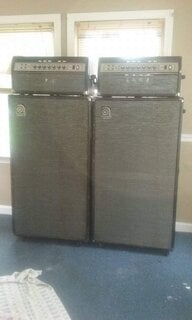
Grunt is an Ampeg SVT with two SVT cabs, that's the standard for grunt. The tubes are a part of it, so are the fairly efficient cabs, the final thing is how you play the bass itself which I think is more important than anything. I voted it's something else.
 
Even though its 30 years since I owned a SVT w/ one cab, That rig always flapped my pants. The low mids ( around 220 hz) just pushed through any room I played in. I remember always cutting the bass back and the room still sounded good.Having said that, I think the acoustic environment ( the room) has a lot to do with whether your amp grunts or not. When there's a wall of speakers behind you, you hear the wall and not the room. When you put sound into the room you encounter a non changeable element. Some rooms sound good, others suck. Can't change that.