• TalkBass has been independent since 1998. Add your voice.
    Create a free account to reply to discussions, view embedded media, and browse with fewer display ads.
    Join freeLog in
    Want zero display ads or expanded classifieds tools? Compare plans.

Do you believe in "sweet spots" for pickups?

Unless you have a pickup that slides depending on where your left hand is, then you have to pick a sweet spot, i.e. the best location on average for most of the notes. It's not a marketing term whatsoever, and I don't know how so many of you think it is. Frankly , I think you're just looking for attention. Maybe it's not exactly where you want it, but it's by far not just a marketing term.

Agreed - I don't even know how this is a question unless people are hung up on semantics. A "sweet spot" is just slang for pickup position that sounds "best" to someone or some group of people. Tone changes with the pickup position (*cough* physics). Part of what makes a Smith sound like a Smith is where the pickups are. And in fact I had a Fodera built with the neck pickup exactly where a Smith is positioned (Fodera would typically put them a bit closer to the neck). I got exactly what I wanted - more of a pissed-off P-bass sound.
 
The point is, sweet spot is not a marketing term. We all agree pickup location makes a big difference. On a P bass, for example, there is an approximate location that majority of people have through the years though it sounded best.
You're making statements with question marks at the end.

But assuming what you meant to write, no, that is not "my logic". I'm a big believer that pickup location changes tone. In fact I think it is the single most important influencer on tone in a build. My argument is that subjective opinions are not objective ones. Also words have meanings that don't change with our feelings. Hence the example of tremolo vs. vibrato.
 
70 J basses disagree. It's well known that layout was chosen solely for visual reasons.

A sweet spot in the sporting goods world where the marketing term came into favor is describing the spot on a racquet which will return the most force and lose the least amount of energy to deflection. Saying you don't believe in sweetspots is not saying you feel pickup placement is irrelevant, that's just another strawman argument so common in these threads. Not accepting the existence of sweetspots in this case simply means you do not think there is an objectively superior location with all other positions being inferior.

Saying it's science or it's physics or you're a troll is a weak argument of emotion no matter how often it's said here. If it's science use science and explain it in a way that can be duplicated. This isn't like declaring a bankruptcy on TV.

Pre CBS J basses where Leo "got it right the first time" conflicts with the love for the '70s position that was chosen so the cover would completely hide the pickup. Both positions can't be the best. Nobody here is saying pickup position has no influence on tone. There is no need to argue against that position.

Also vibrato and tremolo are different things that are not freely interchangable, but that belongs in a Strat forum :bassist:
Interesting. Who was the idea guy deciding that the pickup needed to be set back so it hid completely under the ashtray pickup cover?? First time I've heard that and not sure that makes any sense. I had a '65 Jazz, which was stolen in 1976 along with all my touring gear. In the early 70's when I was touring I specifically left the Ashtray pickup cover in place because I though it looked cool, but removed the pickup cover over the neck pickup.

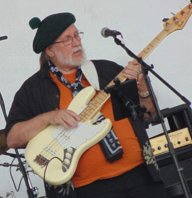
Here's a shot of me playing my 65 in 1972 with said ashtray in place and the pickup is well hidden. I did find a another picture from a front looking to back angle and you could "sort-of" see the edge of the mounts. My bass needs a good wipe down there but in my defense we typically played 9PM to 1AM, 5-nights a week 50-weeks a year. I did that for 3-years; made really good money; and had a great time.

DanSteve_1000x1124.jpg


I finally replaced my '65 Jazz in 1985 with an '82 Jazz that has a white bound all-maple neck and the 70's era pickup spacing. As much as I loved my '65, if I got it back, my '82 Jazz would still probably be my #1. That combination of the 70's pickup spacing (4" center to center) gives my '82 a little brighter sound and a lot more sustain than '65 had. Regardless of whether someone made that choice as an aesthetic or not, in my experience it produces a superior sound. It also growls quite a bit more easily than my '65 did with its 3.6" center to center pickup spacing. Just dig into the strings over the bridge pickup and she'll growl all night long. Having played extensively with both pickup spacing types, I by far prefer the 70's era spacing although the 70's era necks are crap (way too fat).

Here's my '82 Jazz:
WhiteLadyOutside2.jpg

When it was traded in at the music store where I was working part-time (went back to college), the pickup covers were still in their plastic bags and hadn't been opened. So they were never installed on this bass. Fellow handling the trade-in immediately took those covers out and put them up for sale in our accessories case. So I didn't get them when I bought that bass a month later. Since I do move my plucking hand around to fine-tune the sound I want for the song I'm playing, I've never been tempted to put an ashtray cover on it. I dig into the strings directly over the bridge pickup to make my bass growl when needed and I couldn't do that with the pickup cover in place.
 
  • Like
Reactions: DavidEdenAria
Interesting. Who was the idea guy deciding that the pickup needed to be set back so it hid completely under the ashtray pickup cover?? First time I've heard that and not sure that makes any sense.
Definitely not the first time I heard that was the reason, although I can't verify it officially with the thorough 2 minute google search I just did. But I do know two things for sure:

1. It does get covered up fully by the ashtray with 70s spacing, and at certain angles the pickup does stick out on 60s Js. This isn't an original but it's a CS recreation of one:

upload_2024-1-28_0-30-8.jpeg


B. Considering some of CBS's other big ideas, I wouldn't put it past them to move the pickup for that exact reason.
 
Interesting. Who was the idea guy deciding that the pickup needed to be set back so it hid completely under the ashtray pickup cover?? First time I've heard that and not sure that makes any sense. I had a '65 Jazz, which was stolen in 1976 along with all my touring gear. In the early 70's when I was touring I specifically left the Ashtray pickup cover in place because I though it looked cool, but removed the pickup cover over the neck pickup.

Here's a shot of me playing my 65 in 1972 with said ashtray in place and the pickup is well hidden. I did find a another picture from a front looking to back angle and you could "sort-of" see the edge of the mounts. My bass needs a good wipe down there but in my defense we typically played 9PM to 1AM, 5-nights a week 50-weeks a year. I did that for 3-years; made really good money; and had a great time.

View attachment 5332224

I finally replaced my '65 Jazz in 1985 with an '82 Jazz that has a white bound all-maple neck and the 70's era pickup spacing. As much as I loved my '65, if I got it back, my '82 Jazz would still probably be my #1. That combination of the 70's pickup spacing (4" center to center) gives my '82 a little brighter sound and a lot more sustain than '65 had. Regardless of whether someone made that choice as an aesthetic or not, in my experience it produces a superior sound. It also growls quite a bit more easily than my '65 did with its 3.6" center to center pickup spacing. Just dig into the strings over the bridge pickup and she'll growl all night long. Having played extensively with both pickup spacing types, I by far prefer the 70's era spacing although the 70's era necks are crap (way too fat).

Here's my '82 Jazz:
View attachment 5332237
When it was traded in at the music store where I was working part-time (went back to college), the pickup covers were still in their plastic bags and hadn't been opened. So they were never installed on this bass. Fellow handling the trade-in immediately took those covers out and put them up for sale in our accessories case. So I didn't get them when I bought that bass a month later. Since I do move my plucking hand around to fine-tune the sound I want for the song I'm playing, I've never been tempted to put an ashtray cover on it. I dig into the strings directly over the bridge pickup to make my bass growl when needed and I couldn't do that with the pickup cover in place.

How do you have your Eden amps EQed with your 82 J bass?
 
How do you have your Eden amps EQed with your 82 J bass?
Very simply actually. I run the V, V, and T controls wide open. On both my Eden and DNA amps I run everything flat to set the gain - I want that set-gain light dancing on my lowest/loudest notes (gain at ~2 o'clock with my Jazz). Then, if I am using an Eden amp that has semi-parametric controls (3 on my WT500/800, 2 on my TN226, 1 on my Eden Nemesis RS400), I'll set one of them to about 250Hz and boost it to 1:30. Enhance is off, and auto-compressor is bypassed. If the gain light is still dancing with that setting, I'm done. If your gain-set light doesn't dance, the signal you're feeding the power section is too weak. If it comes on and stays on, the signal is set too hot and will not be as clear as it should be. It is extremely important to to get that gain set corretly.

With my WTDI that I use anytime I have to use a backline or go direct to the soundboard, I don't have the option of boosting a little at 250Hz. It only has one mid control and it toggles between 500Hz and 2KHz. So I set it to the 500Hz position and boost it again to ~1:30. Anywhere you can address the low-mids between 250Hz and 550Hz will work. If your sound honks on you, it's set too high. Back it down until that honking sound disappears. By the way the best sounding recordings I ever made with it were at a pro-studio in Seattle in 2019 using the WTDI. Engineer and owner both had to come out to see what I was using as they didn't need to make any adjustments to my raw sound. Just tweaked the level of the recording and that was it.

My DNA-800 amp doesn't have any semi-parametric controls but the low mid is centered at 500Hz, so I boost that to 1:30. I also add a slight boost to the bass EQ because it is set at 30Hz in the Eden amps and at 35Hz in the DNA amps. Boosting that bass shelving control to 1 o'clock gives it the same sound I get from my Eden amps with bass EQ set flat.
 
  • Like
Reactions: DavidEdenAria
Definitely not the first time I heard that was the reason, although I can't verify it officially with the thorough 2 minute google search I just did. But I do know two things for sure:

1. It does get covered up fully by the ashtray with 70s spacing, and at certain angles the pickup does stick out on 60s Js. This isn't an original but it's a CS recreation of one:

View attachment 5332436

B. Considering some of CBS's other big ideas, I wouldn't put it past them to move the pickup for that exact reason.
Hey Jimmy, I did find one shot of my '65 at an angle from the front right and at that angle you could see those edges on mine too. But bear in mind besides being at an angle to the front. I also hold the neck at about a 45° angle to perpendicular from my body. So you could see what looks like bumps from the pickup mounting screw surrounds.

Is that a '61/'62 Jazz or a relic re-issue?

For whatever reason they decided to move it, I'm really glad they did and I'm really glad that they used that spacing on my Jazz. It just produces the best sound at least for me. I imaging the all-maple neck contributes to that too, but most of it has to be pickup placement closer to the bridge.
 
  • Like
Reactions: JimmyM
Very simply actually. I run the V, V, and T controls wide open. On both my Eden and DNA amps I run everything flat to set the gain - I want that set-gain light dancing on my lowest/loudest notes (gain at ~2 o'clock with my Jazz). Then, if I am using an Eden amp that has semi-parametric controls (3 on my WT500/800, 2 on my TN226, 1 on my Eden Nemesis RS400), I'll set one of them to about 250Hz and boost it to 1:30. Enhance is off, and auto-compressor is bypassed. If the gain light is still dancing with that setting, I'm done. If your gain-set light doesn't dance, the signal you're feeding the power section is too weak. If it comes on and stays on, the signal is set too hot and will not be as clear as it should be. It is extremely important to to get that gain set corretly.

With my WTDI that I use anytime I have to use a backline or go direct to the soundboard, I don't have the option of boosting a little at 250Hz. It only has one mid control and it toggles between 500Hz and 2KHz. So I set it to the 500Hz position and boost it again to ~1:30. Anywhere you can address the low-mids between 250Hz and 550Hz will work. If your sound honks on you, it's set too high. Back it down until that honking sound disappears. By the way the best sounding recordings I ever made with it were at a pro-studio in Seattle in 2019 using the WTDI. Engineer and owner both had to come out to see what I was using as they didn't need to make any adjustments to my raw sound. Just tweaked the level of the recording and that was it.

My DNA-800 amp doesn't have any semi-parametric controls but the low mid is centered at 500Hz, so I boost that to 1:30. I also add a slight boost to the bass EQ because it is set at 30Hz in the Eden amps and at 35Hz in the DNA amps. Boosting that bass shelving control to 1 o'clock gives it the same sound I get from my Eden amps with bass EQ set flat.
I totally get the gain light lol! It took a while to figure that out but it shows the excellent design of the Metro and other Edens...i too bypass the comp and only use the enhance for certain 'experimental things' involving effects so its off mostly.

On dark basses like the Epi Newport i boost slightly at 4k and sometimes cut around 150hz a bit, it completely changes the mudbucker sound...sometimes add a tiny bit of enhance...i wish i had a HPF though.

Otherwise pretty flat EQ and enhance off for Fender J bass...P bass is another thing lots can be done with the Metro EQ and a P bass to where you would be hard pressed to tell its a P bass...i do use various picks a lot so its easy to control attack with EQ vs fingers or thumb.

Interesting on the J bass pickup spacing.
 
  • Like
Reactions: Rip Van Dan
Hey Jimmy, I did find one shot of my '65 at an angle from the front right and at that angle you could see those edges on mine too. But bear in mind besides being at an angle to the front. I also hold the neck at about a 45° angle to perpendicular from my body. So you could see what looks like bumps from the pickup mounting screw surrounds.

Is that a '61/'62 Jazz or a relic re-issue?

For whatever reason they decided to move it, I'm really glad they did and I'm really glad that they used that spacing on my Jazz. It just produces the best sound at least for me. I imaging the all-maple neck contributes to that too, but most of it has to be pickup placement closer to the bridge.
It was a Custom Shop relic. I couldn't find a pic of an original and I didn't want to spend all night looking for one.
 
  • Like
Reactions: Rip Van Dan