

Enjoy the benefits of a premium membership!
Upgrade Account
-
TalkBass has been independent since 1998. Add your voice.
Create a free account to reply to discussions, view embedded media, and browse with fewer display ads.
Join free Log in
Want zero display ads or expanded classifieds tools? Compare plans.
You are using an out of date browser. It may not display this or other websites correctly.
You should upgrade or use an alternative browser.
You should upgrade or use an alternative browser.
Do you have to have a 5?
- Thread starter TheArchitect
- Start date
More options
Who Replied?
Jazzdogg
Less barking, more wagging!
All I play right now are 5 string basses. I have 19mm and 18mm 5 strings and I really like the 18mm bass. If you can deal with 18 or even 17.5mm spacing, it makes it more manageable for me anyway.
Like others have said, having the few extra low notes is not the only benefit, you also have a bunch more positions you can utilize to go across the neck instead of making big leaps up and down the fretboard.
I like being able to visualize what I am about to play, using any part of the fingerboard I choose, with fewer jumps from end to end.
I also like to play further up the neck occasionally to give my body a break from habitually reaching for the first fret, as I often do when playing a four-string.
One of the reasons I am eager to try TI Jazz rounds and Dogal Hellborg strings is because I am hoping they will sound good on every fret - even on the B string.

I like the idea of having that low B string. As a practical matter though, what are the real benefits of it. I'm not sure if the perks of having those couple of notes out weighs the practical advantages of the lighter weight, smaller neck etc that would be in play 100% of the time.
I am considering options for a very "modern" bass. I have a 6 string and that neck is so wide the instrument is a beast to play. It is not really giving me a good read on the value of the low B. I am still leaning towards a modern 4, but I don't want any personal bias' from my experience with that 6 to influence the choice
I just bought a Fender American Standard Jazz Bass 5. It's a great bass and sounds incredible...but I do not like playing 5 strings and I absolutely hate playing heavy basses (to me heavy is anything over 9.5 pounds), and this bass weighs in at 10. So why did I just spend over a grand on a bass I don't enjoy playing? because I needed one for the band I'm in. Many of the songs we play require the extended range of the 5. Plus, it really helps with my hand position to be able to play a little higher up the neck making use of the B string. I'm keeping it for now, but like most of the 5 strings I've owned over the years, it probably will see the classifieds at some point.
Nope, personally I am strictly a four string player.
I generally do not like the sound of a low B in most recordings. Same thing with live music.
I remember seeing a country music live show and the bass players kept pounding low notes that did not sound good and got lost in the mix.
Call me old school but that's what my ears are telling me.
I generally do not like the sound of a low B in most recordings. Same thing with live music.
I remember seeing a country music live show and the bass players kept pounding low notes that did not sound good and got lost in the mix.
Call me old school but that's what my ears are telling me.

you can use the B string as a thumbrest on 90% of songs, and then the 'floating thumb' crew might leave you alone
This made me LOL.

As of 2023 I have switched to playing five strings exclusively. I done this before. I've been with a outlaw country band (which is the same as a country band but cooler. Lol) for almost two years, we play a lot of newer country and that requires a five. Not that it's a bad thing.

There's also a percussive attack playing the low E on the B string brings that when playing E open is not nearly as thumpy.As long as the lowest note on the average upright bass is the E, no one actually needs a B string.
I like having a B string if for no other reason than that in addition to the extra 5 low notes and opening up new playing positions, it is also the ultimate thumbrest.
Did the Young Country band gig for years and yes, the fiver was necessary.As of 2023 I have switched to playing five strings exclusively. I done this before. I've been with a outlaw country band (which is the same as a country band but cooler. Lol) for almost two years, we play a lot of newer country and that requires a five. Not that it's a bad thing.
Last edited:

Me? Yes, absolutely. Feels more comfortable, makes more sense than a de-tuner, & a lot of the music I like playing needs it.
Do *You* have to have one? no idea...
Do *You* have to have one? no idea...

Oh Lordy, no genre requires you to play 5 or 6 or 11 string basses, its still the same 7 notes, do you want sub lows ? do you want to go into the tenor range? there are basses that do that but its still the same 7 notes. If you want to get weird , study eastern music, that'll keep you busy for awhile.
I have 4 string basses , I have 5 string basses, I play both , yadda yadda yadda , you do you.
I currently play in a country band and use both, either one works depending what I feel like playing. and no one in the band ever said "hey, you need to play that 5 string like all the time, I dont think they really notice the difference.
I have 4 string basses , I have 5 string basses, I play both , yadda yadda yadda , you do you.
I currently play in a country band and use both, either one works depending what I feel like playing. and no one in the band ever said "hey, you need to play that 5 string like all the time, I dont think they really notice the difference.

OP, I respectfully suggest you approach the question from a different perspective. Don't look to other players for the answers you seek. Only *you* can possibly know if you need more than four strings. This knowledge can only come from experience over time and hinges on a) the type of music you prefer playing, b) your technical ability on the instrument / musical awareness - i.e. whether or not it would be better served by having an instrument facilitating notes in the extended range, and c) Your personal preference for such an instrument.
A few examples of some of the greatest ever players of the bass guitar ( and the instruments with which they're most identified ).
Me - I have four four-strings and two six-strings. I like them, they serve the music I play and I like doing my own thing. I'm not worried about showing up at a folk/rock gig with a six because the cats I play with are cool, and here's the thing: In real musical circles the focus is always on the music and how it is achieved, not on the instrument used. The bass is just a tool. If you find yourself in an opposite situation where the focus becomes less on the music and others are projecting their views on what *they* think you should be playing - excuse yourself and seek out a more productive musical environment.
Apologies for the long-winded response, but there you have it.
All the best.
A few examples of some of the greatest ever players of the bass guitar ( and the instruments with which they're most identified ).
- Jaco Pastorius - four string bass
- Nathan East - five string bass
- Anthony Jackson - six string bass
- It's true that Jaco was in his prime before the advent of extended range instruments, but it's often cited that later on in his career ( after the advent of the five-string ), when asked why he didn't graduate to a five, he answered "why?". This needs little elaboration ( for obvious reasons ) but clearly he thought an extra string - be it a high C or a low B - was simply unnecessary for what he was doing. He was primarily a RnB/Jazz player with a command of the instrument so vast there was no call to play notes in higher or lower registers beyond the scope of the Fender bass at the time. The music simply didn't call for it. As others have suggested - and rightly so - if he'd lived longer, who knows what he might've ended up playing, nevertheless he was a musical genius and four strings were enough for him to do his thing and do it better than anyone else.
- Nathan East started on four string, again, because there were no ERBs when he was coming up. However, as he developed his career as one of THE top session players on the west coast, he quickly adopted the five-string because it was essential for competing with the low notes on keyboard/synthesizers in the studio. The rest is history. Incidentally, Nathan's use of the low B string is so musical, it's hard to imagine him using anything else. He is one beautiful cat. His playing is so tasteful.
- Anthony Jackson, inventor of the six-string and arguably the greatest of all bass guitarists - certainly my favourite ( in a list of favorites that includes Jaco, Jamerson, McCartney, Kaye, Osborn, Rainey, Weeks, Palladino, Edwards and East ) - first conceptualized the six in the late '60's/early 70's after becoming frustrated at not being able to reach notes lower than E while playing along to Jimmy Smith ( jazz organist ) records. He view of the bass guitar - being the lowest pitched instrument in the guitar family - was that it should have had six-strings to begin with and who am I /we to argue. The man is a genius. However, the gestation period for the six string was a long one, but such was/is Anthony's virtuosity, he managed to forge a stellar career on his four string jazz while waiting for the six to come to fruition - at which point he retired the jazz for good and played the six exclusively.
Me - I have four four-strings and two six-strings. I like them, they serve the music I play and I like doing my own thing. I'm not worried about showing up at a folk/rock gig with a six because the cats I play with are cool, and here's the thing: In real musical circles the focus is always on the music and how it is achieved, not on the instrument used. The bass is just a tool. If you find yourself in an opposite situation where the focus becomes less on the music and others are projecting their views on what *they* think you should be playing - excuse yourself and seek out a more productive musical environment.
Apologies for the long-winded response, but there you have it.
All the best.
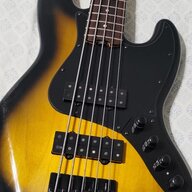
I have a 4.
Also have three 5.
I like the 5ers better.
I play the 5ers 99% the time.
Don't need the 4 since I already have it with the 5ers
TBH I kept the 4 because it was my first bass ever since 1996.
Also have three 5.
I like the 5ers better.
I play the 5ers 99% the time.
Don't need the 4 since I already have it with the 5ers
TBH I kept the 4 because it was my first bass ever since 1996.
I kept trying and trying to find a fiver that I liked for about 10 years. I’ve played soooo many that I eventually just gave up the ghost and figured I’m just a 4 string guy and left it at that.I like the idea of having that low B string. As a practical matter though, what are the real benefits of it. I'm not sure if the perks of having those couple of notes out weighs the practical advantages of the lighter weight, smaller neck etc that would be in play 100% of the time.
I am considering options for a very "modern" bass. I have a 6 string and that neck is so wide the instrument is a beast to play. It is not really giving me a good read on the value of the low B. I am still leaning towards a modern 4, but I don't want any personal bias' from my experience with that 6 to influence the choice
But last year, I found a 5er that finally spoke to me. It didn’t hurt that I’ve been hired by two groups whose music benefits from the extended range, for sure. But yeah - I literally had dreams of me playing this bass so I knew I had to get it. Now it’s the one that I play most and I’m loving the fact that I don’t have to run all across the neck to play the lines that I need to.
So I guess what I’m saying is that one doesn’t need a fiver but it certainly doesn’t hurt to have one - if you can find one that speaks to you and helps you play what you need to!

Hi, I didn't read all the answers, someone mentioned sometimes it sounds better to play the low note instead of the high, and he is right, also, you can play songs in different positions, and also in some cases there is no need to get a different tuning, you can just change the way you are playing the song, if that makes sense, i do like playing 4 but most of the time I play 5 cause sometimes I don't know what to expect so I rather have a swiss army knife, instead of a Rambo knife

I own one and force myself to play it every so often. Its beautiful. Its a “just in case” instrument for a just in case gig

Yes, but there are downsides to playing a five as well.How is this still a discussion? Let me be the first to speak the truth: yes, you NEED a five string! Otherwise you won't be respected as a bass player, a musician or a human being. You will get laughed at at auditions. Audiences will boo you off stage. You will never be part of the bass players' society - yes, there is a club, with secret headquarters in New York, where there will be a foto of you right next to the door, saying "not this guy". Your family will turn away from you in shame. You will die alone, homeless, a failed existence, leaving behind a life full of regrets and a four string bass, that will be thrown into the fires of Mount Doom by a Hobbit in a hazard suit.

I need to replenish the bank account from buying the Fenders but I am liking the look and spec of this..
Yamaha TRBX605FM Bass Guitar - Natural Satin
Yamaha TRBX605FM Bass Guitar - Natural Satin
I
I use a carbon steel wok almost entirely in the kitchen. It is the most versatile pan I have ever owned. Now I am confused.....Or one could pop for a really expensive All-Clad skillet - is Fodera the All-Clad of basses? Here, we favor Scanpan as a cost-effective non-teflon ceramic non-stick pan - Scanpan...the Sadowsky Metro of skillets! But we also use seasoned cast-iron: the P-bass (with flats and tort) of skillets!
And also in total agreement with this assessment of the 4 vs. 5 question.

James Jamerson did play one, (not on record) if you have a copy of Standing in the Shadows it shows a picture of a Fender 5 String Bass, that according to James Jr.
belonged to his father. Granted it had a high C but it was a five.
Update: From another recent thread Jameson did use a 5 String in the studio?


