
Enjoy the benefits of a premium membership!
Upgrade Account
-
TalkBass has been independent since 1998. Add your voice.
Create a free account to reply to discussions, view embedded media, and browse with fewer display ads.
Join free Log in
Want zero display ads or expanded classifieds tools? Compare plans.
You are using an out of date browser. It may not display this or other websites correctly.
You should upgrade or use an alternative browser.
You should upgrade or use an alternative browser.
Do you have to have a 5?
- Thread starter TheArchitect
- Start date
More options
Who Replied?


For me a 5 string isn’t abt the low notes. That’s just gravy.
I feel the real benefit of a 5 is that you can play 2 full octaves in a 5 fret span. That means you need to move less which makes playing easier.
Another thing I like abt 5 strings, and I’m prob in the minority here, is the tighter string spacing some basses have. It’s makes faster parts easier to play, for me.
4 string will always feel like home base though.
I feel the real benefit of a 5 is that you can play 2 full octaves in a 5 fret span. That means you need to move less which makes playing easier.
Another thing I like abt 5 strings, and I’m prob in the minority here, is the tighter string spacing some basses have. It’s makes faster parts easier to play, for me.
4 string will always feel like home base though.
I like the idea of having that low B string. As a practical matter though, what are the real benefits of it. I'm not sure if the perks of having those couple of notes out weighs the practical advantages of the lighter weight, smaller neck etc that would be in play 100% of the time.
I am considering options for a very "modern" bass. I have a 6 string and that neck is so wide the instrument is a beast to play. It is not really giving me a good read on the value of the low B. I am still leaning towards a modern 4, but I don't want any personal bias' from my experience with that 6 to influence the choice
It makes for a fantastic thumb rest. Unbeatable as a thumb rest.

I would say no . Lots of players just use a four string to great effect .
That said three of my four basses are 5 strings and I am way more comfortable on 5 strings . I have a 4 string and I love it but it's a lot more work for me than my 5s .
That said three of my four basses are 5 strings and I am way more comfortable on 5 strings . I have a 4 string and I love it but it's a lot more work for me than my 5s .
Last edited:

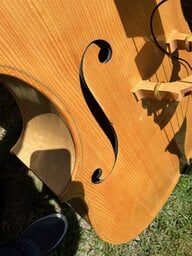
If hire-ability is the end goal, don't worry about bass guitar string quantity; get an upright bass!
For me a 5 string isn’t abt the low notes. That’s just gravy.
I feel the real benefit of a 5 is that you can play 2 full octaves in a 5 fret span. That means you need to move less which makes playing easier.
Another thing I like abt 5 strings, and I’m prob in the minority here, is the tighter string spacing some basses have. It’s makes faster parts easier to play, for me.
4 string will always feel like home base though.
I'm a weird one. A double bass in high school and when I saw an Ibanez K5 (I know..) going really cheap, I just had to have it. When it comes to electric bass, I started out on 5 and an electric 4 is my biggest learning curve.
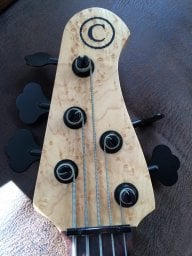
Do you have to have a 5? No
Do I have to have a 5? Yes.
Do I have to have a 4? Nope. It comes with the 5.
After playing on 5's for a number of years, I've found that my playing style and the basslines I come up with for our original songs are heavily influenced by having a 5 and they do not carry over well to a 4 as I am either missing notes low or high. This was confirmed recently when I picked up a 4 string in a guitar trade and struggled. YMMV
Even though I rarely use anything below the low D, I have come to depend on having those low notes available when needed. But the big thing is also hand placement as mentioned above.
As someone who plays in different projects and genres, I am always covered with a 5, especially when songs have to be transposed depending on vocalist.
But to each his/her own. Some like 5's, some 4's, some 6's and beyond. Play what works for you, don't be afraid to try new things and accept that it is OK to like or not like something that people on TB rant about.
And FWIW, a well-seasoned and maintained iron skillet is basically non-stick that lasts forever and you don't have to slowly consume teflon bits...lol
Or one could pop for a really expensive All-Clad skillet - is Fodera the All-Clad of basses? Here, we favor Scanpan as a cost-effective non-teflon ceramic non-stick pan - Scanpan...the Sadowsky Metro of skillets! But we also use seasoned cast-iron: the P-bass (with flats and tort) of skillets!
And also in total agreement with this assessment of the 4 vs. 5 question.

This is true.Jaco only needed 4.
Amirite? Amirite? Amirite? Amirite?!?!?!


The age old question, do we need five. Ask the public do they care, do they even notice. U can bet James Jamerson would have played one if it had been around, but would he have sounded any better? Probably, but still no one would have noticed.

I like the idea of having that low B string. As a practical matter though, what are the real benefits of it. I'm not sure if the perks of having those couple of notes out weighs the practical advantages of the lighter weight, smaller neck etc that would be in play 100% of the time.
I am considering options for a very "modern" bass. I have a 6 string and that neck is so wide the instrument is a beast to play. It is not really giving me a good read on the value of the low B. I am still leaning towards a modern 4, but I don't want any personal bias' from my experience with that 6 to influence the choice
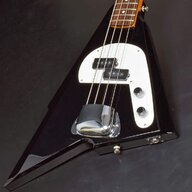
One benefit is the justification to get this beauty : )
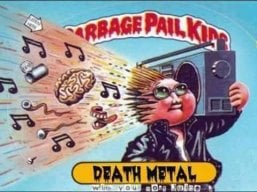
We may never know, but maybe as soon as Jaco got his hands on a modern 5 string with active EMG's and onboard eq he may have tossed that J bass out in the trash.Jaco only needed 4.
Amirite? Amirite? Amirite? Amirite?!?!?!


I played 5 string exclusively for around 10 years. I get the benefits such as economy of motion etc, but for me, when I went back to 4 strings, it just felt right. If I do need the lower notes offered by a 5 string for the odd one to two songs, then I just use a snapshot on my helix to switch to BEAD tuning. An ehx pitchfork or Digitech drop would do the same thing for you if you don’t have a helix type device.

I've been playing a 4-string Jazz Bass since I bought my 1965 Jazz back in 1966. It got stolen in 1976 and I finally found a Jazz with the same neck shape, profile and radius in 1985. It's an '82 maple-necked Jazz with 70's era pickup spacing (4" center to center). It sounds a little brighter than my '65 did and has more sustain. I've been playing it now for 38-years.I like the idea of having that low B string. As a practical matter though, what are the real benefits of it. I'm not sure if the perks of having those couple of notes out weighs the practical advantages of the lighter weight, smaller neck etc that would be in play 100% of the time.
I am considering options for a very "modern" bass. I have a 6 string and that neck is so wide the instrument is a beast to play. It is not really giving me a good read on the value of the low B. I am still leaning towards a modern 4, but I don't want any personal bias' from my experience with that 6 to influence the choice
I got used to that fast 4-string neck on my '65 as I played through high school and some college and then toured for 3 years playing 5-nights a week, 50-weeks a year. I love the playability of that 60's Slim C-shape neck with 7.25" radius. First time I played my '82 it felt like coming home.
I love the sound and playability of my current Jazz, but I hated tuning down my E string to get down to a D or C for some songs back in around 2008. Got to the point that I would have to down-tune my E string 4 to 5 times a night. God help you if you forgot to tune it back up for the next song - that was fun! So in 2009 I bought an inexpensive 5-string.
It's a Rogue LX405 Pro, which was about $200 and made in Korea. Very pleasantly surprised at the fit and finish when I received it. Rogue has moved twice since then and quality has slipped twice, once with the Pro II and again with the Pro III when they moved to a Chinese factory. So it wasn't spendy, but higher quality than I expected.
It sounds good too - not like my Jazz of course, but has a good sound. It also looks good on stage, so I'd keep it handy and just switch my wireless from on to the other. Besides the ability to play notes below a low E, it also allows you to utilize the B-string when playing patterns that would otherwise require you to use open strings - makes it real easy to move patterns around.
One thing that surprised me was the neck. I expected it to be wider, but didn't expect it to be a slim neck, and it is. The radius on it is a LOT flatter than my Jazz at 12" radius vs 7.25" radius, but because the neck is so slim, I can play it comfortably. I rarely use it now because we're not doing any songs that require it, and my Jazz just sounds so good. Now, if I had a Dingwall 5-string, I might not use my 4-string as much, but I really love the sound of my Jazz so I use it as much as possible.

I don't NEED a 5. Or a 4, or any bass at all. But I haven't bought a 4 in many years, and I probably will never buy one again. I've wanted a 5 since the early 80's when I first realized they existed. Now, you can pry it from my cold dead hands.
Of course it gives me more positioning options, as well as more timbral options from playing high up on the B string.
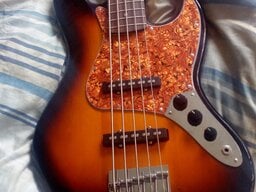
But it seems like a lot of people around here only want an instrument with exactly 4 flatwound strings, fake violin burst, fake tortoiseshell pickguard, passive electronics, made by a company called Fender. And also to play only I-V quarter notes below the 5th fret with the tone rolled off from behind the drummer. They also want everyone else to want that. I don't mind if anybody (or everybody) wants that. I don't want that.
Of course it gives me more positioning options, as well as more timbral options from playing high up on the B string.
But it seems like a lot of people around here only want an instrument with exactly 4 flatwound strings, fake violin burst, fake tortoiseshell pickguard, passive electronics, made by a company called Fender. And also to play only I-V quarter notes below the 5th fret with the tone rolled off from behind the drummer. They also want everyone else to want that. I don't mind if anybody (or everybody) wants that. I don't want that.
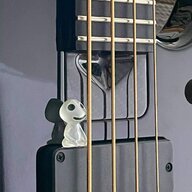
Same here, I don't do slap style, I play fast music, riffs that travel across the fretboard, and the tighter string spacing is niceFor me a 5 string isn’t abt the low notes. That’s just gravy.
I feel the real benefit of a 5 is that you can play 2 full octaves in a 5 fret span. That means you need to move less which makes playing easier.
Another thing I like abt 5 strings, and I’m prob in the minority here, is the tighter string spacing some basses have. It’s makes faster parts easier to play, for me.
4 string will always feel like home base though.


