

Enjoy the benefits of a premium membership!
Upgrade Account
-
TalkBass has been independent since 1998. Add your voice.
Create a free account to reply to discussions, view embedded media, and browse with fewer display ads.
Join free Log in
Want zero display ads or expanded classifieds tools? Compare plans.
You are using an out of date browser. It may not display this or other websites correctly.
You should upgrade or use an alternative browser.
You should upgrade or use an alternative browser.
Do you really need more than 4 strings on a bass?
- Thread starter SoulReflection
- Start date
- Status
- Not open for further replies.
More options
Who Replied?


The title should have been, Why did you play a 5/6 vs a 4, not "Do you really need more than...."
The way this legitimate question is being asked suggests. that no one needs more than 4....
People on this website don't like being questioned.... maybe that is true for anything involving the human being....
The way this legitimate question is being asked suggests. that no one needs more than 4....
People on this website don't like being questioned.... maybe that is true for anything involving the human being....

For me, a 5 string is simply a better tool.
I have a couple of 4 string basses that I love but they never leave the house. Every gig I play has a few songs in Eb or D. I need to be able to transcribe at a moment’s notice if the singer calls out a lower key. Playing an octave higher is not an option. De-tuners are a compromise and make it impossible to maintain efficient fingerings and positions.
Not to mention how cool it is to play leading notes or scales that are lower than E.
The B string is absolutely necessary for me. I never leave home without it. I’m not the only one.
I have a couple of 4 string basses that I love but they never leave the house. Every gig I play has a few songs in Eb or D. I need to be able to transcribe at a moment’s notice if the singer calls out a lower key. Playing an octave higher is not an option. De-tuners are a compromise and make it impossible to maintain efficient fingerings and positions.
Not to mention how cool it is to play leading notes or scales that are lower than E.
The B string is absolutely necessary for me. I never leave home without it. I’m not the only one.

I find the low B on a five string very useful or in some cases outright necessary for legit/theater gigs, modern pop/country, etc. and when I accompany singers who have lower voices and need to transpose songs down.

Five string with a low B would be nice but I play short scale and low B on a short scale is just too floppy. I don't need a B or C on the high end so I'll stick with four.
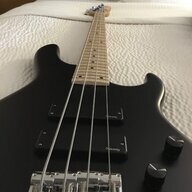
I, being female, have smaller hands than a lot of bass players with their mighty paws. Counterintuitively, I find a five string to be much more forgiving for smaller hands, because you have a lot of key root notes on smaller frets closer to your body (C, D, G, E, etc). That way I can hold one position on the neck no matter what key I'm in and get around a lot more easily.I am "old school" and have never considered having more that 4 strings on a bass. I am, however, curious and open to opinions.
Why would you want and/or need more? What, if anything, am I missing? Is there a reason it wasn't common back in the day and if so, what changed?
Thoughts?
Also, I've always found D to be a weak point on a 4-string. I've got satifying low notes for just about every other key I find myself in, but D leaves me stranded with a root note that is higher than the patterns I play in that key for the 4, 5, etc. I like having that really low D to work off. I don't really use the lowest B or C much.
I never considered buying a 6-string until I started getting a bit better at playing leads. It is nice to have lots of accessible options including highs I never need playing bass lines, and they sound so pretty, like the equivalent of a mezzo-soprano.
I recently bought a four string again just because I wanted to get back to fundamentals, and also to reduce hand strain on certain songs that require a lot of my right hand. It was a Sadowsky 4-string, and I love the thing so much I'm selling it to get a Sadowsky 5-string. Once you play 5-string, it can be pretty hard to go back, because you have to rethink all your patterns. I guess I'm pretty much a 5-string player.
The title should have been, Why did you play a 5/6 vs a 4, not "Do you really need more than...."
The way this legitimate question is being asked suggests. that no one needs more than 4....
People on this website don't like being questioned.... maybe that is true for anything involving the human being....
Thanks, @stevensivak, I appreciate your response but, people on this website should be able to differentiate between someone who is being critical and someone who simply wants some info. It is not a matter of questioning, it is looking for reasons.

You don’t really “need” more than one string and 11 frets….
If you only had one string and 11 frets you would be required to play up and down the fretboard but you’d have every note you’d ever need.
More strings gives you the ability to play up and down the fretboard as well as across the fretboard.
I guess it has a lot to do with economy of motion when you get right down to it.
If you only had one string and 11 frets you would be required to play up and down the fretboard but you’d have every note you’d ever need.
More strings gives you the ability to play up and down the fretboard as well as across the fretboard.
I guess it has a lot to do with economy of motion when you get right down to it.

Smooth_bass88
vaxx!
- Oct 31, 2006
- 12,122
- 16,794
- Disclosures
- have been on nationally released albums, charting on the Billboard 200
...you get a call for a gig that requires a five string. that's basically why.27572808[/URL], member: 317196"]I am "old school" and have never considered having more that 4 strings on a bass. I am, however, curious and open to opinions.
Why would you want and/or need more? What, if anything, am I missing? Is there a reason it wasn't common back in the day and if so, what changed?
Thoughts?
lots of five string basses around starting in the 80s, fourty some-odd years ago. Before that, there really any. so, they've actually been around longer than they haven't.

For me it’s mostly a matter of repertoire followed by what I then become most comfortable playing. There are enough songs I play regularly (with different bands) which contain bass notes below the low E, that an extended-range bass is a necessity for me. I’ve gotten comfortable playing fives so there’s not much reason for me to play fours (not for stage performances at least).
What changed? Synth bass and the fact that an increasing number of bassists began using extended-range basses (and were then recording parts using that extended range).
What changed? Synth bass and the fact that an increasing number of bassists began using extended-range basses (and were then recording parts using that extended range).
Last edited:
I, being female, have smaller hands than a lot of bass players with their mighty paws. Counterintuitively, I find a five string to be much more forgiving for smaller hands, because you have a lot of key root notes on smaller frets closer to your body (C, D, G, E, etc). That way I can hold one position on the neck no matter what key I'm in and get around a lot more easily.
Also, I've always found D to be a weak point on a 4-string. I've got satifying low notes for just about every other key I find myself in, but D leaves me stranded with a root note that is higher than the patterns I play in that key for the 4, 5, etc. I like having that really low D to work off. I don't really use the lowest B or C much.
I never considered buying a 6-string until I started getting a bit better at playing leads. It is nice to have lots of accessible options including highs I never need playing bass lines, and they sound so pretty, like the equivalent of a mezzo-soprano.
I recently bought a four string again just because I wanted to get back to fundamentals, and also to reduce hand strain on certain songs that require a lot of my right hand. It was a Sadowsky 4-string, and I love the thing so much I'm selling it to get a Sadowsky 5-string. Once you play 5-string, it can be pretty hard to go back, because you have to rethink all your patterns. I guess I'm pretty much a 5-string player.
Thank you for your response.
First, there are many threads on this.
My experience is this: I started on 4's. Then, after a couple years, I felt like I wanted to hit lower notes, so I bought a 5. That led to a couple of decades of playing primarily 5-ers, though I always kept a 4-string in the arsenal. Then, I discovered I could mute better and move around better on a 4, and now I play 4's with Hipshot Xtenders primarily, but I still keep a 5-string in the arsenal. Bottom line is, I rarely play exact bass lines--I always play lines that are either original (in the case of original tunes) or informed by the original (in the case of cover tunes). Depending on what/how I want to play, I'll select the instrument that sounds/feels/plays right for what I want to play.
My experience is this: I started on 4's. Then, after a couple years, I felt like I wanted to hit lower notes, so I bought a 5. That led to a couple of decades of playing primarily 5-ers, though I always kept a 4-string in the arsenal. Then, I discovered I could mute better and move around better on a 4, and now I play 4's with Hipshot Xtenders primarily, but I still keep a 5-string in the arsenal. Bottom line is, I rarely play exact bass lines--I always play lines that are either original (in the case of original tunes) or informed by the original (in the case of cover tunes). Depending on what/how I want to play, I'll select the instrument that sounds/feels/plays right for what I want to play.


First, there are many threads on this.
My experience is this: I started on 4's. Then, after a couple years, I felt like I wanted to hit lower notes, so I bought a 5. That led to a couple of decades of playing primarily 5-ers, though I always kept a 4-string in the arsenal. Then, I discovered I could mute better and move around better on a 4, and now I play 4's with Hipshot Xtenders primarily, but I still keep a 5-string in the arsenal. Bottom line is, I rarely play exact bass lines--I always play lines that are either original (in the case of original tunes) or informed by the original (in the case of cover tunes). Depending on what/how I want to play, I'll select the instrument that sounds/feels/plays right for what I want to play.
Thank you @sawzalot!

I came to bass guitar from piano. You know, all the notes in a straight line.
So, bass guitar. Notes not in a straight line, and they overlap. I can play G Here, Here, Here, you get the idea.
Took a while to wrap my head around that.
When I did, I got tired of starting a figure HERE, and then part way through it, I had to slide up THERE to finish it.
When fives came out, the little light came on. I could play a two octave scale ACROSS the fingerboard. Bingo! I started playing only fives in the late 80's and have never looked back, they just suit me best.
OK, the several extra low notes are fun IN THE RIGHT SPOT, but a bad reason to go from four to five.
The real advantage is playing across the fingerboard and the more choices in fingering one more string offers, and transposing is far more simple.
I see no reason why 4 is better than 5, 5 is better than 4, I GOT to have a six, etc. The important thing is to use whatever helps you make your best music, and only your opinion counts for you. I never understand how some cats think that how many strings your bass has is some sort of implied gage of your musical manhood.
Play what suits you.
So, bass guitar. Notes not in a straight line, and they overlap. I can play G Here, Here, Here, you get the idea.
Took a while to wrap my head around that.
When I did, I got tired of starting a figure HERE, and then part way through it, I had to slide up THERE to finish it.
When fives came out, the little light came on. I could play a two octave scale ACROSS the fingerboard. Bingo! I started playing only fives in the late 80's and have never looked back, they just suit me best.
OK, the several extra low notes are fun IN THE RIGHT SPOT, but a bad reason to go from four to five.
The real advantage is playing across the fingerboard and the more choices in fingering one more string offers, and transposing is far more simple.
I see no reason why 4 is better than 5, 5 is better than 4, I GOT to have a six, etc. The important thing is to use whatever helps you make your best music, and only your opinion counts for you. I never understand how some cats think that how many strings your bass has is some sort of implied gage of your musical manhood.
Play what suits you.

Yes. A lot of the music I play requires notes below the low E.
plus it’s a lot easier to transpose having an extra note. Playing with horns and they want Superstition in Eb? No problem, I can get those low Ebs that sound phat and don’t have to play em up an octave where it can lose some of its power.
A lot of country music goes down to low D and C regularly. Same with music theatre.
plus it’s a lot easier to transpose having an extra note. Playing with horns and they want Superstition in Eb? No problem, I can get those low Ebs that sound phat and don’t have to play em up an octave where it can lose some of its power.
A lot of country music goes down to low D and C regularly. Same with music theatre.


I used to be adamant that 4 strings was all I needed. Until one day it occurred to me that playing metal made it a pain to play lots of modern songs on a 4 string bass. Not impossible, just a pain (different gauge strings, different setup, having 6 or more different basses with a different tuning, string gauge, etc, having less notes, etc). On top of that, depending on the tuning, it sucked trying to transpose each song I learned from one tuning to the other if I was recording or doing a live session. Essentially I was learning to play the songs repeatedly on different basses with different setups. It worked, but it was also a waste of my time. Having a five string bass enables me to learn 99% of anything I’d ever need to play without having ever to transpose anything beyond the first time of learning / writing said song.
All in all, my point is…if 4 works for you then awesome. 6, really cool! 4? That’s great! However, I personally can’t stand when I hear people say only bassists need 4 strings, or it’s only 5 extra notes or whatever. Everyone’s situation is different. Statements like those I mentioned just tells me said person saying these things have never played anything above a 4 and are parroting others’ beliefs or haven’t actually spent much time playing a 5 or 6 string bass. To each their own.
All in all, my point is…if 4 works for you then awesome. 6, really cool! 4? That’s great! However, I personally can’t stand when I hear people say only bassists need 4 strings, or it’s only 5 extra notes or whatever. Everyone’s situation is different. Statements like those I mentioned just tells me said person saying these things have never played anything above a 4 and are parroting others’ beliefs or haven’t actually spent much time playing a 5 or 6 string bass. To each their own.
I came to bass guitar from piano. You know, all the notes in a straight line.
So, bass guitar. Notes not in a straight line, and they overlap. I can play G Here, Here, Here, you get the idea.
Took a while to wrap my head around that.
When I did, I got tired of starting a figure HERE, and then part way through it, I had to slide up THERE to finish it.
Great points...
When fives came out, the little light came on. I could play a two octave scale ACROSS the fingerboard. Bingo! I started playing only fives in the late 80's and have never looked back, they just suit me best.
OK, the several extra low notes are fun IN THE RIGHT SPOT, but a bad reason to go from four to five.
The real advantage is playing across the fingerboard and the more choices in fingering one more string offers, and transposing is far more simple.
I see no reason why 4 is better than 5, 5 is better than 4, I GOT to have a six, etc. The important thing is to use whatever helps you make your best music, and only your opinion counts for you. I never understand how some cats think that how many strings your bass has is some sort of implied gage of your musical manhood.
Play what suits you.
Great points...

I am "old school" and have never considered having more that 4 strings on a bass. I am, however, curious and open to opinions.
Why would you want and/or need more? What, if anything, am I missing? Is there a reason it wasn't common back in the day and if so, what changed?
Thoughts?
At age 70, I wouldn't consider me new school exactly, but as for having more than 4 string? Depends on what music you are playing. There are times when it's pretty stinking convenient, like playing music written in this century. But if all you are playing classic 70's rock or classic Motown, odds are you don't need more than 4. And if you do for a few songs, there are work arounds, Drop D, BEAD tunings for instance.
In the end it's up to you to see if there is a value in it. JMO.
- Status
- Not open for further replies.


