Yes. Always two basses, two amp heads, one cabinet.For those of you that bring a backup bass in case of emergency. Do you bring a backup amp as well?

Enjoy the benefits of a premium membership!
Upgrade Account
-
TalkBass has been independent since 1998. Add your voice.
Create a free account to reply to discussions, view embedded media, and browse with fewer display ads.
Join free Log in
Want zero display ads or expanded classifieds tools? Compare plans.
You are using an out of date browser. It may not display this or other websites correctly.
You should upgrade or use an alternative browser.
You should upgrade or use an alternative browser.
Do you switch basses mid-set?
- Thread starter urkel3000
- Start date
More options
Who Replied?
LoveThatBass
Supporting Member
I gave a 5 and 2 4’sI've never once switched basses during a set. I'm a BEAD guy, no fives, no EADG basses... I'll bring two basses with me, and play the one that feels right and the other one stays in the bag.
Do you bust out your 5 for a song or two? Or do you keep the same bass on all night?
. Hardly use the 5 . BEAD sounds very interesting.

There were a couple songs that screamed "fretless!!!" so I switched. There was a break in my part, so nothing stopped.You do a soundcheck and get everything right. Why #%^$$ it up?

buldog5151bass
Kibble, milkbones, and P Basses. And redheads.
Fretted to fretless is one thing (I generally play Fretted for rock, fretless for jazz and bluegrass). But in most cases on fretless, the best thing you can do is get a tone that fits in the mix and stay there. 98.67% of the audience doesn't care if you switch, and those that do likely will just say you picked the wrong instrument.There were a couple songs that screamed "fretless!!!" so I switched. There was a break in my part, so nothing stopped.

This, actually. I usually have a spare with me these days, but lately I’ve tended to be extra redundant and make sure the spare is the functional equivalent of the main axe. So sound person isn’t going to have a lot of work suddenly if I did have to switch. Me either, I don’t want to juggle many variables. So my main is a passive P4, spare is a passive P5. Tempted to start bringing a fretless, but would probably need to be a fretless P too to match close enough to my main axe for mid set switching.You do a soundcheck and get everything right. Why #%^$$ it up?

I only own one bass. My trusty Olympic White American Special P-Bass.
A long time ago I used to switch mid-set when I needed another tuning. This could happen multiple times per set. But then I installed Hipshot detuners and bought a Digitech Drop, and now I bring just one 4-banger and an identical backup and haven't looked back.
Played active fivers for awhile, but figured out that I'm much better on 4 than on 5. So, I switched back to passive 4-bangers.
Played active fivers for awhile, but figured out that I'm much better on 4 than on 5. So, I switched back to passive 4-bangers.

For those of you that bring a backup bass in case of emergency. Do you bring a backup amp as well?

I see your point.
Sometimes yes (for me: most of the times no)
But honestly if the amp should fail you could always play thtough the PA: better than nothing, it would work in an emergency situation.

Carrots. While I used to switch basses often on gigs it was due to different tunings, strings, pickups, tones, feels, fretted/fretless ~ if I took a bass just for backup I would play it for at least one set or song. Now I usually take my main bass and keep thing simple and portable. My current band is requesting me to bring fretless or EUB for some songs but I have resisted so far, that might change. Instead I rely on my pedal board to make a lot of those sonic changes t0 feed my fragile mind. 

Same 6er all night.Do you bust out your 5 for a song or two? Or do you keep the same bass on all night?
I do the same and never needed a backup for any sort of failure, but it seems professional to bring one, just in case.Always have a backup incase of failure, never needed one yet.
sometimes. Not often. Sometimes throw on a fretless for oldie rock gigs or if a Stray Cats, Ella, Billie, etc toon gets called. Or sometimes bring a slack toon (E♭) bass if the guitar wants to do Hendrix or SRV. Can change over quickly; no big.
But 95% just play one bass all night with a backup tuned up and in the bag. 

But 95% just play one bass all night with a backup tuned up and in the bag.
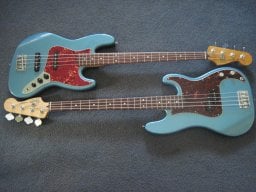
I bring 2 basses and will, on occasion, switch between sets. And I do this for my own personal "kicks-n-giggles".

I usually have a F bass BN5 and a BN5 Fretless on stage. I will use the fretless if we have a dinner set or cocktail hour. Once we hit the dance sets I will switch to the fretted bass. In a perfect world I would also have my P bass with flats as well for all the old school tunes but stages are small.


The only times I used to switch during a set was during corporate gigs where we'd sometimes go from playing cocktail music to dance. I'd play fretless for the cocktail and move to fretted for the dance. That came to an end when I ended up having to play a disco medley (including slapped parts) on a fretless Rob Allen with tapewounds because there wasn't time to switch basses between songs.
No, I only bring one bass. I would like to play different basses during the night, but there are several reasons why I don’t.
First, it’s more stuff to lug around, set up, and worry about during the show. One instrument lets me focus on the music.
Second, absolutely nobody cares or even notices the difference except me.
Third, spending a whole night with a single instrument allows me to fine-tune my tone and attack, which I feel is a valuable experience. I learn by necessity how to coax a variety of sounds out of the instrument.
First, it’s more stuff to lug around, set up, and worry about during the show. One instrument lets me focus on the music.
Second, absolutely nobody cares or even notices the difference except me.
Third, spending a whole night with a single instrument allows me to fine-tune my tone and attack, which I feel is a valuable experience. I learn by necessity how to coax a variety of sounds out of the instrument.

I appreciate your post, but in my case there is a pretty steep drop off. Frankly, I’d much rather move up and down the fretboard than deal with finger contortion to mute ringing strings. As a guitarist, muting is not so much of a problem. When open strings ring on a bass the bass frequencies are much more noticeable. And that is just one issue. Another issue, fatter neck, especially when playing up the finger board, and wouldn’t call my hands small as I have a 9 3/4” span with from the pinky tip to my index finger tip.Alternately, perhaps you should play the 5 more. It really depends on your long-term goals.
I transitioned from 4- to 5-string. About three years later I transitioned from 5- to 6-string. My perception is the transitions degraded my playing and it took about 2 years to get back to where my playing was before each transition. For context I was a full-time pro during these transitions.
I also think it took me about a decade to really feel like a naturalized 6-string bassist. Prior to that, I approached the 6-string like a 4-string with a few extra strings. What do I mean? The number of strings on the bass has some impact on fretboard logic and which patterns of fingering and shifts are optimal. With a 4-string you have to shift up and down the neck more. With a 6-string, it often makes more sense to play across the strings and shift less.
For the following reason, I prefer to play 6-string pretty much exclusively. If I play a 4- or 5-string for even an hour or so, I starts modifying some of the automated processes I use to play. The result is it starts to degrade my fluency on the 6-string. At this point I am far more confident on the 6-string than on a 4- or 5-string.
That is not to say I can't switch between 4-, 5-, and 6-string, only that doing so incurs a cost. I prefer to avoid the cost, so I don't spend very much time on my 4s and 5s.
I concede that there are probably some things I can still do better with less string. However with exception of the first few weeks of transitioning to 6-string, I don't believe I ever reverted to 4-string because I couldn't get the job done perfectly well on the 6-string. At this point, overall I am strongest on the 6-string...it's not even close.
Gigging wise, I play 4-5 gigs a year. At age 72, this isn’t much call for bassists at this ages, some really don’t have years to perfect a proper technique. I’m thinking that at this point I’m ok swapping out a bass for a few songs,


