
• TalkBass has been independent since 1998. Add your voice.
    Create a free account to reply to discussions, view embedded media, and browse with fewer display ads.
    Join freeLog in
    Want zero display ads or expanded classifieds tools? Compare plans.

Do you think finish thickness affects tone?

Does finish thickness affect the output of an electric bass?

  • No, that's crazy talk!

    Votes: 164 61.2%
  • Yes, and I am posting irrefutable scientific proof

    Votes: 49 18.3%
  • Carrot juice is the best finish for tone

    Votes: 68 25.4%

  • Total voters
    268
It affects appearance and durability, but that's about it.

Of course, the unspoken second premise is that most musicians hear with their eyes.

Some do.

OTOH, I stripped and refinished a polyurethane-dipped Stratocaster with a thin coat of nitro, little filler, and the tonal differences, for better or worse, were significant enough that others noticed.

Also, IME subtle tonal differences using different finishes (and components) become less apparent the more gain and effects are used; Subtle differences in dynamic playing response become less apparent the more compression is applied.

I mention both because I've seen ostensible "proof that there's no difference" videos on YouTube where both gain and compression dilute the test data, leaving me to wonder "how could you tell?".
 
  • Like
Reactions: ajkula66
Some do.

OTOH, I stripped and refinished a polyurethane-dipped Stratocaster with a thin coat of nitro, little filler, and the tonal differences, for better or worse, were significant enough that others noticed.

Also, IME subtle tonal differences using different finishes (and components) become less apparent the more gain and effects are used; Subtle differences in dynamic playing response become less apparent the more compression is applied.

I mention both because I've seen ostensible "proof that there's no difference" videos on YouTube where both gain and compression dilute the test data, leaving me to wonder "how could you tell?".

It would be a very difficult experiment to do properly. As others have suggested, a subtle difference in tone could be caused by a change made when reassembling the instrument.
 
  • Like
Reactions: dagrev
Depends on the finish.... if we're talking the normal paint job - no..... now if your finish is something that is capable of changing the mass or the stiffness of the bass, hence changing its resonant frequency - then "yes". So something ridiculous like FLEX SEAL, concrete, etc......
 
Some do.

OTOH, I stripped and refinished a polyurethane-dipped Stratocaster with a thin coat of nitro, little filler, and the tonal differences, for better or worse, were significant enough that others noticed.

Also, IME subtle tonal differences using different finishes (and components) become less apparent the more gain and effects are used; Subtle differences in dynamic playing response become less apparent the more compression is applied.

I mention both because I've seen ostensible "proof that there's no difference" videos on YouTube where both gain and compression dilute the test data, leaving me to wonder "how could you tell?".
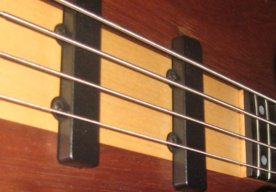
I did this on a 1970 Precision. The dip was about an 1/8" thick at the bottom. Whether the amplified tone changed I couldn't say but it certainly came alive in my hands and weighed a good bit less.
 
This tells you what string sounds like strung between the two benches. You are hearing the benches. This is what happens when you try to prove a belief you already have instead of experimenting with wonder open to any results.
Did you look all the video ? The benches part is only the last detail of it, like the final joke. But i'll join you about one point: beside sounds, we all have our proper reality, our proper way to hear things. So it's a no good replies debate cause even if someone would bring eventual scientific proof, there always be someone who ( sincerely and honestly) not hear the same thing.
 
  • Like
Reactions: chadds
Not a bass, but I think this settles the tone woods and finishes wars

Let’s see. When he puts the cheap strings on you can hear the resonance. Everything vibrates. The question should be is concrete good for Metal? Or heavy Metal?:) No really, “which wood most resembles the resonance of concrete?”:):)

No one said that alternate materials weren’t viable for EGs/EBs.:)

To the title of the thread this luthier put four coats of sealer then a coat of counter wax. So does the finish affect the sound? :):)

Lastly that’s heavily effects laden sound. I like the way it looks and it sounds good.

His video just proves there may be different forms of “tonecrete”. :):)
 
Let’s see. When he puts the cheap strings on you can hear the resonance. Everything vibrates. The question should be is concrete good for Metal? Or heavy Metal?:) No really, “which wood most resembles the resonance of concrete?”:):)

No one said that alternate materials weren’t viable for EGs/EBs.:)

To the title of the thread this luthier put four coats of sealer then a coat of counter wax. So does the finish affect the sound? :):)

Lastly that’s heavily effects laden sound. I like the way it looks and it sounds good.

His video just proves there may be different forms of “tonecrete”. :):)
Tonecrete. Classic!!
 
This tells you what string sounds like strung between the two benches. You are hearing the benches. This is what happens when you try to prove a belief you already have instead of experimenting with wonder open to any results.
So how much of the rest of the video did you actually watch? Or did you just see the image in the post, and make an assumption?
 
  • Like
Reactions: Sid Fang