• TalkBass has been independent since 1998. Add your voice.
    Create a free account to reply to discussions, view embedded media, and browse with fewer display ads.
    Join freeLog in
    Want zero display ads or expanded classifieds tools? Compare plans.

Does a bass being a lightweight indicate a negative?

Allowing for the variety in wood types, weight/density/hardness differences within the same species, or even tree. The only thing a heavier body gives you for certain is a greater chance of a sore back, or shoulder.

I have some heavier than average basses and guitars and some which are lighter than average and I've worked on or built a shed load over the years and I've never found weight to be an accurate predictor of sustain or tone.
 
  • Like
Reactions: FishDub
My best sounding bass is a super light old fender Pee, but the best sounding I've ever owned was a Tele bass that was stupid heavy. So, I don't know. I'm 70 and want to play the best sounding instrument I can get, so if I still had the Tele would be playing that one i guess.

But I play much more bari sax than bass, so I have to laugh at bass players who need less than 10 lbs on their shoulders. Hahahaha Go to the gym or something, jeez.
 
  • Like
Reactions: FishDub
Not at all. Some of the best sounding and playing instruments I own weigh far less than what many people consider light for a bass, and some of the heaviest instruments I've owned have also sounded and played incredibly good. And light and heavy ones have both been pretty bad, too.

However... some heavier materials do have a different tone, such as bubinga bodied warwick basses that are quite heavy but have a lower mid punch and built in compression that is amazing, and yet the identical bass with light weight swamp ash (which is what my warwick is made of) is more punchy and, well, hifi and upper middy sounding kinda. Both ARE great though.
 
The only way I think a "lightweight" bass would be a negative is if the lack of body weight causes neck dive.

When picking the lightest of a particular style of bass, it is the body that is usually responsible for the bass being light and the neck usually weighs the same. This can cause neck dive.

If the bass was designed to be light, then I see no issue with that.

Once the bass neck dives, it's too light. It's more fatiguing for me to fight neck dive on an 8 pound bass vs a 12 pounder that balances properly.
I have basses that are anywhere from just under 8 pounds to nearly 11 pounds, with the vast majority of them in the 9-10 pound range. They all balance perfectly, so none are an issue for any length of play. FWIW, I consider the 9-10 pound zone 'average bass weight.'
 
I say a lightweight bass would be a positive

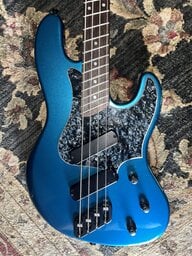
This ones the thinnest and lightest bass (roughly 7.5 lbs) I’ve ever touched along with perfect balance this is the most solid instrument in my lineup. Every note resonates strongly and there’s not a single dead spot to be found. I don’t think thick or heavy bodies determine sound or resonance, but rather the quality of the woods that make up the instrument
EEC2B3A3-9557-40CB-AB74-8FF22806EBEF.jpeg
 
I believe Roger Sadowsky debunked the myth about weight impacting tone which is why all his instruments are chambered and lightweight. A solid body from his shop is a custom order.
Another builder said that
“Tone trumps weight “
I try not to go above 9 lbs since we play long shows and often times without breaks.
 
Last edited:
I've always felt the same way.
But I must say, I am 57, and this is the first year that I have picked up my Warwick 5 string and an audible involuntary "oof!" came out of my mouth.


We're about the same age.

I have a back injury that mandates playing seated, no ifs ands or buts. That in itself makes the difference between my '64 Epiphone parlor acoustic guitar (feather) and my '81 Aria Pro II bass (likely the heaviest piece in my collection) negligible in this respect.

Obviously, YMMV and then some.
 
I ask this because I have read many threads on two different views of this, particularly in the classifieds. The first is that a nice, heavy, thick slab of wood in excess of 10-12 pounds accounts for unmatched, resonate tone quality(IE-Vintage Fenders/Musicmans).


Weight has nothing to do with tone.

There are "boat anchors" out there that don't sound good and basses that will blow away in a strong wind that do. What makes a piece of wood sound good is how resonant it is. You'll find good and not so good sounding woods at all weights.
 
  • Like
Reactions: FishDub
I can't find a correlation between weight and tone. I am starting to prefer my super lightweights (< 8lbs), but both my lightweights and my boat anchors sound great.

I think active basses tend to sound like their electronics, regardless of weight.

I have a bunch of P basses. They all sound about the same, regardless of weight. What really changes the tone on them is string choice.
 
  • Like
Reactions: FishDub and lomo
I recently swapped the outstanding neck of my Ibanez GSRM20 Mikro Bass, which had an unusually heavy mahogany body, to the unusually light weight mahogany body of a GSRM20B Mikro Bass, and the result beside a better looking and much lighter bass was slightly improved resonance and sustain.

However the fact that the neck pocket of the new light weight body fitted dead tight around the heel of the transplanted neck, which was not the case with the neck pocket of the old heavy body, together with the fact that the new light weight body had a really thin open pore finish vs. the insanely thick poly finish of the old heavy body, might very well have had more of a say in that matter than the weight really did.
 
Last edited:

Latest posts