
Upright bass players (perhaps almost exclusively rockabilly players?) occasionally do this, it’s called a “bumped set” of strings, bc you’ve “bumped” each string over a fourth from what it’s usually tuned to. You usually have to set up the instrument specifically to accommodate. I’ve messed around with it, on upright with heavy strings like stark Spirocore and medium Evah Pirazzi, and on electric bass guitar particularly with medium to heavy gauge flat wounds. it can be a cool sound, cool feel, cool vibe… but it is its own thing… I think I might do it again sometime… but probably won’t ever make it my one and only setup.

Enjoy the benefits of a premium membership!
Upgrade Account
-
TalkBass has been independent since 1998. Add your voice.
Create a free account to reply to discussions, view embedded media, and browse with fewer display ads.
Join free Log in
Want zero display ads or expanded classifieds tools? Compare plans.
You are using an out of date browser. It may not display this or other websites correctly.
You should upgrade or use an alternative browser.
You should upgrade or use an alternative browser.
Does anyone else tune their basses down a 4th? (Five string with E A D G C strings but tuned down to B E A D G)
- Thread starter Upstate SC Bass
- Start date
More options
Who Replied?
tuning to D or C standard or in between is also cool. Being able to use open strings in lower keys can add some cool flavors to things. I learned it like this: playing for a singer songwriter artist, she had a groovy song in C# minor, I was always kinda hemmed in by not being able to use open upper strings. When she recorded her album the producer used ace session players. The session guy tuned his medium Spirocores to C# standard and turned the song on its head with a killing Led Zep meets Stevie Wonder flavored bass part, open strings, pull offs, the whole biz… keep an open mind!

No that's not exactly right. One is EADG, but the other is DGCF. And yes it is a good excuse for getting two similar basses@Wicked G usually has some of his 4 string basses tuned EADG and others tuned BEAG. Good excuse for getting two similar basses at a time.
 . If I did need a B String, that would be a good excuse to get a Spector NS Dimension 5 or a Dingwall .
That would be a very floppy setup. Keeping notes in tune with that light of a gauge is hard. I had La Bella White Nylon Tapes on one of my basses when I was still playing in standard tuning...I was thinking the same thing. It's the equivalent of really light gauge strings. I play a 4 string with a .100 E. The OP's setup would designate an .080 E, a .100 B, etc. Possibly a little extreme.
tuning to D or C standard or in between is also cool. Being able to use open strings in lower keys can add some cool flavors to things.
But then I decided to tune my basses to D Standard. The tapes didn't last long after tuning down because they were too floppy (they're meant for standard tuning or higher). My highest string went from G2 to F2, but it was a 35 gauge roundwound under the tape (50 gauge including the tape). I had notes going out of tune when I was recording a bass part for a song. That's when I realized I needed more tension.There is a virtue and cool sound with some lower tension which I hear every time I change strings as I'm tuning to pitch for the first time, but a whole 4th is a bit too floppy. (If you make it work, then bravo, good for you.) It's part of the reason the Chapman stick sounds so rich, long strings loose enough to be tapped not plucked.
Usually I play a 5st in normal BEADG tuning 45-130.
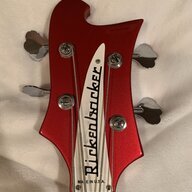
Coincidentally I've been buying for a few of my 4s super heavy gage (I'd never use in standard pitch) with the intension of going down one step. So far I have done it on a late 90s Ibanez RB400 (a stingray like neck and PUs J neck / M bridge) that always had Great fundamental low end. Putting it in DGCF 55-110 steel sounds freeking Great and I don't know why I didn't do it years ago! (The low D is fanastic) That's the note I play the most on a regular B string; I've often played with a guitarist who tunes to D which is why I got into 5s. Next in sight is a Jack Casady I'm tired of fighting with and I'll use nickels on that. I might try it on a Jackson-backer Concert thingie that's super bright with good lows too. I'll keep the Squire paranormal short scale in standard, it sounds too good to mess with and I'm just doing this with 34" scale... although the Reverend Dub King might work one step down...
So I play heavy gauge (55-110) D'Addario NYXLs and medium gauge (50-105) Chromes. Why? String tension is important and physics is a thing.
Last edited:

If I did need a B String, that would be a good excuse to get a Spector NS Dimension 5 or a Dingwall
I just got a Spector NS Dimension 5. Multi-scale is the way to go to solve the “tension on the B” problem.

No, but my main is a 5 string tuned up to F# standard tuning, with a high D, and my F# string is a gauge .074 guitar string, and the bass is just 28.6" scale.
So I suppose string gauge and tuning wise, and somewhat scale length wise as well, more like a 5 string 8 string guitar, with the upper 3 strings missing, though it does still actually sound more like a bass.
However the shorter scale length the stiffer the strings will be though relatively to gauge and tension, and the longer the scale the more flexible the strings will be relatively to gauge and tension.
I do have a relatively light touch as well.
So I suppose string gauge and tuning wise, and somewhat scale length wise as well, more like a 5 string 8 string guitar, with the upper 3 strings missing, though it does still actually sound more like a bass.
However the shorter scale length the stiffer the strings will be though relatively to gauge and tension, and the longer the scale the more flexible the strings will be relatively to gauge and tension.
I do have a relatively light touch as well.
Last edited:
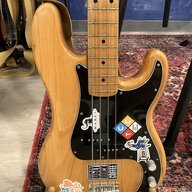
I have one bass set up this way, and it's fun. (Had a six string set lying around for some reason, used the top four strings, so got an extra-light set, tuned EADG.)
It sounds bad unplugged, but it sounds a lot better than I thought it would plugged in. Gives a grindy, Big Black / Black Sabbath tone, as some other posters said. Easier to play. Fun to do guitarist-style bends. And it is not hard to intonate or stay in tune.
I wouldn't use it for everything, but I'd definitely recommend trying it once! Especially if, like the OP, you have hand issues getting you down.
It sounds bad unplugged, but it sounds a lot better than I thought it would plugged in. Gives a grindy, Big Black / Black Sabbath tone, as some other posters said. Easier to play. Fun to do guitarist-style bends. And it is not hard to intonate or stay in tune.
I wouldn't use it for everything, but I'd definitely recommend trying it once! Especially if, like the OP, you have hand issues getting you down.
Oh yeah I hear you. I also own a Spector NS Dimension 4, in Super Faded Black, and the multiscale definitely makes a difference even on just a 4 string. I would like to check out a Dingwall, but honestly I would probably go Spector NS Dimension 5 since I really like my Dimension 4.I just got a Spector NS Dimension 5. Multi-scale is the way to go to solve the “tension on the B” problem.

Tuning string a fourth down from their normal tunings gives you a bit of=ver half the tension of the regular tuning - 56 percent to be more precise.Many B strings are floppy because they don't have enough tension at their normal tuning. If you tune an E string down to B, you are operating with even less tension - That's going to give a result that most people will NOT be OK with .
A big enough B string works just as well. If you; relying on standard 5 string sets, you will forever be disappointed, as the B strings are never big enough for even tension between strings. If you like a 95 E (I do), a 130 B is the correct gauge for the same tension. If you like a 105 E, then a 140 B is what you need. There are literally Zero 5 string sets on the market that fulfill either of those criteria. But if you buy single strings, you cann have a single scale bass that has a very solid low B.I just got a Spector NS Dimension 5. Multi-scale is the way to go to solve the “tension on the B” problem.
A big enough B string works just as well. If you; relying on standard 5 string sets, you will forever be disappointed, as the B strings are never big enough for even tension between strings. If you like a 95 E (I do), a 130 B is the correct gauge for the same tension. If you like a 105 E, then a 140 B is what you need. There are literally Zero 5 string sets on the market that fulfill either of those criteria. But if you buy single strings, you cann have a single scale bass that has a very solid low B.
Yep, totally correct. I’ve built my own sets via singles and depending on the strings, 140 or even 145 is the correct answer tension-wise. The problem is that’s HUGE and I didn’t care for it. StringJoy has higher unit weights for their larger gauges and I could get by with a 135 there and that was better, but they no longer sell singles or custom sets.
On the Spector the 130 is golden. It wasn’t the only reason I got the Spector—the curved body is amazing, wish other brands did that—but it sure is nice to have.

I’ve done this with mixed results. My quest for lightest gauge and lowest tension over shot the mark, it became very hard to mute without fretting notes.
I used the A-C strings in the E-G slots, tuned E-C. Some heavy, stiff sets could do it. Sets with less tension became unmanageable.
I went to regular sets of very light strings in standard tuning. 90-30, E-G. Payson strings, D Addario, GHS boomers, there are plenty of good choices.
TI jazz flats are the stiffest feeling set I use these days.
It was fun experimenting, and I burned up lots of used string sets trying to find the limits of light, low tension, and low action.
I used the A-C strings in the E-G slots, tuned E-C. Some heavy, stiff sets could do it. Sets with less tension became unmanageable.
I went to regular sets of very light strings in standard tuning. 90-30, E-G. Payson strings, D Addario, GHS boomers, there are plenty of good choices.
TI jazz flats are the stiffest feeling set I use these days.
It was fun experimenting, and I burned up lots of used string sets trying to find the limits of light, low tension, and low action.


