• TalkBass has been independent since 1998. Add your voice.
    Create a free account to reply to discussions, view embedded media, and browse with fewer display ads.
    Join freeLog in
    Want zero display ads or expanded classifieds tools? Compare plans.

Does putting a combo amp on casters serve to decouple it from the floor?

This is only marginally related, but I've always liked Bryan Beller's bass rigs that he uses with Aristocrats. He has separate heads powering his bottom cabinets versus his top cabinets, specifically so he can play at high volumes while managing the coupling effect.
 
Yep - it’s wavelength related. At 40 Hz (low E), a wavelength is about 27 feet. If your woofers are a quarter of that or less from the floor, they are coupled well to it.
The frustrations of acoustics in any given room and my lack of any ability to control it drove me endlessly crazy. I rarely was comfortable, rarely heard myself properly, and frequently toasted the rest of the stage while not being able to hear myself. Too bad I never figured out my cabinets needed to be SIX FEET off the floor. At least they'd have been on access with my ears. No wonder guys flock to IEM's.

Probably the biggest reason I don't miss gigging at all any more.
 
  • Like
Reactions: rjmsteel
Based on my my measurements, @micguy and @agedhorse nailed the interactive relation between the cab and the stage plate; with the additional information that wavelength goes down as frequency increases.

One curious effect I noticed is that the coupling actually increases as the cab is initially elevated the first 1/8 wavelength +/-; then decreases with further elevation. My guess is there is some kind of absorption / reflection effect.

I also found that placing absorbing mats on the stage plate in front of the drivers resulted in a significance reduction in coupling; though I have a hard time seeing any type of practical application. Anyhow…

The takeaway is that the coupling is driven by the pressure waves emitted by the drivers; and not by vibration transfer from the cabinet contact. This is why it is important for the mixing chores of the sound engineer to keep your backline levels reasonably low. You have to rock n roll through the mains, not the backline.
 
  • Like
Reactions: Jazzdogg
bassslinger fourstring,

three inch soft rubber casters helped me bof w/decoupling to help defeat any bogarting bottom and having my speakerbox (2x12 bergantino nxt) double as a walker cuz I use a crutch for a bad port-side knee. along w/my forte hp2x in its shoulderpurse-sack and bass in a backwack bass-sack, I bring what the gig needs in one schlep from/to the boat.

on bass, watt


Does putting a combo amp on casters serve to decouple it from the floor? I was thinking about using these from Harbor Freight:

View attachment 7369259
 
One curious effect I noticed is that the coupling actually increases as the cab is initially elevated the first 1/8 wavelength +/-; then decreases with further elevation.

Never heard of this in my years getting a degree in Acoustical Physics or designing pro audio gear. My guess is it’s something related to other factors in whatever situation you’re measuring.
 
If you are close, the bass will also couple to a wall or a corner. The corner is the worst with three boundaries. Mud and more mud.
Or it may be a useful placement. It depends entirely on the situation. It doesn’t have to be mud.
 
Or it may be a useful placement. It depends entirely on the situation. It doesn’t have to be mud.
"Mud" is usually not too much low frequency energy. If you have too much low end, eq can tame it most of the time. Mud is usually harmonics caused when you try to get low frequency energy out of a speaker that ca n't produce it, and it creates harmonics that are....not pleasant. Bass cabs can't really produce the lowest fundamentals, and they need HP filters to avoid creating those harmonics. I get to play through PA's that handle low frequency energy very well; extended low frequencies on a 5 in that situation are not at all "muddly", they are.....awesome.
 
"Mud" is usually not too much low frequency energy. If you have too much low end, eq can tame it most of the time. Mud is usually harmonics caused when you try to get low frequency energy out of a speaker that ca n't produce it, and it creates harmonics that are....not pleasant. Bass cabs can't really produce the lowest fundamentals, and they need HP filters to avoid creating those harmonics. I get to play through PA's that handle low frequency energy very well; extended low frequencies on a 5 in that situation are not at all "muddly", they are.....awesome.
The room modes, which can be particularly noticeable in a relatively small room, can also contribute to exaggerated peaks and valleys in the low end.
 
  • Like
Reactions: Al Kraft
Never heard of this in my years getting a degree in Acoustical Physics or designing pro audio gear. My guess is it’s something related to other factors in whatever situation you’re measuring.
Well, guesses and sheepskins are fine; but, we used have a saying: Theory guides, Data decide.

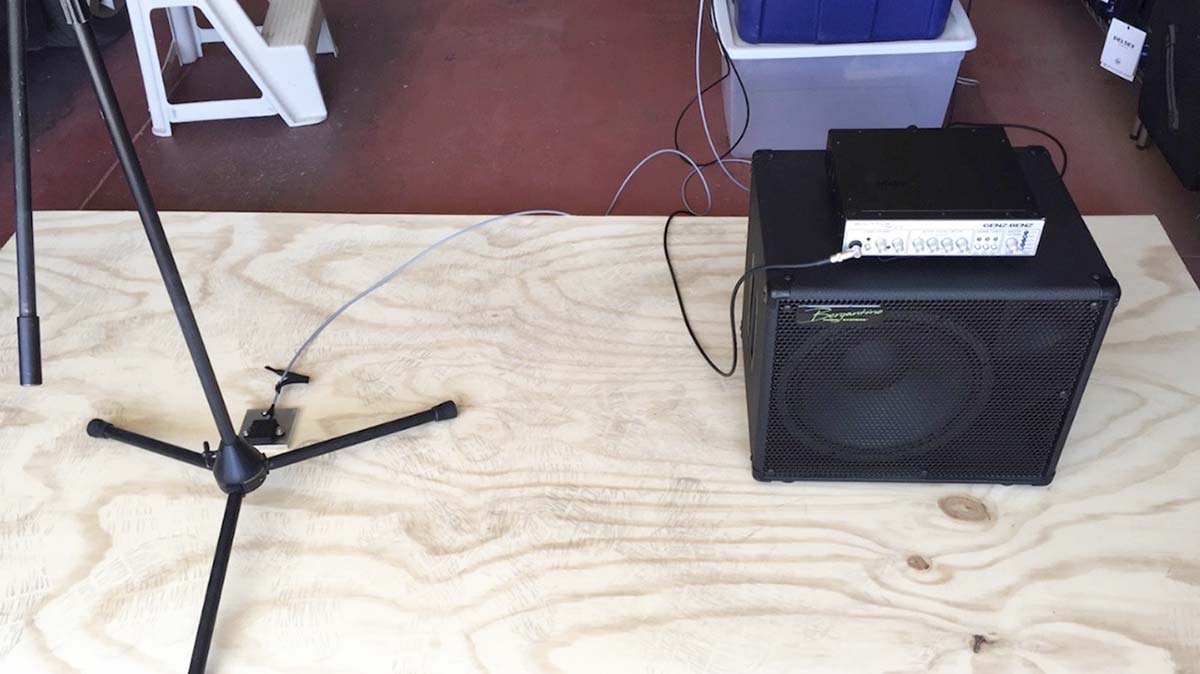
I “published” my experimental details and observations here:


Please feel free to disprove those results or my conclusions.

What I did not describe in that article was the further response I observed when I repeatedly lifted the driver cabinet off of the stage plate while observing the sensor amplitude increase then decrease. At least seven or eight times. But, you can see the effect in the results shown in Table I, in which the coupling increases monotonically with the height of intended isolation device.

At which point, I was pretty much done with the work having mechanistically disproven that particular use of the device I had designed (and which I still use with trad amp heads).
 
Well, then, the sound guy will probably send it all to the subwoofers so you can't hear anything but BOOM BOOM anyway...

I'm not sure whether I hate Highland bagpipes or subwoofers most, but I think I'm going to come down on the side of the subwoofers.
 
Well, guesses and sheepskins are fine; but, we used have a saying: Theory guides, Data decide.

I “published” my experimental details and observations here:


Please feel free to disprove those results or my conclusions.

What I did not describe in that article was the further response I observed when I repeatedly lifted the driver cabinet off of the stage plate while observing the sensor amplitude increase then decrease. At least seven or eight times. But, you can see the effect in the results shown in Table I, in which the coupling increases monotonically with the height of intended isolation device.

At which point, I was pretty much done with the work having mechanistically disproven that particular use of the device I had designed (and which I still use with trad amp heads).

Sorry, I'm trying to take a look at this while monitoring 6th graders fixing a math quiz, and my head is spinning a bit with the calculations. To sum up, I'm guessing putting an am cabinet or combo amp on casters doesn't do much to reduce the sonic effects of floor coupling, it just makes the amp easier to move, right?
 
I'm not sure whether I hate Highland bagpipes or subwoofers most, but I think I'm going to come down on the side of the subwoofers.
But, what's your opinion on highland cows?

1763417303729.png


I actually looked to see if there was such a thing as highland subwoofers, but Google is playing dumb.
 
Well, then, the sound guy will probably send it all to the subwoofers so you can't hear anything but BOOM BOOM anyway...

I'm not sure whether I hate Highland bagpipes or subwoofers most, but I think I'm going to come down on the side of the subwoofers.
Don't blame the subwoofers, they aren't the problem.
 
Don't blame the subwoofers, they aren't the problem.
Well, of course, it's the MISUSE of subwoofers that's the problem, but if they weren't there they couldn't be overboosted till everything sounds like that '93 Honda Civic - you know, the one with the 25 series tires sticking eight inches out past the fenders, the purple neon bulbs underneath, fart can, lots of stickers (cause stickers make a car faster!) and the wing on the trunk lid, still in the original black primer.
 
Sorry, I'm trying to take a look at this while monitoring 6th graders fixing a math quiz, and my head is spinning a bit with the calculations. To sum up, I'm guessing putting an am cabinet or combo amp on casters doesn't do much to reduce the sonic effects of floor coupling, it just makes the amp easier to move, right?
Correct
 
  • Like
Reactions: fourstringbliss