• TalkBass has been independent since 1998. Add your voice.
    Create a free account to reply to discussions, view embedded media, and browse with fewer display ads.
    Join freeLog in
    Want zero display ads or expanded classifieds tools? Compare plans.

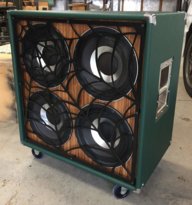
Does putting a combo amp on casters serve to decouple it from the floor?

What does that have to do with anything? Its decoupled or it isn't
It has everything to do with it. Coupling is frequency dependent, position dependent and boundary dependent. It can be 100%, 0% or anywhere in between.

Well, of course, it's the MISUSE of subwoofers that's the problem, but if they weren't there they couldn't be overboosted till everything sounds like that '93 Honda Civic - you know, the one with the 25 series tires sticking eight inches out past the fenders, the purple neon bulbs underneath, fart can, lots of stickers (cause stickers make a car faster!) and the wing on the trunk lid, still in the original black primer.
The tradeoff without subs is overdriving the snot out of the speakers in the attempt to generate low frequencies. Both are problematic in the wrong hands.
 
I'm w/you on that, mr horse!

I use soft casters cuz they travel better w/a rough deck, cracks in the sidewalk, tiny pieces of whatever and such.

anything less than three inches in diameter I've found to be lame also, that's why I like that size.

on bass, watt


  • Like
Reactions: agedhorse
Well, guesses and sheepskins are fine; but, we used have a saying: Theory guides, Data decide.

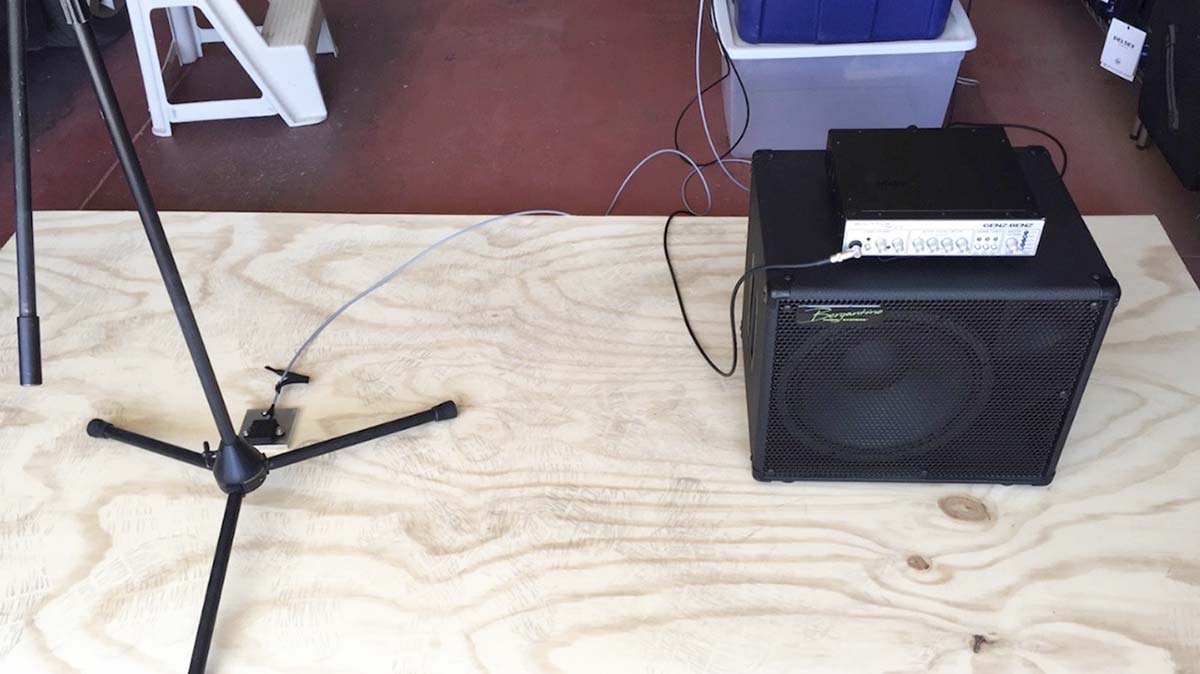
I “published” my experimental details and observations here:


Please feel free to disprove those results or my conclusions.

What I did not describe in that article was the further response I observed when I repeatedly lifted the driver cabinet off of the stage plate while observing the sensor amplitude increase then decrease. At least seven or eight times. But, you can see the effect in the results shown in Table I, in which the coupling increases monotonically with the height of intended isolation device.

At which point, I was pretty much done with the work having mechanistically disproven that particular use of the device I had designed (and which I still use with trad amp heads).
Good read!
I wonder about the measurements you found for the mechanical coupling isolation. The fact that the accelerometer showed more vibration after any of the isolation devices were used was curious.

Is it possible that the phase interaction of mechanical and acoustic coupling was causing some cancelation? Once mechanically isolated, the actual acoustical coupling caused more issues? Showing more vibration at the accelerometer.
 
The only relevant thing I've noticed that if I put isolation pads (foam) under the feet of my combo amp it serves as a high-pass filter, cutting out some of the low frequency boom. Same as setting the amp on carpet or a rug vs. hard floor.
 
Yes if you want your 'quality' Hi Fi to have the tightest bass response you 'fix' the speaker to the surface with a rigid point creating an extremely rigid minimal contact area, so the base and speaker is solid but separated.... hard to explain but it works.
It’s hard to explain because it’s bull poopie…
 
Good read!
I wonder about the measurements you found for the mechanical coupling isolation. The fact that the accelerometer showed more vibration after any of the isolation devices were used was curious.

Is it possible that the phase interaction of mechanical and acoustic coupling was causing some cancelation? Once mechanically isolated, the actual acoustical coupling caused more issues? Showing more vibration at the accelerometer.
The part left out of that table, though I did comment on it, was that the increased accelerometer response was well behaved, and seemingly a monotonic function of the elevation, scaling with the thickness of the isolation device. Standing on the stage, lifting the cab, and watching the accelerometer response made the interaction pretty clear to me; though I did not systematically quantify that response, nor comment on it.

I believe what is missing would be to systematically elevate the cab on the plate while recording the coupling as a function of elevation. In such a study, vibration devices or lack thereof could be inserted to secondarily check your phase question. My sense was that the pressure waves coming of the driver cones are dominant; but, I’ve been wrong before.

My hypothesis for this behavior is that there may be a critical angle of impingement for the coupling to occur; where pressure waves below some critical angle reflect off of the stage plate rather than being absorbed by the plate. Kind of like optical light on water. If this conjecture proved to be true, then possibly shaped ports of some kind close to the stage plate would have a lower tendency to create rumble; though such a design would need to essentially eliminate the driver projection - probably not a good idea; but, possibly drivers could be located higher on the cab. You never know.

I’ve personally gone away from much use of trad backline drivers, opting instead for powered wedge monitors for most of my gigs. So, I’m much less affected by the stage plate coupling. But, it does remain an issue on hollow stages with backline stacks / rigs.
 
Based on my my measurements, @micguy and @agedhorse nailed the interactive relation between the cab and the stage plate; with the additional information that wavelength goes down as frequency increases.

One curious effect I noticed is that the coupling actually increases as the cab is initially elevated the first 1/8 wavelength +/-; then decreases with further elevation. My guess is there is some kind of absorption / reflection effect.

I also found that placing absorbing mats on the stage plate in front of the drivers resulted in a significance reduction in coupling; though I have a hard time seeing any type of practical application. Anyhow…

The takeaway is that the coupling is driven by the pressure waves emitted by the drivers; and not by vibration transfer from the cabinet contact. This is why it is important for the mixing chores of the sound engineer to keep your backline levels reasonably low. You have to rock n roll through the mains, not the backline.
Absolutely! And the effects become much more noticeable on a hollow and resonant wooden stage!

I started stacking two cabs toward the end of the century. The one at ear level was my intonation monitor, and the one on the bottom provided bass I could feel without being too loud on stage, even when aimed elsewhere - often as a side-fill for the drummer.

When I got my composite Crazy8 and Crazy88, I had cup sockets installed; sometimes I pole-mount, sometimes I stack, sometimes I use them individually.

I've never felt like I needed more, or could ask for more, as personal stage monitors; the needs of the audience are the province of FOH. ;)
 
  • Like
Reactions: bucephylus
This is really interesting. I always thought that the inertia of the drivers would create forces which would propagate through the cabinet into the feet or casters. From there I assumed that rigid feet would transfer the forces into the ground and keep the cabinet mostly stationary and casters would create a degree of freedom for the cabinet to move equal and opposite to the driver inertial forces (minus friction from the casters). Is that not the case? Does it just not matter? I figured it would be best for the cabinet to be rigid and stationary so that the drivers don't waste energy moving the cabinet instead of moving air. I used corner casters and solid rubber feet with a grab bar on my recent cabinet built.
 
This is really interesting. I always thought that the inertia of the drivers would create forces which would propagate through the cabinet into the feet or casters. From there I assumed that rigid feet would transfer the forces into the ground and keep the cabinet mostly stationary and casters would create a degree of freedom for the cabinet to move equal and opposite to the driver inertial forces (minus friction from the casters). Is that not the case? Does it just not matter? I figured it would be best for the cabinet to be rigid and stationary so that the drivers don't waste energy moving the cabinet instead of moving air. I used corner casters and solid rubber feet with a grab bar on my recent cabinet built.
Doesn't matter in practice.
 
  • Like
Reactions: Deloofs
This is really interesting. I always thought that the inertia of the drivers would create forces which would propagate through the cabinet into the feet or casters. From there I assumed that rigid feet would transfer the forces into the ground and keep the cabinet mostly stationary and casters would create a degree of freedom for the cabinet to move equal and opposite to the driver inertial forces (minus friction from the casters). Is that not the case? Does it just not matter? I figured it would be best for the cabinet to be rigid and stationary so that the drivers don't waste energy moving the cabinet instead of moving air. I used corner casters and solid rubber feet with a grab bar on my recent cabinet built.
If your cab starts moving backwards you might want to turn the volume on your amp down a hair? More likely your audience will start moving backwards before your cab moves.
 
Pole mounting a cab decouples it from the floor as well as is possible short of hanging it from the ceiling.
I do it to reduce feedback with the acoustic bass (which it does significantly) and because my ankles don’t have ears.
Amp Pole Rig 250831 -2 small.png
 
  • Like
Reactions: 6thplanet
Pole mounting a cab decouples it from the floor as well as is possible short of hanging it from the ceiling.
I do it to reduce feedback with the acoustic bass (which it does significantly) and because my ankles don’t have ears.
View attachment 7373553
You are more effectively acoustically decoupling it from your bass than the floor.

You are changing the frequency spectrum that your floor boundary is most effective however.
 
Yes, decoupling from the bass is the entire point of this rig.
I use it with solid bodies too because it sounds good and it’s convenient to use the same rig for everything.

That said, my instinct with solid bodies has always been to get the cab off the floor with a case lid or whatever. The thinking being that closer to the ears is easier to hear. I was functionally unconscious of the floor boundary effect until about ten years ago when I started trying to play the acoustic louder. But I wonder how much decoupling from the floor vs speakers closer to the ears is what I've actually been hearing all these years?
 
  • Like
Reactions: agedhorse
Nope its fact my ears tell me so.
That’s the kind of marketing bs that sells all kinds of products in the hi-fi market. Snake-oil explanations that can not be backed up or explained by science and physics.

You may hear something you like, but assigning an accurate cause to the result requires more than just a belief, or hearing anecdotal stories or claims.

Of course, you are welcome to your opinion…