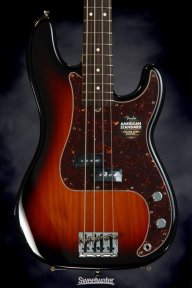
Does the name on the headstock matter? A rhetorical question and here is one good reason why it may.
When a player cannot blame the instrument, the tend to work harder to get to get the results they want, it cannot be the basses fault so it must be theirs mentality. But when say a cheaper model is being used then there is an excuse, a bail out for them not doing as well, or not sounding the way they believe they should ( amps and cabs come in to this as well ).
To my ears and my experience ( which is extensive, nearly 40 years) today's modern instruments in terms do build and quality are as good, if not better than in my day. The range of fantastic copies and budget basses never ceases to amaze me that students bring in and I encounter in my work.*
I have 1983 Squier JV 57 Precision, that played and sounded as good as a 57 precision ( sad to say all original electrics were lost in a fire it was in). *It always amazes me when it gets played how many people think it is great because they believe it to be an actual Fender 57 rather than the Squier 83 JV. Due to headstock damage from cigarettes burn it, the decal looks like it did read Fender because of damage to the Squi part and the er being good, it does look like it said fender on there to the un-trained eye.
With the different basses that are brought in and used, students and players seem to aspire to having a bass like it because when theory it.....it seems to be what they need to be a better, or even a complete player.
So I have come to a conclusion from what I have experienced with students ( *i indeed suffered it as well in my youth) that indeed the name on the bass will help make a player better, just because there is no longer an excuse to be had for not moving forward or improving. With the instrument of their choice they will work harder and with more purpose than they would do, as they see it, with an inferior bass (amps and cabs will play apart in this thinking as well), simply because there are now no real excuses to be had.
I believe a player will learn better and improve if they have the bass of their choice because they are psychologically content it must be them....not the instrument. Now the one difference between this and my situation when I was younger was I was a pro player, so I worked harder to be able to get a better instrument and better gear. Only later and after the old was gone, as many older players will have done, did I realise that what I had was good enough if not better suited to what I changed it for...or is that just another trick of the mind as in looking back through rose tinted glasses.
Anyone care to comment, or share stories to help paint a broader picture of this phenomenon?
For example, at a recent clinic one of the guitar instructors had an 80s G&L Strat to which a one of the many school kids there held up his brand new Fender Strat *and exclaimed to him "what's the problem.......couldn't afford a real one". Needless to say the next few minutes were so funny as he played the G&L, dismissed it, then to be told that the L in G&L stood for Leo as in Leo Fender, and there was every chance that Leo had actually handled this guitar......something impossible ever to have happened to his brand new one......priceless .
When a player cannot blame the instrument, the tend to work harder to get to get the results they want, it cannot be the basses fault so it must be theirs mentality. But when say a cheaper model is being used then there is an excuse, a bail out for them not doing as well, or not sounding the way they believe they should ( amps and cabs come in to this as well ).
To my ears and my experience ( which is extensive, nearly 40 years) today's modern instruments in terms do build and quality are as good, if not better than in my day. The range of fantastic copies and budget basses never ceases to amaze me that students bring in and I encounter in my work.*
I have 1983 Squier JV 57 Precision, that played and sounded as good as a 57 precision ( sad to say all original electrics were lost in a fire it was in). *It always amazes me when it gets played how many people think it is great because they believe it to be an actual Fender 57 rather than the Squier 83 JV. Due to headstock damage from cigarettes burn it, the decal looks like it did read Fender because of damage to the Squi part and the er being good, it does look like it said fender on there to the un-trained eye.
With the different basses that are brought in and used, students and players seem to aspire to having a bass like it because when theory it.....it seems to be what they need to be a better, or even a complete player.
So I have come to a conclusion from what I have experienced with students ( *i indeed suffered it as well in my youth) that indeed the name on the bass will help make a player better, just because there is no longer an excuse to be had for not moving forward or improving. With the instrument of their choice they will work harder and with more purpose than they would do, as they see it, with an inferior bass (amps and cabs will play apart in this thinking as well), simply because there are now no real excuses to be had.
I believe a player will learn better and improve if they have the bass of their choice because they are psychologically content it must be them....not the instrument. Now the one difference between this and my situation when I was younger was I was a pro player, so I worked harder to be able to get a better instrument and better gear. Only later and after the old was gone, as many older players will have done, did I realise that what I had was good enough if not better suited to what I changed it for...or is that just another trick of the mind as in looking back through rose tinted glasses.
Anyone care to comment, or share stories to help paint a broader picture of this phenomenon?
For example, at a recent clinic one of the guitar instructors had an 80s G&L Strat to which a one of the many school kids there held up his brand new Fender Strat *and exclaimed to him "what's the problem.......couldn't afford a real one". Needless to say the next few minutes were so funny as he played the G&L, dismissed it, then to be told that the L in G&L stood for Leo as in Leo Fender, and there was every chance that Leo had actually handled this guitar......something impossible ever to have happened to his brand new one......priceless .