
Enjoy the benefits of a premium membership!
Upgrade Account
-
TalkBass has been independent since 1998. Add your voice.
Create a free account to reply to discussions, view embedded media, and browse with fewer display ads.
Join free Log in
Want zero display ads or expanded classifieds tools? Compare plans.
You are using an out of date browser. It may not display this or other websites correctly.
You should upgrade or use an alternative browser.
You should upgrade or use an alternative browser.
Does Wood Grain Affect Anything?
- Thread starter wednesdayagain
- Start date
More options
Who Replied?



Does grain matter?
Why do basses sound different that
have the same wood and electronics?
Two basses that are identical, usually
don't sound the same.
Don't believe it. Then it's probably your
tin ear,
Tabdog
Or, it could be that those who do hear are only hearing it because they expect to.

Lots of BAD info in THIS thread!
I agree. Don't really want to take sides because I am a bit of skeptic on HOW MUCH wood affects tone, but why dont all Mexican Squire P-Basses sound exactly alike? I'm serious Tuxedo Joe, I see you are a luthier (I like # 3) and have had ample oppertunity to compare, so what's up with this. I have played Squires new in the store that sound great and ones that sound like shite. Any idea why?
tabdog said:Does grain matter?
Why do basses sound different that
have the same wood and electronics?
Two basses that are identical, usually
don't sound the same.
Don't believe it. Then it's probably your
tin ear,
Tabdog
I would contribute 99% of the difference to strings. Identical strings? Then their age, wear, and setup. Much more a tone factor than wood on any electric solidbody instrument, IMO.
I would contribute 99% of the difference to strings. Identical strings? Then their age, wear, and setup. Much more a tone factor than wood on any electric solidbody instrument, IMO.
So let me get this straight, wood=hocus pocus, steel=all the difference in the world.
The physics behind various construction methods, materials or mass impacting the ability of a vibrating or otherwise moving component to continue to vibrate or move at a specific frequency for a specific period is undisputable. To say a construction component as significant as the body and neck woods on a bass have absolutely no impact on the ability of the strings to vibrate at a certain frequency for a certain period would be like claiming the world is flat or gravity does not exist.
From a pure physics standpoint a pine wood body and bolt on pine wood neck bass would impact the strings vibration differently than a bass carved out of a single slab of granite. One is just going to have significantly more dampening or absorbing effect on the strings than the other. Since the sound of a solid body bass is picked up via the vibration of the strings through the magnetic field of the pickups it stands to reason there would be some measurable impact as well.
We can all disagree forever on how easily the difference can be heard and what the actual impact is but thats a whole different level of science that deals with inherent bias of the human mind and what it perceives as reality.
All that said, it stands to reason that Wood Matters. How much and to whom and why are the questions that belong along side the question of Whats the meaning of life.
Or you can just use some fairy dust and make a claim that it doesn't exist or it's dramatic, either way is using fairy dust.
From a pure physics standpoint a pine wood body and bolt on pine wood neck bass would impact the strings vibration differently than a bass carved out of a single slab of granite. One is just going to have significantly more dampening or absorbing effect on the strings than the other. Since the sound of a solid body bass is picked up via the vibration of the strings through the magnetic field of the pickups it stands to reason there would be some measurable impact as well.
We can all disagree forever on how easily the difference can be heard and what the actual impact is but thats a whole different level of science that deals with inherent bias of the human mind and what it perceives as reality.
All that said, it stands to reason that Wood Matters. How much and to whom and why are the questions that belong along side the question of Whats the meaning of life.
Or you can just use some fairy dust and make a claim that it doesn't exist or it's dramatic, either way is using fairy dust.

2 things...
1. does this mean that wood is irrelevant in an acoustic bass/guitar? If yes, than how do those instruments work? I Realize that the pick up in an electric guitar takes on the responsibility of the top and bridge reaction of an acoustic instrument, but am wondering of the same pick up, mounted in different woods, sound the same.
I just cant' believe that the wood does not resonate or effect the overall sound some how.In fact, it has to resonate some because I can "hear" the bass when I put my ear on the upper horn...I can feel the wood vibrate.
I could totally see the argument for wood not being a factor if it is because the pickup does not respond to the type of wood it is in, but is this the case?
2. coming from the world of percussion, where wood DOES make a huge difference in sound, I still think that it is all the same thing...one surface vibrating in conjunction with a resonator (in this case the head) to create a sound. I realize in this situation that the shell is an amplifier, but also that different shell types and constructions GREATLY effect the sound of a drum.
The resonator in the case of an acoustic bass is the bridge/top combination, and the resonator on an electric bass is mainly the pickup, but I still have to believe that the wood has to have some small effect on the pup's interpretation of the sound...
1. does this mean that wood is irrelevant in an acoustic bass/guitar? If yes, than how do those instruments work? I Realize that the pick up in an electric guitar takes on the responsibility of the top and bridge reaction of an acoustic instrument, but am wondering of the same pick up, mounted in different woods, sound the same.
I just cant' believe that the wood does not resonate or effect the overall sound some how.In fact, it has to resonate some because I can "hear" the bass when I put my ear on the upper horn...I can feel the wood vibrate.
I could totally see the argument for wood not being a factor if it is because the pickup does not respond to the type of wood it is in, but is this the case?
2. coming from the world of percussion, where wood DOES make a huge difference in sound, I still think that it is all the same thing...one surface vibrating in conjunction with a resonator (in this case the head) to create a sound. I realize in this situation that the shell is an amplifier, but also that different shell types and constructions GREATLY effect the sound of a drum.
The resonator in the case of an acoustic bass is the bridge/top combination, and the resonator on an electric bass is mainly the pickup, but I still have to believe that the wood has to have some small effect on the pup's interpretation of the sound...
acoustic instruments, gonna go out on a limb (ha!) and say I don't think anyone here will dispute, are much more greatly affected by what species, or piece, of wood is used, than solid body electric instruments are.
I spend a lot of time in lumber yards, too much really, some days I have to buy some pine 2x4s if you pick up a bunch of them you will note some (from the same lot) are very noticeably heavier than others, they're denser, wood is inconsistent, a plank of something can have varying density from one spot in it to another, (hi wolf notes/dead notes!) which can be inconvenient for people who make anything with wood. in 32 years of playing I think I've only encountered one or 2 instruments (and I've played a lot of instruments, owned well over 30 basses among other things), that had wolf notes or dead notes.
I've built (mostly from the ground up) 3 stringed instruments so far, a 5 string fretless bass, a 2 string slide bass (http://www.talkbass.com/forum/f57/bat-bass-749410/) and a bouzouki, er, I mean an 8 string ultra-piccolo bass. I have one custom 5 I designed and had built for me, which has a serious problem the g string simply does not resonate well. not sure why. I should start a thread for that bass. the fingerboard is solid epoxy, the lower strings are all fine and sing out, but on the G the notes just do not sustain. the saddles are ebony btw.
also I need harmonic knobs!
I spend a lot of time in lumber yards, too much really, some days I have to buy some pine 2x4s if you pick up a bunch of them you will note some (from the same lot) are very noticeably heavier than others, they're denser, wood is inconsistent, a plank of something can have varying density from one spot in it to another, (hi wolf notes/dead notes!) which can be inconvenient for people who make anything with wood. in 32 years of playing I think I've only encountered one or 2 instruments (and I've played a lot of instruments, owned well over 30 basses among other things), that had wolf notes or dead notes.
I've built (mostly from the ground up) 3 stringed instruments so far, a 5 string fretless bass, a 2 string slide bass (http://www.talkbass.com/forum/f57/bat-bass-749410/) and a bouzouki, er, I mean an 8 string ultra-piccolo bass. I have one custom 5 I designed and had built for me, which has a serious problem the g string simply does not resonate well. not sure why. I should start a thread for that bass. the fingerboard is solid epoxy, the lower strings are all fine and sing out, but on the G the notes just do not sustain. the saddles are ebony btw.
also I need harmonic knobs!
I think it's cool that Surfer Joe has strongly voiced his opinion on a controversial issue, but I think he goes a little too far with it. To say that wood doesn't matter at all is crazy. Yet, is it really crazier than believing that certain layers of your Alembic bring out certain tonal attributes to a measurable degree?
When talking about solid body electic bass guitars, I suspect that the truth lies somewhere between the two poles.
When talking about solid body electic bass guitars, I suspect that the truth lies somewhere between the two poles.
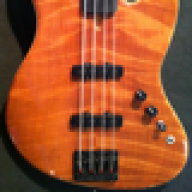
Really aren't most high end basses essentially "plywood"? Made of alternating layers of different varieties of wood chosen by the luthier to effect the ultimate tonal goal of the bass?
While I don't think wood is the SOLE factor in the tone of an instrument it certainly has some effect. If it had NO effect then acoustic guitars made of dissimilar woods but otherwise similar construction would sound EXACTLY the same and yet they clearly do not. In the end I see the basses built by SurferJoe46 as all sounding similar because they are Fender style bolt ons with maple necks. Fender themselves made guitars out of Pine so I am not surprised they all sound like Fender. What I don't see are any Fender style basses made out of extremely dense oily tropical hardwoods. With a body like that and a neck made from something similar I am guessing a difference would be heard. And I am guessing most people wouldn't like it. Why? Because it doesn't sound like a Fender bass "should".
All that said I think basses have to be viewed holistically. No one thing can be singled out as making or breaking a bass. It's either a good bass or it isn't. For you - at any given time. SurferJoe46's basses sure look like good basses!
While I don't think wood is the SOLE factor in the tone of an instrument it certainly has some effect. If it had NO effect then acoustic guitars made of dissimilar woods but otherwise similar construction would sound EXACTLY the same and yet they clearly do not. In the end I see the basses built by SurferJoe46 as all sounding similar because they are Fender style bolt ons with maple necks. Fender themselves made guitars out of Pine so I am not surprised they all sound like Fender. What I don't see are any Fender style basses made out of extremely dense oily tropical hardwoods. With a body like that and a neck made from something similar I am guessing a difference would be heard. And I am guessing most people wouldn't like it. Why? Because it doesn't sound like a Fender bass "should".
All that said I think basses have to be viewed holistically. No one thing can be singled out as making or breaking a bass. It's either a good bass or it isn't. For you - at any given time. SurferJoe46's basses sure look like good basses!
What I don't see are any Fender style basses made out of extremely dense oily tropical hardwoods. With a body like that and a neck made from something similar I am guessing a difference would be heard.
I have one. A Walnut bodied Precision with a Schecter all-rosewood neck. And Fender 62P pickups. It's one of the most articulate basses I've ever played. People who pick it up and play it remark about how responsive it is to the touch. Youi have to adjust your attack on it compared to (for example) an alder/maple Precision.
Buuut... I guess since it has a 62 P stock Fender pickup, it must sound exactly like any other Precision, and there's no difference, huh?
Nope.
I have one. A Walnut bodied Precision with a Schecter all-rosewood neck. And Fender 62P pickups. It's one of the most articulate basses I've ever played. People who pick it up and play it remark about how responsive it is to the touch. Youi have to adjust your attack on it compared to (for example) an alder/maple Precision.
Buuut... I guess since it has a 62 P stock Fender pickup, it must sound exactly like any other Precision, and there's no difference, huh?
Nope.
That bass sounds cool!
I've always loved the look, feel and sound of solid rosewood necks. Never had any bass with a walnut body but I've been looking at a jazz bass with a solid walnut body lately (maple neck with pau fb). Unfortunately I cant try before I buy so not sure if I'll like the sound or not.
I guess I shouldn't worry, it should sound exactly the same as my Fender swampash body / maple neck bass -
 yeah right.
Wood can't possibly be as important as colour (or color). As we all know, red cars are at least 5mph faster than a similar model of a different colour. It stands to reason, that Red basses are faster, and therefore better 

Hmm.
What if a bass had no wood or body, and was made with metal rods with welded on metal plates to attach the bridge, pick-ups, knobs, strap pins, cord plug, and a metal pipe as the neck where the fretboard was screwed on top with the nut and then another metal plate where the headstock would be so you could screw on the pegs. So, the metal pipe would strong enough to hold the tension of the strings. It would kind of be like the Yamaha silent guitar, but it would be a bass and there would no wood.
So, would this sound better or the same as a low-end Squier or a high-end custom Sadowsky?
It would sound like poop... albeit metal poop, but poop nonetheless.

Is it true that wood has much less of an impact when active pickups are installed? I've heard/seen this stated at the Seven string gutiar forum.

Turnaround
Commercial User
FWIW I have two basses that are identical - same everything , strings, bridge, pickups, preamp, tuners, nut material - everything but the wood and the frets. One is a high-end bass, the other a highly modified standard brand. I set out to see if I could make the standard brand sound like the premier bass.
Well, the standard one sounds good, but it's not as good as the premier bass. Even someone who is tone deaf can hear the difference. Both were strung at the same time with the same brand/model of strings. I even swapped the strings from one bass to the other to eliminate the possibility that the strings were the reason for the difference. The swap had no effect on the outcome. The only difference I can see in the basses is the wood. One is acoustically more resonant than the other and is made of high quality swamp ash with a maple top, premium grade maple in the neck with a very fine pau ferro fingerboard. The other is an alder body with a somewhat rubbery maple neck and a fairly opened-grained rosewood board.
When I did this experiment, I put aside my own beliefs about how much the instrument's wood contributed to the sound and simply tried to make the two basses sound alike. It wasn't that I wanted the more expensive bass to sound better (you-hear-what-you-want-to-hear syndrome), I really wanted to show that I could make a production bass sound like a boutique one. FAIL!
So unless anyone has any other explanation as to why the "boutique" bass sounds better, I have to conclude that the wood makes the difference. I am willing to listen to reasonable suggestions.
Well, the standard one sounds good, but it's not as good as the premier bass. Even someone who is tone deaf can hear the difference. Both were strung at the same time with the same brand/model of strings. I even swapped the strings from one bass to the other to eliminate the possibility that the strings were the reason for the difference. The swap had no effect on the outcome. The only difference I can see in the basses is the wood. One is acoustically more resonant than the other and is made of high quality swamp ash with a maple top, premium grade maple in the neck with a very fine pau ferro fingerboard. The other is an alder body with a somewhat rubbery maple neck and a fairly opened-grained rosewood board.
When I did this experiment, I put aside my own beliefs about how much the instrument's wood contributed to the sound and simply tried to make the two basses sound alike. It wasn't that I wanted the more expensive bass to sound better (you-hear-what-you-want-to-hear syndrome), I really wanted to show that I could make a production bass sound like a boutique one. FAIL!
So unless anyone has any other explanation as to why the "boutique" bass sounds better, I have to conclude that the wood makes the difference. I am willing to listen to reasonable suggestions.
Latest posts
-

-

-
 Thinking about finally buying a Ric...not a bad price at Walmart.
- Latest: birminghambass
-

-
