chadds said:Almost every discussion states that wood is an element not "the" element in a basses tone.
Perhaps the least audible element...

TalkBass has been independent since 1998. Add your voice.
Create a free account to reply to discussions, view embedded media, and browse with fewer display ads.
Join free Log in
Want zero display ads or expanded classifieds tools? Compare plans.
chadds said:Almost every discussion states that wood is an element not "the" element in a basses tone.
SurferJoe46 said:I've got a really cheap (free) bass that I rebuilt and defretted and it has about a zillion laminations of wood in it's plywood body.
My point: it is a sweet sounding bass. Even with all those 'resonant' and 'harmonic' layers and not forgetting: the glue - it has no significant difference in tone-voice-harmonics-sustain nor playability than any other bass I own.
Of course - it is fretless so it has that certain wowee sound that a non fretted instrument will have. But I cannot say that there's any evidence that the multiple layers of glue is causing any loss of tone. It sounds like a Precision without any frets. That's it - that's all.
Your: "Tobias, Fbass, Alembic, Sadowski etc. state it's significance. All state it's one aspect of tone propagation."
...still leaves me standing pat on my observation that this is the same mystique that keeps selling their instruments.
If they say 'it's the wood' (and they really DO build a pretty bass) and it costs as much as it does to the buyer, then the buyer will parrot the same sentiment.
The buyer'd have to state it unequivocally is so --- or they would have to admit they fell prey to the marketing ploy.

I'm not sure quarter sawn necks are necessarily more stable or make straighter necks than half or rift sawn.
Placebo!!

In the body, neck, or fingerboard, does having a straight grain mean better stability, sustain, etc.?
Or is it purely aesthetics?

I have my own ideas about this subject but this is about wood grain in a neck.
If wood and the grain do not matter, how you you explain dead spots in a neck?

It's a matter of mass, and not type of wood or grain.

These threads are regular and predictable. And always end up in the same place - nowhere. Bias cuts both ways, though most will only think that the other guy is "wrong" and will not look at how their own perception is colored. And this happens on both sides of the fence.
I know what my personal experience tells me, taking into account my biases. The "scientific" listening tests offered here and elsewhere are almost always anything but rigorous, and fail to take into account the myriad human factors involved is creating music. If one views the wood question as a science experiment, then the answers will skew one direction. If one views it as part of the art of making music, then "truth" likely falls somewhere else. There is no single right answer. To think there is imho means that a person understands neither art nor science. ymmv.
See.
I believe in the possibility and probability.
In fact I've actually experienced it.
I also know what I hear.
Since I can't hear you play I can't tell if you could hear the distinctions or not.
You may have spent many years in a cinder block room crankin' the volume so perhaps your hearing is shot.
Perhaps the type of music you play it doesn't matter.
This is strange because you wouldn't deny the effect of the mass of the bridge. What about dead spots?
You seem so sure. Nothing is.

It's a matter of mass, and not type of wood or grain.

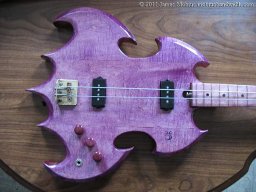
Even the various methods of construction doesn't change the fact that the majority of basses have a dead spot around the 7th fret on the g-string. Some are more obvious than others, some almost non-existent.
James Mobius said:I've never heard that, I've owned between 30 and 40 basses and played many more in over 3 decades, I haven't found that. has anyone else?
This might be a good time to point out the http://www.talkbass.com/forum/f8/scrap-lumber-bass-vs-alder-bass-can-you-tell-difference-743932/ thread for those that have not seen it.
Have a listen and decide for yourself.