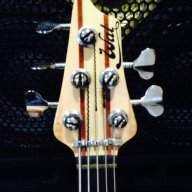
What brand is that ? The body looks a lot like an Ibanez AFR.Here is mine

TalkBass has been independent since 1998. Add your voice.
Create a free account to reply to discussions, view embedded media, and browse with fewer display ads.
Join free Log in
Want zero display ads or expanded classifieds tools? Compare plans.
What brand is that ? The body looks a lot like an Ibanez AFR.Here is mine
If you can get past the tuning key/headstock obstruction problem, it *is* more logical to put the bass neck on top. The longer lateral reach to the bass nut is compensated for by the shorter vertical reach from the shoulder, and the lower-pitched-strings-are-higher-up rule of most western string instruments is preserved.Ironically ALL Rickenbacker 4080's had the bass on the top....The only one that I knew of with the guitar on top was the Rutherford and that was because HE had it made that way from two existing guitars. I may be wrong and if I am , someone please post a picture of a stock 4080 with guitar on top. All of Geddy Lee's to my knowledge were stock 4080's with guitar on the bottom.
If you can get past the tuning key/headstock obstruction problem, it *is* more logical to put the bass neck on top. The longer lateral reach to the bass nut is compensated for by the shorter vertical reach from the shoulder, and the lower-pitched-strings-are-higher-up rule of most western string instruments is preserved.

I agree it's a personal preference. For me, I thought bass on top would be more comfortable (actually, I fell in love with a double neck on a Rennaisaince video <link> and Jon Camp had the bass on top - Also, Thanks to TB member Bob_Ross for that link. It began my search for a double neck). Originally, I tried to visualize the bass on top and the 12 on bottom and it seemed right. Now, with 12 on top and bass on bottom, I'll have to adjust my thinking a bit.
Cool. I actually found that Shergold link last night, but haven't read it yet. Thanks for all the great words, btw. Just to clarify; My change of heart re: neck placement, is one that will be good for me. I am 6' - 4", 180lbs soaking wet. I have very long fingers and tend to arch them while fretting. I'm even guilty of Mr. Camps tendency to take my hand completely off the fretboard, between notes (a good example of this left handed 'slapping' technique is at 3:26 of this yootube video link). I guess I am worried about hitting the keys on the headstock of the 12 string below, while playing the first 3 frets of the bass. For me, the change is a welcome revelation/improvement....Mike Rutherford is a tall guy with long arms...I don't know why he decided to change that , but it was done by a luthier , not Rickenbacker.
...Mike Rutherford's Shergold double necks are modular...he can switch half around to any configuration he wants (he has 4 halves but the bass he elected to always have on the bottom).
...My point for all of this is , for my build, I wanted it the way I felt it was best for me. People can agree with me or not...it's what is best for ME that concerns me, not what other people think.

Okay, that's it.....I look a bit like Mike Rutherford, a bit like Jon Camp, a little like Geddy, a touch like Derek Smalls and a bit like....Zaphod Beeblebrox!!??!!Then you just need to get a third arm installed like Zaphod Beeblebrox.

 ;
;
I agree it's a personal preference. For me, I thought bass on top would be more comfortable (actually, I fell in love with a double neck on a Rennaisaince video <link> and Jon Camp had the bass on top - Also, Thanks to TB member Bob_Ross for that link. It began my search for a double neck). Originally, I tried to visualize the bass on top and the 12 on bottom and it seemed right. Now, with 12 on top and bass on bottom, I'll have to adjust my thinking a bit.
So you fell in love with Jon's double neck while I fell in love with Jon's singer Annie Haslam.
[EDIT]- I've noticed a somewhat trivial common occurrence while researching. All of the DNs I've seen with the bass on top, have only one set of controls (see: Rickenbacker, video link above, etc.), while DNs that have the guitar on top, have 2 separate sets of controls (see: Genesis video on page 1 of this thread) . Can anyone explain why this might be?

What brand is that ? The body looks a lot like an Ibanez AFR.
I made the body from a piece of European alder that was in the garbage bin at my old workplace.
A production 4080 uses the Stereo input , but I believe has a design flaw....Both neck pickups are sent to one channel while both bridge pickups are sent to the other channel. I guess the thought was that you have a bass channel for the neck pickups and a treble channel for the bridge pickups.
I had mine designed the opposite... the bass goes to a bass amp , while the guitar goes to a guitar amp. To me that makes much more sense as you are basically using each instrument as if they were separate and EQ'd properly for each instrument. That is just my opinion , other's may feel they like it the other way. I also have a selector switch to turn on either neck.

A production 4080 uses the Stereo input , but I believe has a design flaw....Both neck pickups are sent to one channel while both bridge pickups are sent to the other channel. I guess the thought was that you have a bass channel for the neck pickups and a treble channel for the bridge pickups.
I had mine designed the opposite... the bass goes to a bass amp , while the guitar goes to a guitar amp. To me that makes much more sense as you are basically using each instrument as if they were separate and EQ'd properly for each instrument. That is just my opinion , other's may feel they like it the other way. I also have a selector switch to turn on either neck.
I have searched for 4080's and have done some bidding on a few...typically they go from 6-10 K and the conditions have been questionable.
I am having mine made by a luthier who is pretty much one of the best Rickenbacker guys around and it has been less than any 4080 I have ever bid on. I had specific requirements that you would never be able to get on a stock 4080 , a major one is the guitar neck being on top. I also wanted one similar to Mike Rutherford's (I am in a Genesis Tribute Band) and needed the 12 string. Mikes was originally made by cutting a 4001 and a 360/12 in half and putting them together (thats why his has the original slash sound hole and separate controls for the guitar).
I sent a 4001 body down to him and he did all the work building the guitar part from scratch. Mine has neck thru body design, which the 4080 doesn't have . A 4080 has bolt on necks. The beauty of having it made is you can do what you want ...I had Ebony boards done over the bubinga, Hipshot bridge over the stock...I really don't care what the Rickenbacker purist's say , I want it functional for me and according to MY likes , not an Exact Rickenbacker copy that would be less than ideal for me. It will be roughly 14 lbs.
I am going to post the whole build on my own thread here when it is finished ,which should be before Christmas. Meanwhile I'll post a pic of the stage it is in at this point.View attachment 513244View attachment 513245
Here is another one he did prior to mine.....View attachment 513252
............
...
Here's my '79 4080. Despite what everybody says (heavy, useless etc), this is an amazing instrument. The sound is full and heavy.
Everytime I put this onstage, the audience gets insane. ......