SnipI had to figure out how to set up my basses before the internet. Meaning, as a teenager I abused my first bass like nobody's business. But I learned a lot about what the various adjustments did and how they affected playability. While I am grateful for all the online resources, they also create unnecessary OCD around this stuff.
My distilled guide that doesn't spend 35 pages explaining stuff because it really isn't brain surgery (assuming everything works on the bass):
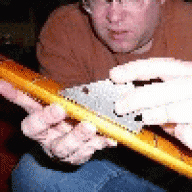
1. Use the truss rod to set the curvature of the neck. You want it almost straight, with just enough curvature to allow for the string to move with no buzz. (Unless buzz is part of your sound.) I hold down the E string at the first fret and 17th fret and look at the space around the 8th fret. If the string is sitting on the fret, loosen the truss rod. If it looks like you can fit more than a business card under the E string, tighten the rod. I rotate no more than 45 degrees at a time. If it's tight and doesn't want to move, stop, take it to a pro. For what it's worth, James Jamerson's bass's neck was bent like a banana and he didn't give a crap and still sounded great.
2. Set the string height at the bridge so that you have the action that gets you the sound and feel you want. Turns out, once I bothered to measure, I like 3/32" at the 12th fret for the E string, 2/32" for the G, the A and D in between. Pretty standard. My fingers could tell without a ruler. Go figure. Some people like higher, some lower. Keep the saddles parallel to the body of the bass.
3. Set intonation to get your notes in tune everywhere on the neck. I loosen the strings when I reset the intonation because it's easier to adjust the saddles that way.
Ultimately, as long as you don't take the rod to its extremes, you will not hurt the instrument. It's meant to adjust the bass to your preferences and playing style. Don't be afraid to experiment. You can bring out different characteristics of the instrument via different setups.
"My distilled guide that doesn't spend 35 pages explaining stuff because it really isn't brain surgery (assuming everything works on the bass):"
paste.
Unnecessary comment. It's a COMPLETE GUIDE. it explains the mechanics at work. Many people want to know the details, it gives the confidence, once you totally understand what's happening, to think through your approach to dealing with an issue.
What's wrong with learning? Our OP came here for help and to learn. The guide was suggested because it's really very good at laying out cause and effect. Our OP read it and still has questions. Soon enough, expedited by reading the book entirely like he has, he will have a flash of total understanding. That's called learning. That guide serves very well for they that seek enlightenment.