• TalkBass has been independent since 1998. Add your voice.
    Create a free account to reply to discussions, view embedded media, and browse with fewer display ads.
    Join freeLog in
    Want zero display ads or expanded classifieds tools? Compare plans.

Doubts about Fender's bass adjustments procedure

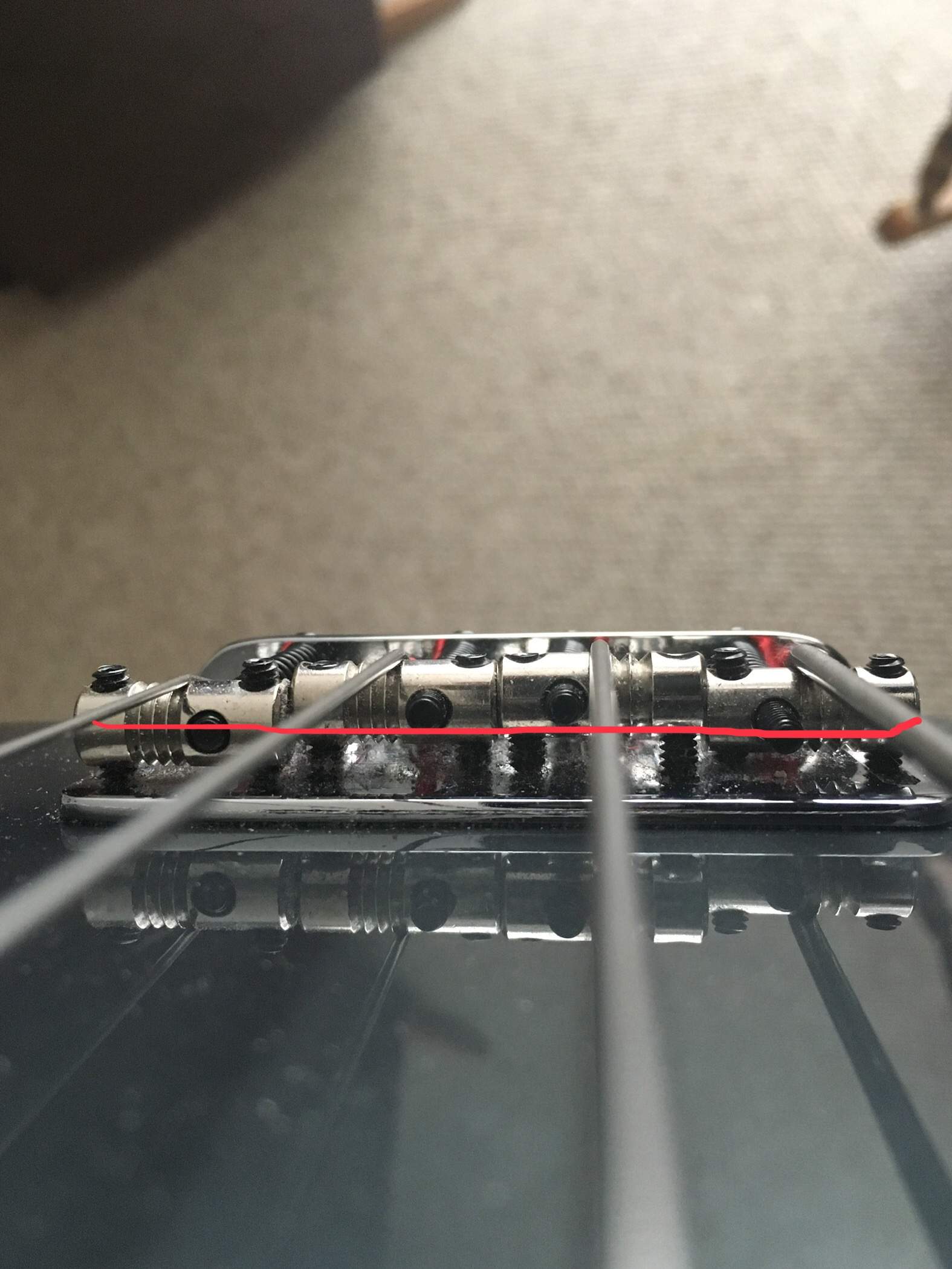
Here's what I mean about the saddles:
75993EBF-B6A1-4F5C-99AD-08923DF0855E.jpeg


I drew the red line to indicate how the saddles should be situated, meaning horizontally. Ignore the heights in the image. This is just to present you with a visual reference to what I meant by horizontal. Notice none of the saddles are askew and are more or less sitting straight relative to their height. (Could be straighter...I could probably tweak mine a little, lol.)
 
Last edited:
The goal here is to use the string as a straight edge. What you want is the string to touch two frets at the same time and measure the bow of the neck against a straight reference (The string). Most people only have at most two hands, so the capo at one end is there to help you hold the string at one end, while you hold it against the fret at the other end. So basically the position doesn't matter much as long as the string makes proper contact with the fret. Just don't put too much pressure too close to the string as this may bend the string slightly up at the other side of the fret.


You only have one truss rod to adjust, so you can't adjust the relief under the strings independently. If it's correct under one string all the others have to be correct as well.


Because they are lazy. :p Just do it. It doesn't harm anything to loosen the tension, and it may save your truss rod. You have to retune anyway.


Moving the saddle towards the bridge will change the angle of the bridge end of the string. This will put tension on the system when you adjust. On some bridges you don't have a crew to help you. Adjusting under tension just makes it more dfficult.


The strings should more or less match the radius of the frets, but with more height on the bass side. (Heavier strings have a larger swing when played, so they need more clearance.) If you set the outer strings first and then match the radius relative to those two strings then the inner two should be close to perfect. I tend yo set the strings slightly lower individually afterwards, but that is personal preference.


The grooves are to adjust the spacing between the strings at the bridge. If you have a wide neck you use the outer grooves, and a narrower neck use the inner grooves. Usually the strings should be more or less parallel with the edges of the fretboard.


The saddles should IMO always be level relative to the base plate.This prevents movement when adjusting and playing. My thinking is that the force on the saddle is downwards. Putting load on screws at an angle is not a good thing.

I don't think it really matters all that much, though.
OP, @Smilodon really took the time to walk you through most of this with great accurate answers.

Two small additions:
  • I would use the "grooves" in the saddles to line the strings up with the mid-point of their respective pickup poles. But that's because I like them lined up esthetically - it doesn't hugely matters and making the spacing comfortable for you is more important.
  • It looks like you are not very experienced with setups and/or this is a new bass for you. Consider taking it to a tech the first time, to have a good bass-line (no pun intended) to start with for your next setups and to have any issues that the bass may have resolved professionally before trying to take it all in yourself (unless this is a "beater-bass" you want to practice setups on)
 
  • Like
Reactions: Mingus_Habens
Thanks a lot for the replies.
@ProfFrink my bass was taken to a tech when I bought it, than another couple of times for little adjustments, so I always kept things in order. I just want to learn how to do a basic setup like most experienced players seem to do. I'll keep taking my bass to a tech when necessary, of course.
 
  • Like
Reactions: ProfFrink
If and when you need to tighten the truss be sure to loosen the strings, place bass between legs(one in front of other) and gently pull back neck while tightening truss rod. That's only if the nut is on the headstock. Can't expect that little nut to move that chunk of wood by itself.
 
If and when you need to tighten the truss be sure to loosen the strings, place bass between legs(one in front of other) and gently pull back neck while tightening truss rod. That's only if the nut is on the headstock. Can't expect that little nut to move that chunk of wood by itself.
Yes, I needed to make almost half of a turn after moving from 45-100 to 50-105 strings. I did it one quarter of turn at the time, and the last quarter was definitely harder to move. I thought that the truss rod was almost maxed out, but maybe I'm wrong. I didn't apply any pressure to the bass though, next time I'll try for sure.
 
Another popular recommended guide is this one:
Invalid Link Removed

This set of instructions is not recommended by most (maybe all) of the techs on TalkBass. Some of the information it contains can be misleading. Use the Drozd guide as suggested by others.
 
The goal here is to use the string as a straight edge. What you want is the string to touch two frets at the same time and measure the bow of the neck against a straight reference (The string). Most people only have at most two hands, so the capo at one end is there to help you hold the string at one end, while you hold it against the fret at the other end. So basically the position doesn't matter much as long as the string makes proper contact with the fret. Just don't put too much pressure too close to the string as this may bend the string slightly up at the other side of the fret.


You only have one truss rod to adjust, so you can't adjust the relief under the strings independently. If it's correct under one string all the others have to be correct as well.


Because they are lazy. :p Just do it. It doesn't harm anything to loosen the tension, and it may save your truss rod. You have to retune anyway.


Moving the saddle towards the bridge will change the angle of the bridge end of the string. This will put tension on the system when you adjust. On some bridges you don't have a crew to help you. Adjusting under tension just makes it more dfficult.


The strings should more or less match the radius of the frets, but with more height on the bass side. (Heavier strings have a larger swing when played, so they need more clearance.) If you set the outer strings first and then match the radius relative to those two strings then the inner two should be close to perfect. I tend yo set the strings slightly lower individually afterwards, but that is personal preference.


The grooves are to adjust the spacing between the strings at the bridge. If you have a wide neck you use the outer grooves, and a narrower neck use the inner grooves. Usually the strings should be more or less parallel with the edges of the fretboard.


The saddles should IMO always be level relative to the base plate.This prevents movement when adjusting and playing. My thinking is that the force on the saddle is downwards. Putting load on screws at an angle is not a good thing.

I don't think it really matters all that much, though.
Nailed it. All.
 
About the Drodz guide, take a look at page 20. Here's the link to the pdf file:
http://www.jerzydrozdbasses.com/akcndfr54jdhrei567/Ultimate_Guide_ver100.pdf

There's a beautiful chart with reference heights for different basses, but no indication about how to measure. Let's take a standard 4 strings bass: you can see the values for the G and E strings, respectively 1.8/2.0 mm and 2.0/2.5 mm. I know that the measure should be taken from the top of the 17th fret because I've read other guides and articles, but there isn't any indication in the manual, at least in that paragraph. I've read the pdf several times and found absolutely nothing. I admit I'm a little bit shocked, the guide seems very clear and precise but I think ANY newbie would get stuck at this point, not knowing what to do.

Plus, Drozd suggests to set the strings height BEFORE adjusting the truss rod?
Before adjusting the neck, we have to adjust the approximate height of the strings over the
bridge. If we don't do it at this point, the neck adjustment won't be correct because if the
strings are too close to the bridge or too far away, this will lead to an incorrect estimate of
the true position of the neck.
Never hear about this and based on my (VERY limited) experience, strings (saddles) height doesn't interfere when measuring the neck release since the string must be pushed at the first and last fret, creating a straight line.
Am I missing something?
 
About the Drodz guide, take a look at page 20. Here's the link to the pdf file:
http://www.jerzydrozdbasses.com/akcndfr54jdhrei567/Ultimate_Guide_ver100.pdf

There's a beautiful chart with reference heights for different basses, but no indication about how to measure. Let's take a standard 4 strings bass: you can see the values for the G and E strings, respectively 1.8/2.0 mm and 2.0/2.5 mm. I know that the measure should be taken from the top of the 17th fret because I've read other guides and articles, but there isn't any indication in the manual, at least in that paragraph. I've read the pdf several times and found absolutely nothing. I admit I'm a little bit shocked, the guide seems very clear and precise but I think ANY newbie would get stuck at this point, not knowing what to do.

Plus, Drozd suggests to set the strings height BEFORE adjusting the truss rod?

Never hear about this and based on my (VERY limited) experience, strings (saddles) height doesn't interfere when measuring the neck release since the string must be pushed at the first and last fret, creating a straight line.
Am I missing something?
He says to set height APPROXIMATELY... you need a basis to work from. By first getting them close to where they will end up makes the process smooth.
 
  • Like
Reactions: Mingus_Habens
If he doesn't tell you HOW to measure strings height (from "X" to "Y"), you don't have a basis to work from. I still don't understand how strings height can affect the neck's release measurement.
Please, don't take my posts as argumentative, I just want to undestand and I'm struggling a little bit. English is not my native language.

EDIT: I'm almost at the end of the document and everything was super clear.
 
With the chart in that book I'm going to assume it is meant to be measured at the 12th fret. I searched Google and this seems to be the consensus on his intentions.

You could email them and get a definitive answer.

Best bet is do it at the 12th fret and if works, great. If not, try at the 17th. You can't really break anything just adjusting the height of the bridge saddles so try.
 
  • Like
Reactions: Mingus_Habens
With the chart in that book I'm going to assume it is meant to be measured at the 12th fret. I searched Google and this seems to be the consensus on his intentions.

You could email them and get a definitive answer.

Best bet is do it at the 12th fret and if works, great. If not, try at the 17th. You can't really break anything just adjusting the height of the bridge saddles so try.
I set mine yesterday using the 17th fret. I know it's a safe thing to do, I just wanted to point out that even the most accurate guide can be confusing.
I finished reading the whole guide for the second time and it's the best I've read.
 
I set mine yesterday using the 17th fret. I know it's a safe thing to do, I just wanted to point out that even the most accurate guide can be confusing.
I finished reading the whole guide for the second time and it's the best I've read.
Understand that English isn't Jerzy Drozd's first language either. So when I first read it I had to re-read a few sentences myself. You're doing well.
 
  • Like
Reactions: Mingus_Habens
Mingus_Habens , hey man --- these cats jumped in to save your a$$ and hold your hand through this setup process! how cool! relax and enjoy the sound of new skills being acquired by your 'more-than-capable self! the cool thing = after you've done this once you'll be more of an expert on your setups than anyone else on earth!

patience is your friend. good luck! :thumbsup:


FWIW: all instructions are starting points.
 
I had to figure out how to set up my basses before the internet. Meaning, as a teenager I abused my first bass like nobody's business. But I learned a lot about what the various adjustments did and how they affected playability. While I am grateful for all the online resources, they also create unnecessary OCD around this stuff.


My distilled guide that doesn't spend 35 pages explaining stuff because it really isn't brain surgery (assuming everything works on the bass):

1. Use the truss rod to set the curvature of the neck. You want it almost straight, with just enough curvature to allow for the string to move with no buzz. (Unless buzz is part of your sound.) I hold down the E string at the first fret and 17th fret and look at the space around the 8th fret. If the string is sitting on the fret, loosen the truss rod. If it looks like you can fit more than a business card under the E string, tighten the rod. I rotate no more than 45 degrees at a time. If it's tight and doesn't want to move, stop, take it to a pro. For what it's worth, James Jamerson's bass's neck was bent like a banana and he didn't give a crap and still sounded great.

2. Set the string height at the bridge so that you have the action that gets you the sound and feel you want. Turns out, once I bothered to measure, I like 3/32" at the 12th fret for the E string, 2/32" for the G, the A and D in between. Pretty standard. My fingers could tell without a ruler. Go figure. Some people like higher, some lower. Keep the saddles parallel to the body of the bass.

3. Set intonation to get your notes in tune everywhere on the neck. I loosen the strings when I reset the intonation because it's easier to adjust the saddles that way.

Ultimately, as long as you don't take the rod to its extremes, you will not hurt the instrument. It's meant to adjust the bass to your preferences and playing style. Don't be afraid to experiment. You can bring out different characteristics of the instrument via different setups.
 
Mingus_Habens , hey man --- these cats jumped in to save your a$$ and hold your hand through this setup process! how cool! relax and enjoy the sound of new skills being acquired by your 'more-than-capable self! the cool thing = after you've done this once you'll be more of an expert on your setups than anyone else on earth!
patience is your friend. good luck! :thumbsup:
FWIW: all instructions are starting points.
Yeah, really cool! I just wanted to thank all you guys for helping me. Really, thank you.
I guess I have my personal learning curve. I start really slow, usually overthink anything, ask tons of questions, and proceed with extrem caution. At a certain point I feel like my mind finlly "clicks", everything seems more clear, and I start to proceed with more confindence until I develop my personal way of doing things. Usually, once I get to that point, I'm done. I'm not saying that I became an expert in a couple of weeks of course, but I'm sure I absorbed and done what I've read. New things to fix will happen during time of course, and I'll try to see what I can (or can't) do by myself.

I had to figure out how to set up my basses before the internet. Meaning, as a teenager I abused my first bass like nobody's business. But I learned a lot about what the various adjustments did and how they affected playability. While I am grateful for all the online resources, they also create unnecessary OCD around this stuff.
My distilled guide that doesn't spend 35 pages explaining stuff because it really isn't brain surgery (assuming everything works on the bass):
1. Use the truss rod to set the curvature of the neck. You want it almost straight, with just enough curvature to allow for the string to move with no buzz. (Unless buzz is part of your sound.) I hold down the E string at the first fret and 17th fret and look at the space around the 8th fret. If the string is sitting on the fret, loosen the truss rod. If it looks like you can fit more than a business card under the E string, tighten the rod. I rotate no more than 45 degrees at a time. If it's tight and doesn't want to move, stop, take it to a pro. For what it's worth, James Jamerson's bass's neck was bent like a banana and he didn't give a crap and still sounded great.
2. Set the string height at the bridge so that you have the action that gets you the sound and feel you want. Turns out, once I bothered to measure, I like 3/32" at the 12th fret for the E string, 2/32" for the G, the A and D in between. Pretty standard. My fingers could tell without a ruler. Go figure. Some people like higher, some lower. Keep the saddles parallel to the body of the bass.
3. Set intonation to get your notes in tune everywhere on the neck. I loosen the strings when I reset the intonation because it's easier to adjust the saddles that way.
Ultimately, as long as you don't take the rod to its extremes, you will not hurt the instrument. It's meant to adjust the bass to your preferences and playing style. Don't be afraid to experiment. You can bring out different characteristics of the instrument via different setups.
Thanks for the explaination.
I finished my first setup yesterday, on my Fender American Professional Precision. I know, I shouldn't brutalize my main axe at this point, but it's my only axe and I want it to sound good.
I need to check again a couple of little things today, but the most is done.
I've set neck release at 0.40 mm, I really wanted to tighten the truss rod a little bit more to get 0.30 mm (Fender specs) but the truss rod was really hard to move (at least with the t-shaped wrench Fender gave me) and I was scratching my pickguard too much, so I left it at 0.40 mm which is perfectly fine for me.
Action at the 17th fret is 2.7 mm on the E side and 2.5 on the G side. Not super low, I'd say medium-low, maybe a little bit more on the low side?
According to Fender specs, the G string height should be around 2 mm, significantly lower than the E string, but I prefer not having a big jump from the D to the G string, in terms of height. I like the G string lower than the E string of course, but not too much lower than the D string. Strings follow the neck radius, I like it so.
The bass plays good, all the strings buzz just a little bit past 12th fret only if I dig a little bit harder, but I think
The last thing I want to do today is hearing the bass into my Quilter BB800, a super clean class D solid state amp. I want to be sure that the bass stays clean over the entire fretboard, which is something I can't do with my BDDI. With 50-105 strings and the setup I like on my bass (inlcuding pickup height of course), getting a very clean sound from the BDDI is really hard, maybe impossible. The BDDI isn't designed to sound super clean, but I've found a clean setting that worked for more than a year with 45-100 strings (both flats and rounds). With bigger strings and new setup everything changed, but I really like the tone so I want to keep things like this.
I want to be sure that the grind I hear comes from only the BDDI alone or it's buzz. The BB800 will tell me if that's the case.
 
  • Like
Reactions: JRA